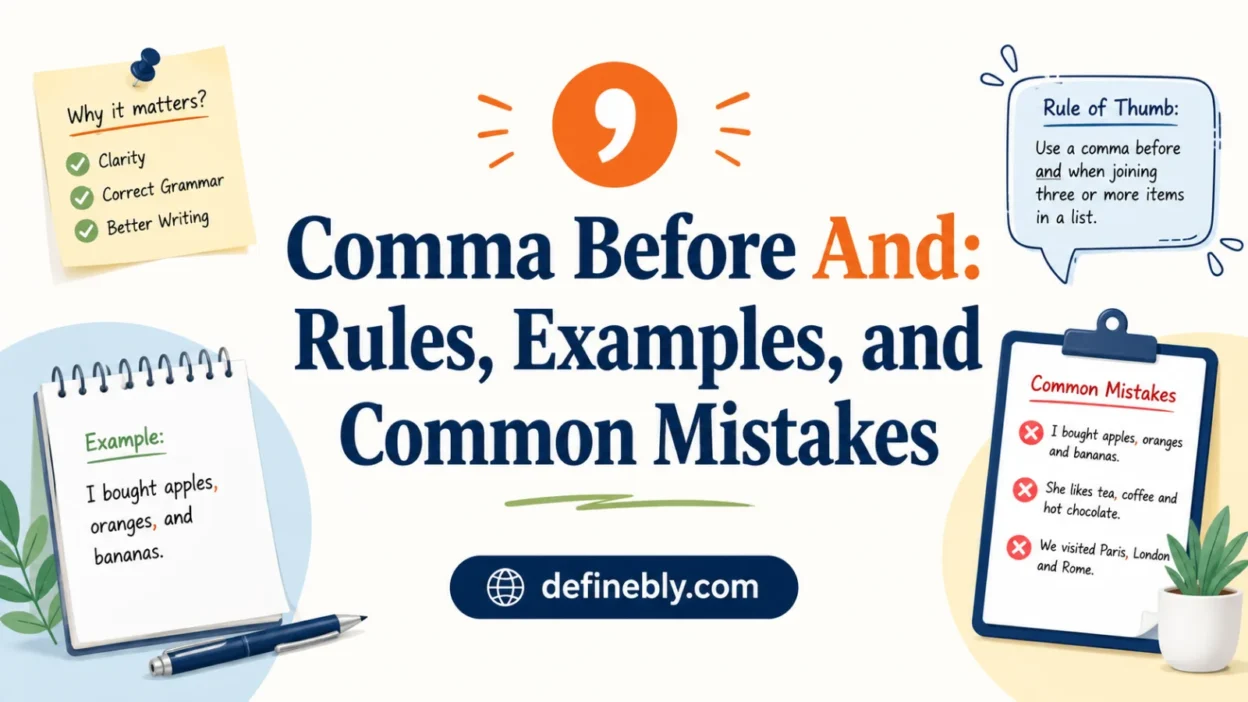
Use a comma before and when and joins two complete thoughts.
Example:
- I finished my homework, and my brother cleaned the kitchen.
You may also use a comma before and in a list of three or more items. That comma is called the Oxford comma or serial comma.
Example:
- I bought apples, bananas, and oranges.
Do not use a comma before and when it joins only two words, two phrases, or two actions with the same subject.
Example:
- I bought apples and oranges.
Quick Answer
Use a comma before and in two main situations.
First, use it when and joins two complete sentences.
Correct:
- The rain stopped, and the game continued.
Second, use it in a list of three or more items if your style uses the Oxford comma.
Correct:
- We packed towels, sunscreen, and snacks.
Do not use a comma before and in a simple two-item list.
Incorrect:
- I ordered coffee, and toast.
Correct:
- I ordered coffee and toast.
The fastest test is this: if both sides of and can stand alone as sentences, use a comma before and.
The Rule Explained
The comma before and depends on what and connects.
If and connects two independent clauses, use a comma before and.
An independent clause is a complete thought. It has a subject and a verb, and it can stand alone as a sentence.
Example:
- The movie ended, and everyone left the theater.
Both parts can stand alone:
- The movie ended.
- Everyone left the theater.
That is why the comma belongs before and.
If and connects only two words or phrases, do not use a comma.
Correct:
- The room was quiet and dark.
- My brother and sister are visiting.
- She packed her bag and left for school.
In these sentences, and does not join two complete thoughts.
When To Use It
Use A Comma Before And Between Two Complete Thoughts
Use a comma before and when each side has its own subject and verb.
Correct:
- I called Sam, and he answered right away.
- The alarm rang, and everyone left the building.
- She opened the laptop, and I started the meeting.
- The train arrived, and the passengers got off.
Each sentence joins two complete thoughts.
You can check by splitting the sentence into two sentences.
Example:
- She opened the laptop.
- I started the meeting.
Since both parts stand alone, the comma before and is correct.
Use A Comma Before And In A Three-Item List
Use a comma before and in a list of three or more items if you follow Oxford comma style.
Correct:
- We invited Mia, Jordan, and Ava.
- I packed socks, shoes, and a jacket.
- The room was clean, bright, and quiet.
The comma before and is the Oxford comma.
In American English, many schools, publishers, and academic styles prefer the Oxford comma because it often makes lists clearer.
Use A Comma Before And To Avoid Confusion
Use the comma when leaving it out could make the sentence unclear.
Unclear:
- I thanked my parents, Taylor and Morgan.
This could sound like Taylor and Morgan are the parents.
Clear:
- I thanked my parents, Taylor, and Morgan.
Now the sentence clearly names three people or groups: my parents, Taylor, and Morgan.
Another example:
Unclear:
- We served the kids, macaroni and cheese and fruit.
Clear:
- We served the kids, macaroni and cheese, and fruit.
The comma helps readers see the separate items.
Use A Comma Before And With A Clear Subject Shift
A comma is especially helpful when the subject changes after and.
Correct:
- Maya packed the lunches, and Jordan loaded the car.
- The client approved the design, and the team started production.
- I emailed the teacher, and she replied within an hour.
The subject changes in the second part, so the comma helps the sentence read smoothly.
Use A Comma Before And Then When It Joins Two Complete Thoughts
The phrase and then follows the same basic rule.
Use a comma before and then if it joins two complete thoughts.
Correct:
- We checked in at the hotel, and then we walked to dinner.
Do not use a comma if the same subject performs both actions.
Correct:
- We checked in at the hotel and then walked to dinner.
The subject we applies to both actions, so no comma is needed.
When Not To Use It
Do Not Use A Comma Before And In A Two-Item List
A simple two-item list does not need a comma before and.
Incorrect:
- I bought milk, and bread.
Correct:
- I bought milk and bread.
More correct examples:
- She ordered soup and salad.
- We need paper and tape.
- He likes coffee and tea.
Do Not Use A Comma Before And In A Compound Predicate
A compound predicate happens when one subject does two or more actions.
Incorrect:
- Maya packed her bag, and left for school.
Correct:
- Maya packed her bag and left for school.
The subject Maya performs both actions. The second part, left for school, is not a complete sentence by itself.
More correct examples:
- He checked his email and replied to the client.
- The dog barked and ran to the door.
- Ava opened the window and smiled.
Do Not Use A Comma Before And Between Two Descriptions
Do not add a comma before and when it joins two simple descriptions.
Incorrect:
- The room was quiet, and dark.
Correct:
- The room was quiet and dark.
More correct examples:
- The test was long and difficult.
- The answer was short and clear.
- The soup was hot and salty.
Do Not Use A Comma Just Because You Pause
A spoken pause does not always need a comma.
Incorrect:
- I went outside, and locked the door.
Correct:
- I went outside and locked the door.
Punctuation follows sentence structure. It does not mark every pause in speech.
Common Mistakes
Missing The Comma Between Two Complete Thoughts
Incorrect:
- The alarm rang and everyone left the building.
Correct:
- The alarm rang, and everyone left the building.
Both sides can stand alone, so the comma belongs before and.
Adding A Comma Before And When One Subject Does Two Actions
Incorrect:
- He checked his email, and replied to the client.
Correct:
- He checked his email and replied to the client.
The subject he does both actions.
Using The Oxford Comma Inconsistently
Inconsistent:
- We bought bread, milk, and eggs. We packed shirts, socks and shoes.
Better:
- We bought bread, milk, and eggs. We packed shirts, socks, and shoes.
Choose one style and use it consistently.
Thinking The Oxford Comma Is Always Required
The Oxford comma is often a style choice.
Both versions can be acceptable in simple lists:
- We bought bread, milk, and eggs.
- We bought bread, milk and eggs.
However, the Oxford comma is the safer choice when the sentence could be misunderstood.
Clear:
- I thanked my parents, Taylor, and Morgan.
Putting A Comma After And For No Reason
Incorrect:
- I made dinner and, washed the dishes.
Correct:
- I made dinner and washed the dishes.
Do not put a comma after and unless another rule requires it, such as a nonessential interruption.
Correct:
- I made dinner and, after everyone left, washed the dishes.
Correct Examples
| Sentence | Comma Before And? | Why |
|---|---|---|
| I called Sam, and he answered right away. | Yes | Two complete thoughts |
| We packed towels, sunscreen, and snacks. | Yes | Three-item list with Oxford comma |
| I ordered soup and salad. | No | Two-item list |
| Ava opened the door and waved. | No | One subject, two actions |
| The room was clean, bright, and quiet. | Yes | Three-item list |
| My brother and sister are visiting. | No | Two subjects joined by and |
| The dog barked, and the baby woke up. | Yes | Two complete thoughts |
| She smiled and waved. | No | One subject, two actions |
More correct examples:
- I submitted the form, and the office confirmed it.
- We need pens, paper, and tape.
- The laptop was fast and lightweight.
- She revised the essay and submitted it before midnight.
- The meeting ended early, and everyone returned to work.
- I invited my cousins, Noah, and Emma.
- We watched a movie and ordered pizza.
- The report was accurate, detailed, and easy to read.
Quick Memory Fix Or Rule Of Thumb
Use this rule:
Complete sentence + and + complete sentence = comma before and.
Example:
- The lights went out, and the room became silent.
Both sides can stand alone.
For lists, use this rule:
Three or more items? Use the Oxford comma if your style requires it or if the sentence could be unclear without it.
Example:
- We packed blankets, snacks, and water.
Do not use a comma before and in a simple two-item pair.
Example:
- blankets and snacks
FAQs
What is the comma before and called?
The comma before and in a list of three or more items is called the Oxford comma or serial comma.
Example:
- I packed socks, shoes, and a jacket.
The comma before and is the Oxford comma.
Do you always need a comma before and?
No. You do not always need a comma before and.
Use one when and joins two complete thoughts. In lists, the comma before and depends on style and clarity.
When should you use a comma before and?
Use a comma before and when it joins two complete sentences.
Example:
- I made dinner, and my roommate washed the dishes.
You can also use one in a list of three or more items.
Example:
- We need pens, paper, and tape.
Do you use a comma before and in a list?
You may use a comma before and in a list of three or more items.
Example:
- The flag is red, white, and blue.
That comma is the Oxford comma.
Do you use a comma before and in a list of two?
No. Do not use a comma before and in a simple list of two.
Incorrect:
- I bought milk, and bread.
Correct:
- I bought milk and bread.
Is the Oxford comma required?
The Oxford comma is often a style choice.
Many American academic and publishing styles use it. Some news styles leave it out in simple lists. Use it when it prevents confusion.
Can a sentence have and without a comma?
Yes. Many sentences use and without a comma.
Example:
- She smiled and waved.
No comma is needed because one subject does both actions.
What is an example of a missing comma before and?
Incorrect:
- The train arrived and the passengers got off.
Correct:
- The train arrived, and the passengers got off.
The comma belongs because both sides are complete thoughts.
Do you put a comma before and then?
Use a comma before and then when it joins two complete thoughts.
Correct:
- We finished lunch, and then we went back to work.
Do not use one when the same subject does both actions.
Correct:
- We finished lunch and then went back to work.
Should I use a comma before and in short sentences?
Usually, use the comma if and joins two complete thoughts.
Correct:
- I called, and he answered.
Some styles allow the comma to be left out when both clauses are very short and clear. When in doubt, use the comma for clarity.
Conclusion
Use a comma before and when and joins two complete thoughts.
Use a comma before and in a list of three or more items if you follow Oxford comma style or need to avoid confusion.
Do not use a comma before and in a simple two-item list or when one subject performs two actions.
The easiest rule is this: if both sides of and can stand alone as sentences, use the comma.