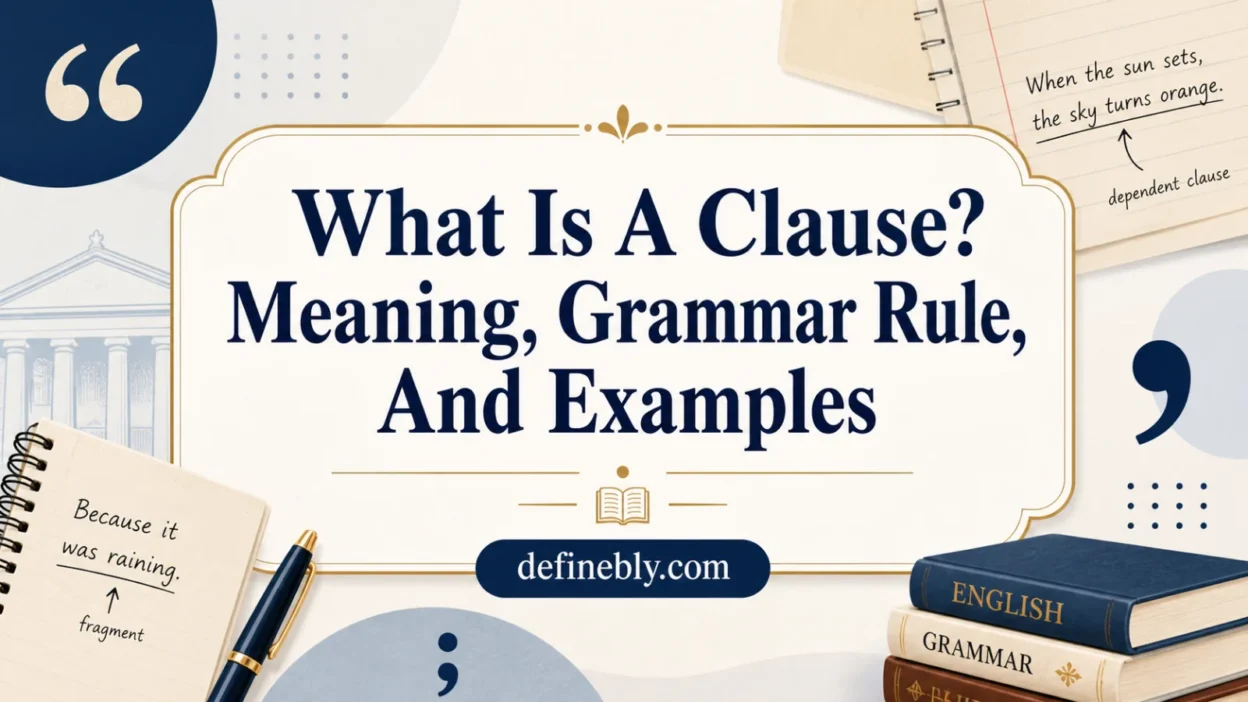
A clause is a group of words with a subject and a verb. It can be a complete sentence, or it can be part of a longer sentence.
Clauses are building blocks of English sentences. Once you understand them, sentence structure becomes much easier to see.
What Is A Clause? Quick Answer
A clause is a group of words that contains a subject and a verb.
Example:
“she laughed”
This is a clause because she is the subject and laughed is the verb.
Some clauses can stand alone as complete sentences.
Example:
“She laughed.”
Other clauses have a subject and verb but do not express a complete thought by themselves.
Example:
“because she laughed”
That word group is still a clause, but it needs another clause to complete the sentence.
The Grammar Rule For Clauses
A clause must contain two main parts:
A subject, which tells who or what the clause is about.
A verb, which tells what the subject does or what happens.
Example:
“The dog barked.”
Subject: The dog
Verb: barked
This clause can stand alone as a sentence because it expresses a complete thought.
Now compare:
“when the dog barked”
This word group still has a subject and verb.
Subject: the dog
Verb: barked
But it begins with when, so the thought feels unfinished. The reader wants to know what happened when the dog barked.
Complete sentence:
“I woke up when the dog barked.”
Clause Vs. Phrase Vs. Sentence
Clauses, phrases, and sentences are different grammar units.
| Grammar Unit | What It Contains | Complete Thought? | Example |
|---|---|---|---|
| Phrase | A word group without a complete subject-and-verb structure | No | “after dinner” |
| Clause | A word group with a subject and verb | Sometimes | “after we ate dinner” |
| Sentence | A complete thought with at least one independent clause | Yes | “We cleaned up after we ate dinner.” |
A phrase does not have a complete subject-and-verb structure.
A clause has a subject and verb.
A sentence expresses a complete thought.
Compare:
Phrase:
“because of the rain”
Clause:
“because it rained”
Sentence:
“We stayed inside because it rained.”
In the clause because it rained, it is the subject and rained is the verb.
The Two Main Types Of Clauses
The two main types of clauses are independent clauses and dependent clauses.
An independent clause can stand alone as a complete sentence.
A dependent clause has a subject and verb, but it cannot stand alone as a complete sentence.
| Clause Type | Can Stand Alone? | Example |
|---|---|---|
| Independent Clause | Yes | “The lights went out.” |
| Dependent Clause | No | “when the lights went out” |
The difference is not whether the clause has a subject and verb. Both types do.
The difference is whether the clause expresses a complete thought.
Independent Clauses
An independent clause is a clause that can stand alone as a complete sentence.
Examples:
“I made coffee.”
“The train arrived late.”
“She opened the window.”
“We watched the movie.”
Each example has a subject, a verb, and a complete thought.
An independent clause is also called a main clause because it can be the main idea of a sentence.
Examples:
“I made coffee because I was tired.”
“Although the store was crowded, the line moved fast.”
In both sentences, the independent clause carries the complete main idea.
Dependent Clauses
A dependent clause has a subject and a verb, but it does not express a complete thought by itself.
Examples:
“because I was tired”
“when the meeting ended”
“although the store was crowded”
“if you need help”
“that you lent me”
Each example leaves the reader waiting for more.
Complete sentences:
“I made coffee because I was tired.”
“When the meeting ended, we ordered lunch.”
“Although the store was crowded, the line moved fast.”
“If you need help, call me.”
“The book that you lent me was excellent.”
A dependent clause is also called a subordinate clause because it depends on another clause.
Main Clause Vs. Subordinate Clause
A main clause is another name for an independent clause.
A subordinate clause is another name for a dependent clause.
Examples:
“Because it was raining, we stayed inside.”
Subordinate clause: Because it was raining
Main clause: we stayed inside
The subordinate clause adds a reason. The main clause completes the thought.
Common Words That Begin Dependent Clauses
Many dependent clauses begin with subordinating conjunctions or relative pronouns.
Common subordinating conjunctions include:
because
although
when
while
if
unless
since
before
after
until
as
even though
once
wherever
Examples:
“because I forgot”
“although she tried”
“when the bell rang”
“if the weather improves”
“unless you call first”
Common relative pronouns include:
who
whom
whose
which
that
Examples:
“who lives next door”
“that you borrowed”
“which I bought yesterday”
“whose phone was missing”
These words often signal that the clause may not stand alone.
Noun Clauses
A noun clause is a dependent clause that acts like a noun.
It can be a subject, object, or complement in a sentence.
Examples:
“What she said surprised me.”
“I know that you tried.”
“The problem is that we are late.”
In these sentences:
What she said acts as the subject.
that you tried acts as the object of know.
that we are late acts as a complement after is.
Common words that introduce noun clauses include:
what
whatever
who
whoever
whom
whose
that
whether
if
why
how
when
where
Example:
“I wonder why he left early.”
The noun clause why he left early is the thing the speaker wonders.
Adjective Clauses
An adjective clause is a dependent clause that describes a noun or pronoun.
It is also called a relative clause.
Examples:
“The book that you lent me was great.”
“The woman who lives next door is a doctor.”
“The car, which had a flat tire, was towed.”
In these sentences:
that you lent me describes book.
who lives next door describes woman.
which had a flat tire describes car.
Adjective clauses often begin with relative pronouns such as who, whom, whose, which, and that.
Adverb Clauses
An adverb clause is a dependent clause that describes a verb, adjective, or another adverb.
It often tells when, where, why, how, under what condition, or despite what contrast.
Examples:
“We left when the movie ended.”
“I stayed home because it rained.”
“If you need help, call me.”
“Although she was tired, she finished the essay.”
In these sentences:
when the movie ended tells when we left.
because it rained tells why I stayed home.
If you need help gives a condition.
Although she was tired shows contrast.
Relative Clauses
A relative clause is a dependent clause that describes a noun.
Examples:
“The student who won the award gave a speech.”
“The laptop that I bought is already broken.”
“My car, which needs repairs, is in the shop.”
Relative clauses are often adjective clauses because they modify nouns.
There are two common types:
Restrictive relative clauses
Nonrestrictive relative clauses
A restrictive clause gives essential information.
Example:
“The student who won the award gave a speech.”
The clause who won the award tells which student.
A nonrestrictive clause adds extra information.
Example:
“My car, which needs repairs, is in the shop.”
The clause which needs repairs adds extra information and is set off with commas.
How To Identify A Clause
Use this simple test.
Step 1: Find The Subject
Ask: Who or what is the clause about?
Example:
“The baby slept.”
Subject: The baby
Step 2: Find The Verb
Ask: What does the subject do, or what happens?
Verb: slept
Step 3: Ask Whether The Words Express A Complete Thought
Complete thought:
“The baby slept.”
Incomplete thought:
“because the baby slept”
Both are clauses, but only the first one can stand alone.
Step 4: Look For Marker Words
Words such as because, when, although, if, while, who, which, and that often introduce dependent clauses.
Example:
“Although the baby slept”
This has a subject and verb, but although makes the thought incomplete.
How Clauses Work In Sentences
A sentence can have one clause or several clauses.
One independent clause:
“Mia closed the window.”
Two independent clauses:
“Mia closed the window, and Leo turned off the light.”
One independent clause and one dependent clause:
“Mia closed the window because it was cold.”
Dependent clause first:
“Because it was cold, Mia closed the window.”
Multiple clauses:
“When the storm started, Mia closed the window, and Leo turned off the light.”
Clauses help writers connect ideas instead of writing only short, choppy sentences.
Punctuation Rules For Clauses
Clause punctuation depends on the type and order of the clauses.
Rule 1: Use A Comma After An Introductory Dependent Clause
When a dependent clause comes before the independent clause, use a comma.
Examples:
“Because it was raining, we stayed inside.”
“When the movie ended, we went home.”
“Although I studied all night, the test was still hard.”
Rule 2: Do Not Usually Use A Comma Before A Dependent Clause At The End
When the independent clause comes first, you usually do not need a comma before a dependent clause.
Examples:
“We stayed inside because it was raining.”
“We went home when the movie ended.”
“The test was still hard although I studied all night.”
Rule 3: Use A Comma And Coordinating Conjunction Between Independent Clauses
When joining two independent clauses with a coordinating conjunction, use a comma before the conjunction.
Examples:
“I called you, but you did not answer.”
“She opened the door, and the dog ran outside.”
“We wanted to stay, but the office was closing.”
Common coordinating conjunctions are for, and, nor, but, or, yet, and so.
Rule 4: Use A Semicolon Between Closely Related Independent Clauses
A semicolon can join two closely related independent clauses.
Example:
“I called you; you did not answer.”
Both sides must be independent clauses.
Rule 5: Do Not Join Two Independent Clauses With Only A Comma
This mistake is called a comma splice.
Incorrect:
“I called you, you did not answer.”
Correct:
“I called you, but you did not answer.”
Correct:
“I called you. You did not answer.”
Correct:
“I called you; you did not answer.”
Common Mistakes With Clauses
Mistake 1: Calling A Phrase A Clause
A phrase does not have a full subject-and-verb structure.
Phrase:
“under the table”
Clause:
“the cat slept under the table”
The clause has a subject, the cat, and a verb, slept.
Mistake 2: Treating Every Clause As A Complete Sentence
Some clauses can stand alone. Others cannot.
Complete:
“We left early.”
Incomplete:
“because we left early”
The second clause needs another clause to complete the thought.
Mistake 3: Creating A Dependent-Clause Fragment
A dependent-clause fragment is a dependent clause written as if it were a sentence.
Fragment:
“Although I studied all night.”
Complete:
“Although I studied all night, the test was still hard.”
Mistake 4: Creating A Comma Splice
A comma splice happens when two independent clauses are joined with only a comma.
Incorrect:
“The phone rang, I answered it.”
Correct:
“The phone rang, and I answered it.”
Correct:
“The phone rang. I answered it.”
Correct:
“The phone rang; I answered it.”
Mistake 5: Missing A Comma After An Introductory Dependent Clause
Incorrect:
“When the alarm rang I woke up.”
Correct:
“When the alarm rang, I woke up.”
The comma helps readers see where the dependent clause ends and the main clause begins.
Correct Examples Of Clauses
| Sentence | Clause | Type |
|---|---|---|
| “Mia closed the window.” | “Mia closed the window” | Independent Clause |
| “I stayed inside because it was cold.” | “because it was cold” | Dependent Clause |
| “When the movie ended, we went home.” | “When the movie ended” | Dependent Clause |
| “The phone rang while I was cooking.” | “while I was cooking” | Dependent Clause |
| “He smiled, and she waved.” | “He smiled” | Independent Clause |
| “He smiled, and she waved.” | “she waved” | Independent Clause |
| “The book that you lent me was great.” | “that you lent me” | Adjective Clause |
| “What you said makes sense.” | “What you said” | Noun Clause |
| “If you need help, call me.” | “If you need help” | Adverb Clause |
A sentence can have one clause or many clauses. The key is to find the subject and verb in each clause.
Quick Practice: Find The Clause
Identify the clause in each example and decide whether it is independent or dependent.
- “The sun came out.”
- “because the sun came out”
- “When the class ended, we packed our bags.”
- “The movie that we watched was funny.”
- “I called her, but she was busy.”
Answers:
- The sun came out — independent clause
- because the sun came out — dependent clause
- When the class ended — dependent clause
- that we watched — adjective clause
- I called her and she was busy — independent clauses
Why Clauses Matter In Writing
Clauses help you build clearer, stronger sentences.
They let you:
write complete thoughts
connect related ideas
show cause and effect
show time and sequence
show contrast
add description
avoid fragments
avoid comma splices
vary sentence structure
Choppy:
“I was tired. I made coffee. I had a long meeting.”
Smoother:
“Because I was tired and had a long meeting, I made coffee.”
Clauses help writing sound more connected and mature.
Quick Memory Rule
A clause has a subject and a verb.
Then ask:
Can it stand alone as a complete thought?
If yes, it is an independent clause.
Example:
“The lights went out.”
If no, it is a dependent clause.
Example:
“when the lights went out”
That one needs another clause to become a complete sentence.
FAQ
What is a clause in simple words?
A clause is a group of words with a subject and a verb. It may be a complete sentence, or it may be part of a longer sentence.
What is an example of a clause?
“The baby slept” is a clause. It has a subject, the baby, and a verb, slept.
What are the two main types of clauses?
The two main types are independent clauses and dependent clauses. An independent clause can stand alone as a sentence. A dependent clause has a subject and verb but cannot stand alone as a complete thought.
What is an independent clause?
An independent clause is a clause that expresses a complete thought and can stand alone as a sentence.
Example:
“The train arrived late.”
What is a dependent clause?
A dependent clause has a subject and verb, but it does not express a complete thought by itself.
Example:
“because the train arrived late”
Complete sentence:
“We missed dinner because the train arrived late.”
What is the difference between a main clause and an independent clause?
A main clause and an independent clause are the same thing. Both terms describe a clause that can stand alone as a complete sentence.
What is the difference between a dependent clause and a subordinate clause?
A dependent clause and a subordinate clause are the same thing. Both terms describe a clause that has a subject and verb but needs another clause to complete the thought.
What is the difference between a clause and a phrase?
A clause has a subject and a verb. A phrase does not have a complete subject-and-verb structure.
Phrase:
“in the kitchen”
Clause:
“she cooked in the kitchen”
What is the difference between a clause and a sentence?
A clause is a word group with a subject and verb. A sentence expresses a complete thought. Some clauses are complete sentences, but dependent clauses are not.
Can a sentence have more than one clause?
Yes. A sentence can have one clause or many clauses.
Example:
“I called her because I needed help.”
This sentence has two clauses: I called her and because I needed help.
Can a clause begin with because?
Yes. A clause can begin with because, but it usually needs an independent clause to complete the thought.
Fragment:
“Because I was tired.”
Complete sentence:
“I went to bed early because I was tired.”
Is “because I was tired” a clause?
Yes. “Because I was tired” is a dependent clause. It has a subject, I, and a verb, was, but it needs another clause to complete the thought.
Is “after school” a clause?
No. “After school” is a phrase. It does not have a subject and verb.
What are noun, adjective, and adverb clauses?
Noun, adjective, and adverb clauses are types of dependent clauses. A noun clause acts like a noun, an adjective clause describes a noun, and an adverb clause adds details about time, reason, condition, contrast, or manner.
Why are clauses important?
Clauses are important because they help you build complete sentences, connect ideas, avoid fragments, fix comma splices, and write with more variety and clarity.
Final Takeaway
A clause is a group of words with a subject and a verb. If it expresses a complete thought, it is an independent clause. If it has a subject and verb but cannot stand alone, it is a dependent clause. The easiest way to identify a clause is to find the subject and verb, then ask whether the word group can stand alone as a complete sentence.
Conclusion
A clause is a group of words with a subject and a verb. It can stand alone as a sentence, or it can depend on another clause.
The easiest way to spot a clause is to find the subject and verb. Then ask whether the words express a complete thought.