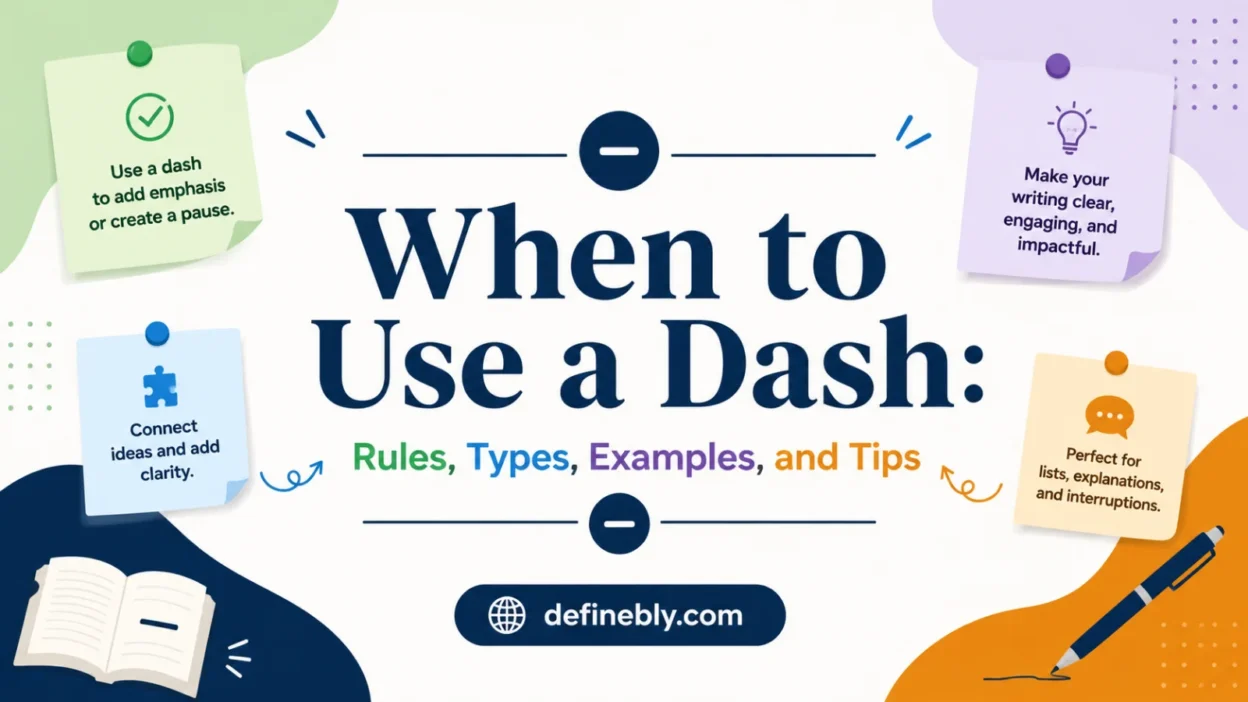
A dash is used to create a break in a sentence, add emphasis, insert extra information, show interruption, or mark a range. The two main dashes are the em dash and the en dash. An em dash creates a strong pause or break. An en dash shows a range or connection.
Example with an em dash:
I had one goal—finish the report before lunch.
Example with an en dash:
The office is open Monday–Friday.
A dash is not the same as a hyphen. A hyphen joins words, while a dash separates, interrupts, or connects ideas.
Quick Answer
Use an em dash when you want a strong break, added information, emphasis, or interruption.
Use an en dash when you mean to, through, or between in a range or connection.
Use a hyphen when you need to join words or word parts.
| Mark | Name | Main Use | Example |
|---|---|---|---|
| – | Hyphen | Joins words | well-known author |
| – | En Dash | Shows ranges or connections | 2019–2026 |
| — | Em Dash | Shows breaks, emphasis, or extra information | I knew one thing—she was right. |
The easiest rule is simple: hyphen joins, en dash connects, em dash breaks.
What Is A Dash?
A dash is a punctuation mark that changes the rhythm or meaning of a sentence. It can create a pause, set off extra details, or show a range between numbers, dates, or places.
Many people call every horizontal mark a dash, but that is not quite right. A hyphen, en dash, and em dash look similar, but they do different jobs.
The most common dash in everyday sentences is the em dash.
Example:
The answer was obvious—no one had checked the file.
The dash creates a strong break before the explanation.
When To Use An Em Dash
Use an em dash when you want a sentence to pause, shift, or emphasize what comes next.
Use An Em Dash For Emphasis
An em dash can make the final word or phrase stand out.
Example:
She wanted one thing—peace.
The dash gives extra weight to peace.
Another example:
The problem was not the price—it was the timing.
The dash highlights the real issue.
Use An Em Dash For A Break In Thought
An em dash can show a sudden change or turn in a sentence.
Example:
I was about to text you—then my phone died.
The dash shows the moment where the thought changes.
Another example:
He opened the door—and stopped cold.
The dash creates a dramatic pause before the reaction.
Use Em Dashes Around Extra Information
A pair of em dashes can set off extra information inside a sentence.
Example:
My neighbor—who moved in last week—brought us cookies.
The words between the dashes add extra detail. The main sentence still works without them:
My neighbor brought us cookies.
Another example:
The meeting—originally planned for Monday—was moved to Thursday.
The dashes make the added detail easy to notice.
Use An Em Dash For Interruptions In Dialogue
An em dash can show that someone stops suddenly or gets interrupted.
Example:
“I thought you said—”
“I changed my mind,” she said.
The dash shows that the first speaker did not finish.
Another example:
“Wait—I forgot my keys!”
Here, the dash shows a sudden break in the speaker’s thought.
Use An Em Dash Before A Strong Explanation
An em dash can introduce an explanation when you want more force than a comma.
Example:
There was only one problem—the tickets were sold out.
A colon would also work here:
There was only one problem: the tickets were sold out.
The colon sounds more formal. The dash sounds more direct.
When To Use An En Dash
Use an en dash for ranges, spans, scores, and some connections. It often means to, through, or between.
Use An En Dash For Number Ranges
Use an en dash between numbers when you mean from one number to another.
Examples:
Read pages 14–22.
The score was 31–24.
The meeting runs 2:00–3:30.
In each case, the en dash shows a span or range.
Use An En Dash For Date Ranges
Use an en dash for dates when you mean from one date to another.
Examples:
The festival runs June 4–June 9.
The 2025–2026 school year starts in August.
The museum exhibit covers 1900–1950.
The en dash keeps the range short and clear.
Use An En Dash For Connections
An en dash can connect two equal terms, places, or names.
Examples:
The Chicago–Detroit flight was delayed.
The Lakers–Celtics rivalry is famous.
The student–teacher meeting lasted 20 minutes.
In these examples, the en dash shows a connection between two sides.
Dash Vs. Hyphen
A hyphen is shorter than a dash. It is used inside words or between words.
Examples:
well-known writer
part-time job
twenty-one students
A dash is longer. It separates or connects larger ideas.
Example:
The writer was late—again.
Do not use a hyphen when you need a dash in a range.
Less polished:
The store is open 9-5.
Better:
The store is open 9–5.
The en dash is the better mark for a time range.
When Not To Use A Dash
Do not use a dash when simpler punctuation works better.
Do Not Use A Dash When A Comma Is Enough
Too much:
I went to the store—and bought milk.
Better:
I went to the store and bought milk.
The sentence does not need a dramatic pause.
Do Not Use A Dash Before Every List
A colon is usually clearer before a list.
Less clear:
Bring these items—water, snacks, and sunscreen.
Better:
Bring these items: water, snacks, and sunscreen.
The colon tells the reader that a list is coming.
Do Not Overuse Em Dashes
One em dash can add energy. Too many can make writing feel choppy.
Choppy:
I opened my laptop—the battery was dead—I forgot my charger—I missed the meeting.
Better:
I opened my laptop, but the battery was dead. I had forgotten my charger, so I missed the meeting.
Use dashes for useful emphasis, not for every pause.
Do Not Use A Dash To Fix Weak Grammar
Unclear:
The reason—because we were late.
Better:
The reason was simple: we were late.
A dash cannot repair an incomplete sentence.
Should You Put Spaces Around A Dash?
In American English, many books and style guides use an em dash with no spaces:
She had one plan—leave early.
Some newspapers, magazines, and websites use spaces around the dash:
She had one plan — leave early.
Both styles appear in published writing. The most important rule is consistency. Choose one style and use it throughout the same article, essay, or document.
For most clean US-style web writing, the no-space em dash is common:
The answer was clear—she needed more time.
How To Type A Dash
Typing a dash depends on your device and writing program.
Many word processors turn two hyphens into an em dash automatically.
Example:
word–word may become word—word
You can also copy and paste the marks when needed:
Em dash: —
En dash: –
Hyphen: –
Use the actual dash mark when possible. If your platform does not support it, two hyphens can work as a plain-text substitute for an em dash.
Common Mistakes With Dashes
The most common mistake is using a hyphen instead of an en dash.
Incorrect:
The event runs May 5-9.
Better:
The event runs May 5–9.
Another mistake is using an em dash where a colon would be clearer.
Less clear:
We need three things—time, money, and support.
Better:
We need three things: time, money, and support.
A third mistake is placing too many dashes in one sentence.
Overloaded:
My sister—who lives in Austin—called me yesterday—and asked for a favor.
Better:
My sister, who lives in Austin, called me yesterday and asked for a favor.
Use dashes only where they add clarity, emphasis, or rhythm.
Correct Dash Examples
Here are clear examples of dash use in everyday writing.
| Sentence | Dash Type | Why It Works |
|---|---|---|
| I needed one thing—sleep. | Em dash | Adds emphasis |
| My brother—who just got home—is making dinner. | Em dash | Adds extra information |
| “Don’t open that—” | Em dash | Shows interruption |
| The trip runs July 2–July 8. | En dash | Shows a date range |
| The final score was 28–21. | En dash | Shows a score |
| The New York–Boston train was full. | En dash | Shows a connection |
| She took a part-time job. | Hyphen | Joins words |
More examples:
The plan sounded simple—until we saw the cost.
The em dash shows a turn in the sentence.
Please read chapters 6–8 before class.
The en dash shows a range.
My old truck—believe it or not—still runs well.
The em dashes add a side comment.
The 2026–2027 budget will be reviewed next month.
The en dash connects the two years.
He sent a last-minute email.
The hyphen joins words before a noun.
Quick Rule Of Thumb
Use this memory rule:
Hyphen joins words. En dash shows a range. Em dash creates a break.
Ask yourself what the mark needs to do:
Am I joining words? Use a hyphen.
Am I showing a range? Use an en dash.
Am I adding a break or emphasis? Use an em dash.
That simple check will fix most dash mistakes.
FAQs
When should you use a dash?
Use a dash when you need a strong break, emphasis, interruption, extra information, range, or connection.
Use an em dash for breaks and emphasis. Use an en dash for ranges and connections.
What is an em dash used for?
An em dash is used to create a strong pause, add emphasis, show interruption, or set off extra information.
Example:
I knew the answer—finally.
What is an en dash used for?
An en dash is used for ranges, dates, times, scores, and connections.
Example:
The office is open Monday–Friday.
Is a dash the same as a hyphen?
No. A dash and a hyphen are different marks.
A hyphen joins words:
well-known author
A dash separates, interrupts, or connects larger ideas:
The author was late—again.
Can a dash replace a comma?
Yes, sometimes. An em dash can replace commas when the added information needs more emphasis.
Example:
My cousin—who lives nearby—stopped by after work.
Commas would be softer:
My cousin, who lives nearby, stopped by after work.
Can a dash replace parentheses?
Yes. Dashes can replace parentheses when you want the extra information to feel more noticeable.
Example:
The answer—after three long hours—finally came.
Parentheses would make the detail feel quieter:
The answer (after three long hours) finally came.
Can a dash replace a colon?
Sometimes. A colon is clearer for formal introductions and lists.
Example with colon:
I need three things: coffee, Wi-Fi, and silence.
Example with dash:
I need one thing—silence.
Use a colon for a clean setup. Use a dash for stronger emphasis.
Should there be spaces around an em dash?
Both styles exist.
No spaces:
She left early—without saying goodbye.
With spaces:
She left early — without saying goodbye.
Pick one style and stay consistent.
Can I use two hyphens instead of an em dash?
Yes, in plain text, two hyphens can stand in for an em dash when the real character is not available.
Example:
I had one goal–finish on time.
In polished writing, use the actual em dash:
I had one goal—finish on time.
Is a dash formal or informal?
A dash can work in both formal and informal writing. It depends on how often you use it.
A few well-placed dashes can make writing clearer. Too many can make writing feel casual or choppy.
Conclusion
Use a dash when it helps the reader follow a break, emphasis, interruption, range, or connection.
The em dash is best for sentence breaks and added information. The en dash is best for ranges, dates, times, scores, and connections. The hyphen is not a dash; it joins words.
The simplest rule is this: hyphen joins, en dash connects, em dash breaks.