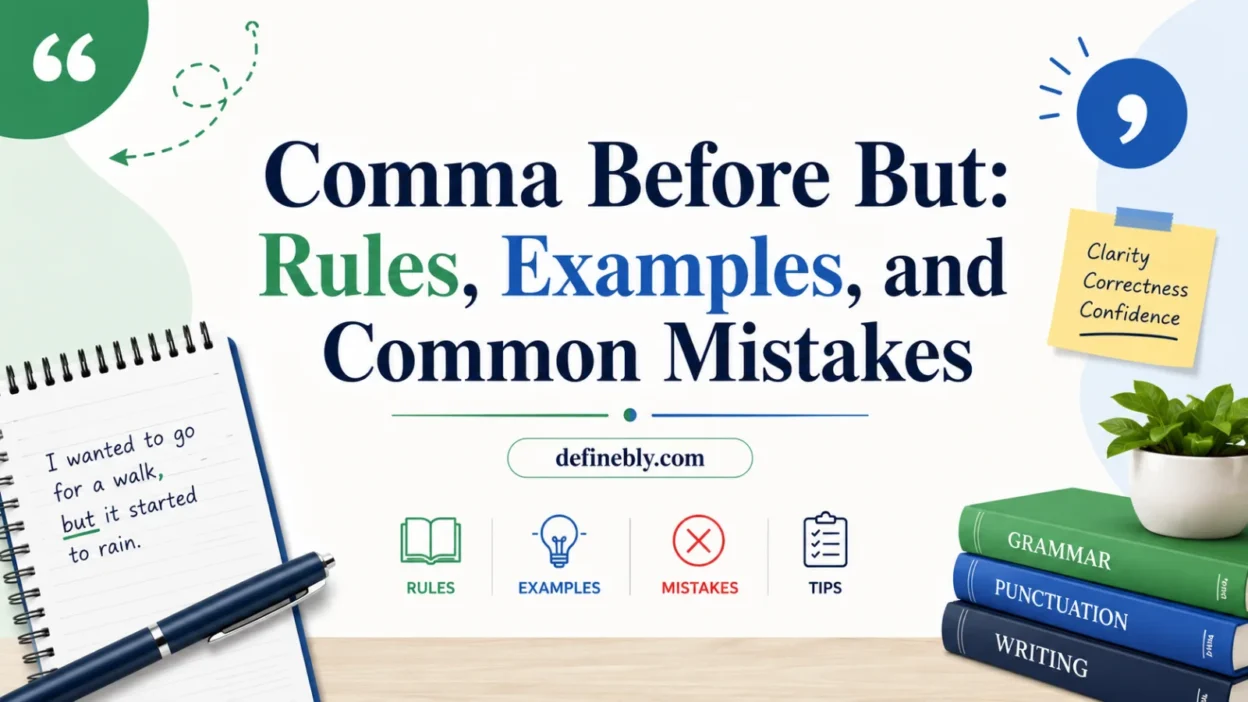
Use a comma before but when it joins two independent clauses—groups of words that can each stand alone as a complete sentence.
Correct: I wanted to go for a walk, but it started raining.
Both parts express complete thoughts:
- I wanted to go for a walk.
- It started raining.
Do not usually use a comma before but when it connects two words, phrases, or actions that share the same subject.
Correct: The test was difficult but fair.
The key to knowing whether to use a comma before but is sentence structure, not the pause you hear when reading aloud.
Quick Answer: Do You Put a Comma Before But?
Yes, when but connects two independent clauses. Otherwise, a comma is usually unnecessary.
| Sentence | Comma? | Reason |
|---|---|---|
| I wanted to help, but I arrived too late. | Yes | Joins two independent clauses |
| The movie was long but interesting. | No | Joins two descriptions |
| Maya opened the email but forgot to reply. | No | One subject performs two actions |
| The store was closing, but we made it in time. | Yes | Joins two independent clauses |
| The meal was simple but delicious. | No | Joins two adjectives |
An independent clause contains a subject and a predicate and can function as a complete sentence.
The Main Rule for a Comma Before But
But is a coordinating conjunction that connects contrasting words, phrases, or clauses.
When it connects two independent clauses, place a comma before it.
Correct:
- She studied all night, but she still felt nervous.
- The restaurant was crowded, but we found a table.
- I called twice, but nobody answered.
- The plan sounded simple, but it took all afternoon.
Each side of but can stand alone:
- She studied all night.
- She still felt nervous.
Because both are complete clauses, the comma belongs before but.
What Is an Independent Clause?
An independent clause expresses a complete thought and can stand alone as a sentence.
For example:
- The rain stopped. — Complete clause
- We went outside. — Complete clause
When you combine them with but, use a comma:
The rain stopped, but we stayed inside.
By contrast, but tired is not an independent clause because it does not express a complete thought on its own.
Correct: She was exhausted but happy.
No comma is needed because but connects two descriptions of the same subject.
When to Use a Comma Before But
1. When But Joins Two Complete Sentences
Use a comma when both sides of but contain a subject and predicate and can stand alone.
Examples:
- The lecture was long, but the examples were useful.
- I wanted to buy the jacket, but it was sold out.
- Maya sent the file, but Jordan never received it.
- The weather was cold, but the children played outside.
- We arrived late, but the meeting had not started.
In each example, the second clause introduces a contrast with the first.
2. When the Subject Changes After But
A change in subject often makes the two independent clauses easy to identify.
Examples:
- I finished my work, but my colleagues were still busy.
- The team worked quickly, but the client requested more changes.
- Sarah wanted to leave, but her friends stayed.
- The laptop was expensive, but its performance was excellent.
The comma separates the two complete clauses and helps readers follow the contrast.
Remember, however, that a change in subject alone is not the rule. The important question is whether but joins two independent clauses.
3. In Longer Sentences With Contrasting Ideas
Longer sentences often benefit from a comma before but when the conjunction introduces a complete contrasting clause.
Examples:
- The team had practiced for weeks, but the final round was harder than expected.
- The first draft looked promising, but the revised version needed more supporting details.
- We checked the figures carefully, but the final report still contained an error.
The comma helps separate the ideas and makes the sentence easier to read.
4. In Short Sentences When Both Clauses Are Complete
Even in short sentences, use a comma before but when it joins two independent clauses in standard writing.
Correct: I tried, but I failed.
Both I tried and I failed are complete sentences.
For school assignments, professional writing, and general American English, the comma is the standard choice in this structure.
When Not to Use a Comma Before But
1. When But Connects Two Adjectives
Do not use a comma when but connects two adjectives describing the same noun or subject.
Correct:
- The room was small but cozy.
- The answer was short but helpful.
- The soup was spicy but delicious.
- The job was difficult but rewarding.
- The laptop was expensive but reliable.
Incorrect: The room was small, but cozy.
In these examples, the words after but are descriptions, not independent clauses.
2. When the Same Subject Performs Two Actions
When but connects two verbs or verb phrases with the same subject, a comma is generally unnecessary.
Correct:
- Maya opened the email but forgot to reply.
- He opened the app but entered the wrong password.
- She tried to explain but stopped halfway through.
- We planned to leave early but stayed for dessert.
In the first example, Maya is the subject of both opened and forgot. The second action does not introduce a separate independent clause with its own subject.
Compare:
- No comma: Maya opened the email but forgot to reply.
- Comma: Maya opened the email, but Jordan forgot to reply.
In the second sentence, Jordan forgot to reply is a separate independent clause.
3. When But Connects Two Short Phrases
A comma is usually unnecessary when but joins two phrases rather than two independent clauses.
Correct:
- The answer was surprising but true.
- The trip was tiring but worth it.
- I liked the idea but not the price.
- She wanted to speak but remained silent.
Incorrect: I liked the idea, but not the price.
The phrase not the price does not form a complete independent clause.
4. When You Are Adding a Comma Only Because of a Pause
A pause in speech does not automatically require a comma in writing.
Correct: The movie was long but enjoyable.
Correct: I liked the design but not the color.
In both cases, but connects related sentence elements rather than two independent clauses.
Always check the grammar before deciding where punctuation belongs.
Common Mistakes With Commas Before But
Mistake 1: Leaving Out the Comma Between Independent Clauses
Incorrect: I wanted to stay home but my friends convinced me to go.
Correct: I wanted to stay home, but my friends convinced me to go.
Both clauses have their own subjects and predicates: I wanted to stay home and my friends convinced me to go.
Mistake 2: Adding a Comma Before a Single Adjective
Incorrect: The movie was long, but interesting.
Correct: The movie was long but interesting.
The conjunction connects two adjectives, so a comma is not needed.
Mistake 3: Placing a Comma Immediately After But
The comma that separates two independent clauses normally comes before but, not directly after it.
Incorrect: I wanted to help but, I was too late.
Correct: I wanted to help, but I was too late.
However, a comma can appear after but when it is needed to set off an introductory or interrupting expression.
Correct: I wanted to help, but, honestly, I was too late.
Correct: The plan worked, but, to be fair, it took longer than expected.
These examples use commas around the interrupting expressions honestly and to be fair. In many sentences, a smoother alternative is possible:
Smoother: I wanted to help, but honestly, I was too late.
Mistake 4: Automatically Adding a Comma Before But Also
The construction not only … but also usually does not need a comma when it connects words or phrases.
Correct:
- She is not only smart but also patient.
- The job is not only challenging but also rewarding.
- He not only wrote the report but also presented it.
When but joins two independent clauses, a comma is appropriate.
Correct: Not only did she finish the report, but she also reviewed the charts.
Here, Not only did she finish the report and she also reviewed the charts are independent clauses.
Comma Before But: Correct Examples
| Example | Comma Needed? | Explanation |
|---|---|---|
| I was tired, but I finished the report. | Yes | Two independent clauses |
| The soup was hot but delicious. | No | Two adjectives |
| She called me, but I missed the call. | Yes | Two independent clauses |
| He opened the app but forgot his password. | No | One subject, two actions |
| The job was difficult but rewarding. | No | Two descriptions |
| The store was closing, but we made it in time. | Yes | Two independent clauses |
| I liked the design but not the color. | No | Two contrasting phrases |
| I wanted to help, but, honestly, I was too late. | Yes | Independent clauses plus an interrupter |
More Examples
Comma before but:
- The road was icy, but we drove carefully.
- I sent the invoice, but the client did not receive it.
- The report was short, but it answered every question.
- She wanted to attend, but she had another appointment.
- The weather looked clear, but a storm was approaching.
No comma before but:
- The class was hard but useful.
- She wanted to speak but stayed quiet.
- The laptop was expensive but reliable.
- I liked the idea but not the price.
- The instructions were simple but effective.
An Easy Rule to Remember
Use this simple test: Can both sides of but stand alone as complete sentences?
If yes, use a comma before but.
Example: I was hungry, but the fridge was empty.
- I was hungry.
- The fridge was empty.
Both are complete sentences, so the comma is correct.
If the words after but cannot stand alone as a sentence, a comma is usually unnecessary.
Example: I was hungry but patient.
Patient is a description, not an independent clause.
This test works for many everyday sentences, although you should still check the sentence structure in more complex cases.
Frequently Asked Questions
Do You Put a Comma Before But?
Yes, when but joins two independent clauses.
Example: I wanted to call, but my phone was dead.
No comma is usually needed when but connects words, phrases, or two actions sharing the same subject.
Do You Always Need a Comma Before But?
No. Use a comma when but connects two independent clauses. Skip it when the conjunction connects two adjectives, two phrases, or two verbs with a shared subject.
- Comma: The store was open, but nobody was inside.
- No comma: The store was open but quiet.
What Is an Example of a Comma Before But?
The road was icy, but we drove carefully.
The first clause is The road was icy. The second is we drove carefully. Both are complete thoughts, so a comma comes before but.
When Should You Not Use a Comma Before But?
Do not usually use a comma when but connects two words or phrases rather than two independent clauses.
Correct: The lesson was difficult but useful.
The words difficult and useful describe the same lesson.
Do You Put a Comma After But?
Usually, no. When but joins two independent clauses, the comma normally comes before the conjunction.
Correct: I wanted to help, but I was too late.
A comma may follow but when an interrupting expression requires punctuation, as in “I wanted to help, but, honestly, I was too late.”
Can You Start a Sentence With But?
Yes. Starting a sentence with but is acceptable when it clearly contrasts with the previous sentence.
Example:
I wanted to go. But I was too tired.
In formal or professional writing, make sure the contrast is clear and avoid using this structure excessively.
Is But a Coordinating Conjunction?
Yes. But is a coordinating conjunction that connects words, phrases, or clauses, usually to express contrast.
For example, “The room was small but comfortable” connects two adjectives, while “The room was small, but we enjoyed our stay” connects two independent clauses.
Is “Small but Powerful” Correct Without a Comma?
Yes. Small but powerful is correct without a comma because but connects two adjectives describing the same thing.
Do You Use a Comma Before But Also?
Not automatically. In a simple not only … but also construction, no comma is usually needed.
Correct: She is not only talented but also hardworking.
Use a comma when but joins two independent clauses:
Correct: Not only did she lead the project, but she also trained the new team.
What Is the Easiest Way to Check a Comma Before But?
Split the sentence at but and see whether each side can function as a complete sentence.
- I wanted to leave, but the meeting was not over. Both sides are complete, so use a comma.
- I wanted to leave but stayed. The same subject performs both actions, so no comma is needed.
Conclusion
Use a comma before but when it connects two independent clauses. Do not usually use a comma when but joins two adjectives, phrases, or actions performed by the same subject.
The most reliable approach is to check the sentence structure rather than relying on a pause. If both sides of but can stand alone as complete sentences, a comma is generally the correct choice.