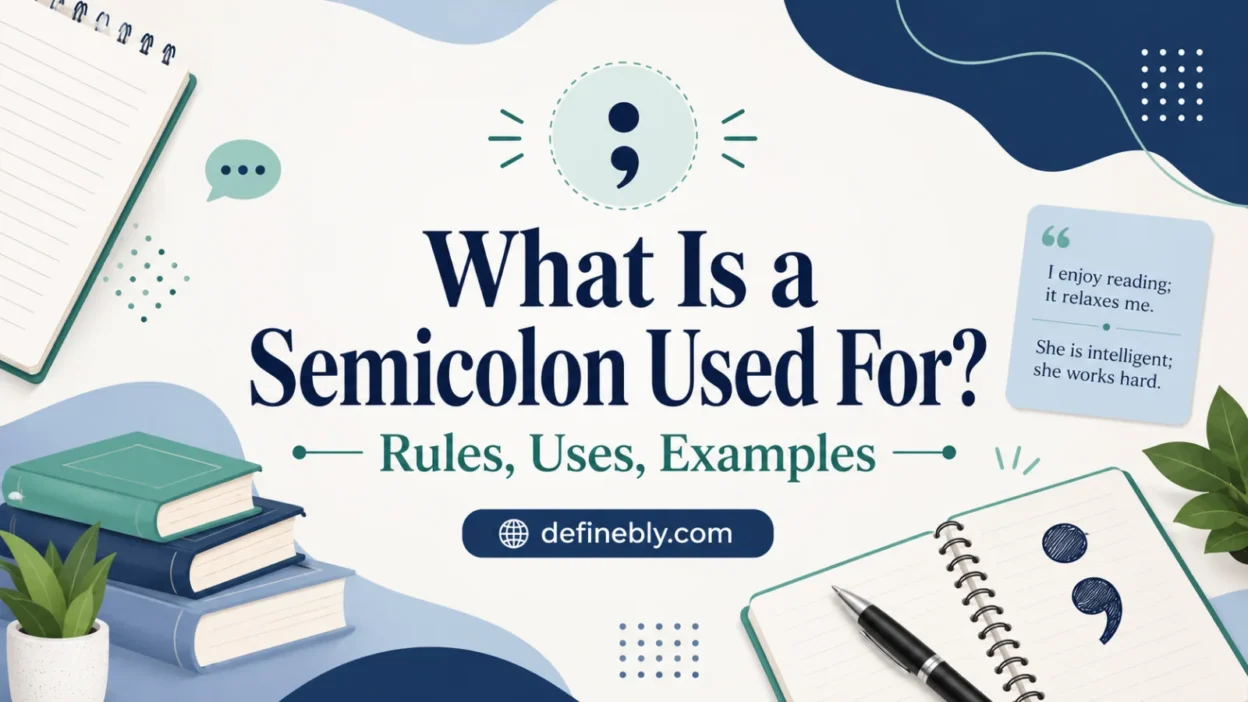
A semicolon is used to connect closely related complete thoughts or to separate items in a complex list.
It is stronger than a comma but less final than a period. Used well, it helps show that two ideas belong together without making them separate sentences.
Example:
- I wanted to leave early; the meeting ran longer than expected.
Both sides could stand alone as sentences. The semicolon shows that the ideas are connected.
Quick Answer
A semicolon has two main uses.
First, it connects two closely related independent clauses.
- The store was closed; we ordered dinner online.
Second, it separates items in a list when the items already contain commas.
- We visited Austin, Texas; Denver, Colorado; and Portland, Oregon.
A semicolon should not be used like a regular comma. It should not appear before a simple list or between a complete sentence and a fragment.
The Rule Explained
The most important semicolon rule is simple: use a semicolon between two complete thoughts that are closely related.
A complete thought is also called an independent clause. It has a subject and a verb, and it can stand alone as a sentence.
Example:
- The deadline is tomorrow; we should finish tonight.
First complete thought:
- The deadline is tomorrow.
Second complete thought:
- We should finish tonight.
The semicolon works because both parts are complete sentences. It also works because the second sentence explains why the first sentence matters.
A semicolon does not need a coordinating conjunction such as and, but, or, or so.
Correct:
- The printer stopped working; I sent the file by email.
Also correct:
- The printer stopped working, so I sent the file by email.
Both versions are grammatical. The semicolon version connects the thoughts without adding a conjunction.
When To Use It
Use a semicolon when two complete thoughts are closely connected.
Correct:
- The weather changed quickly; we canceled the picnic.
- My laptop died; I forgot the charger at home.
- The road was icy; driving was dangerous.
- She practiced every day; her confidence improved.
In each sentence, both sides can stand alone. The semicolon shows a close relationship between them.
Use a semicolon when the second thought explains, contrasts with, or follows from the first.
Explanation:
- The schedule is full; we need to start early.
Contrast:
- I wanted to stay longer; my ride was already outside.
Result:
- The team missed the deadline; the launch moved to Friday.
The two ideas should feel naturally connected. If they are unrelated, use a period and start a new sentence.
Unclear:
- The meeting ended early; my neighbor bought a new bike.
Better:
- The meeting ended early. My neighbor bought a new bike.
The semicolon is not wrong because of grammar alone. It is weak because the ideas do not clearly belong together.
Semicolons With Transition Words
Use a semicolon before a transition word when the transition connects two complete thoughts.
Common transition words and phrases include:
- however
- therefore
- nevertheless
- meanwhile
- for example
- for instance
- as a result
- consequently
Correct:
- I studied all week; however, the test was still difficult.
- The file was too large; therefore, I uploaded it to a shared folder.
- The first plan failed; as a result, we tried a simpler approach.
- The rule sounds simple; nevertheless, many writers misuse it.
The semicolon comes before the transition word. A comma usually follows the transition word or phrase.
Incorrect:
- I studied all week, however, the test was still difficult.
Correct:
- I studied all week; however, the test was still difficult.
You can also use a period instead.
Correct:
- I studied all week. However, the test was still difficult.
The semicolon keeps the two thoughts closer together. The period creates a stronger break.
Semicolons In Complex Lists
Use semicolons to separate list items when the items already contain commas.
Simple list:
- We bought apples, bread, and milk.
Complex list:
- We invited Ben, my cousin; Lena, my neighbor; and Omar, my coworker.
The semicolons make the list easier to read because each item already has a comma.
More examples:
- The finalists were Maya Lopez, first place; Jordan Kim, second place; and Ava Reed, third place.
- The conference has sessions in Boston, Massachusetts; Phoenix, Arizona; and Portland, Oregon.
- Please email the report to Dana, the project manager; Luis, the designer; and Priya, the editor.
Without semicolons, these lists can become crowded and confusing.
Crowded:
- The speakers were Anna Torres, a journalist, Mark Lee, a professor, and Nina Patel, a researcher.
Clear:
- The speakers were Anna Torres, a journalist; Mark Lee, a professor; and Nina Patel, a researcher.
Semicolons help readers see where one list item ends and the next begins.
Semicolon Vs. Comma, Colon, And Period
A semicolon is not just a fancy comma. It has a different job.
| Punctuation Mark | Main Use | Example |
|---|---|---|
| Comma | Separates smaller parts of a sentence | We packed snacks, water, and jackets. |
| Semicolon | Connects related complete thoughts | The trail was closed; we chose another route. |
| Colon | Introduces a list, explanation, or example | Bring three things: snacks, water, and jackets. |
| Period | Ends a complete thought | The trail was closed. We chose another route. |
Use a comma with a coordinating conjunction when you want a smoother, more common compound sentence.
Correct:
- The trail was closed, so we chose another route.
Use a semicolon when both thoughts are complete and closely related.
Correct:
- The trail was closed; we chose another route.
Use a colon when the second part explains, introduces, or expands the first part more directly.
Correct:
- We chose another route for one reason: the trail was closed.
Use a period when the ideas should stand separately.
Correct:
- The trail was closed. We chose another route.
When Not To Use It
Do not use a semicolon between a complete sentence and a fragment.
Incorrect:
- I packed my bag; before school.
Correct:
- I packed my bag before school.
The words before school cannot stand alone as a sentence.
Do not use a semicolon before a simple list.
Incorrect:
- I bought; apples, milk, and bread.
Correct:
- I bought apples, milk, and bread.
Use a colon if a complete sentence introduces a list.
Correct:
- I bought three things: apples, milk, and bread.
Do not use a semicolon after because, although, while, if, or similar dependent words.
Incorrect:
- I stayed home; because I felt sick.
Correct:
- I stayed home because I felt sick.
Do not place a semicolon before every transition word. Use it only when the transition connects two complete thoughts.
Incorrect:
- The meeting was short; for example, the budget update.
Correct:
- The meeting was short; for example, the budget update took only five minutes.
Common Mistakes
One common mistake is using a comma between two complete thoughts.
Incorrect:
- The movie was sold out, we watched another one.
Correct:
- The movie was sold out; we watched another one.
This error is called a comma splice.
Another mistake is using a semicolon when the second part cannot stand alone.
Incorrect:
- She opened the window; after the room got warm.
Correct:
- She opened the window after the room got warm.
A third mistake is capitalizing the first word after a semicolon.
Incorrect:
- The bus was late; We took a cab.
Correct:
- The bus was late; we took a cab.
Do not capitalize after a semicolon unless the next word is a proper noun.
Correct:
- We arrived late; Chicago traffic was heavy.
Chicago stays capitalized because it is a proper noun.
Another mistake is using a semicolon between unrelated ideas.
Weak:
- I finished the report; my shoes are by the door.
Better:
- I finished the report. My shoes are by the door.
A semicolon should connect ideas that have a clear relationship.
Correct Examples
| Sentence | Why It Works |
|---|---|
| The rain stopped; the game continued. | Both sides are complete thoughts. |
| I called twice; no one answered. | The ideas are closely connected. |
| She practiced daily; as a result, she improved. | A transition phrase connects two complete thoughts. |
| We visited Tampa, Florida; Boise, Idaho; and Reno, Nevada. | The list items contain commas. |
| The deadline moved up; everyone stayed late. | The second thought follows from the first. |
| The plan was risky; however, it worked. | However connects two independent clauses. |
More correct examples:
- The recipe looked simple; however, it took two hours.
- He wanted to apologize; she was not ready to talk.
- The alarm rang; everyone left the building.
- The email was unclear; I asked for more details.
- The guests came from Dallas, Texas; Phoenix, Arizona; and Madison, Wisconsin.
- The first draft was messy; the final version was strong.
Quick Memory Fix Or Rule Of Thumb
Use this simple rule:
A semicolon connects two complete thoughts or clears up a crowded list.
Before using a semicolon, ask two questions:
- Can both sides stand alone as sentences?
- Are the ideas closely related?
If the answer to both questions is yes, a semicolon may work.
For lists, ask one question:
- Do the list items already contain commas?
If yes, semicolons can make the list clearer.
FAQs
What is a semicolon used for in simple words?
A semicolon connects two complete thoughts that are closely related.
It can also separate long or complex list items that already contain commas.
Example:
- I was tired; I finished the project anyway.
Both parts could be separate sentences.
What is an example of a semicolon?
Here is a simple example:
- I finished my homework; my brother was still studying.
Both parts are complete thoughts. The semicolon shows that the two ideas are connected.
Can a semicolon replace a period?
Yes, sometimes. A semicolon can replace a period when two complete sentences are closely related.
Period:
- The road was icy. Driving was dangerous.
Semicolon:
- The road was icy; driving was dangerous.
The semicolon creates a closer connection between the ideas.
Can a semicolon replace a comma?
Sometimes, but not always.
A semicolon can replace a comma in a complex list when the items already contain commas.
Correct:
- We invited Ben, my cousin; Lena, my neighbor; and Omar, my coworker.
A semicolon should not replace a comma in a simple list.
Incorrect:
- I bought apples; bread; and milk.
Correct:
- I bought apples, bread, and milk.
Do you capitalize after a semicolon?
Usually, no.
Correct:
- The class ended early; the students went home.
Capitalize after a semicolon only if the next word is a proper noun.
Correct:
- We missed our flight; Denver was covered in snow.
Can I use a semicolon with “however”?
Yes. Use a semicolon before however when it connects two complete thoughts.
Correct:
- I wanted to go; however, I had too much work.
A comma usually follows however.
What is the difference between a semicolon and a colon?
A semicolon connects related complete thoughts or separates complex list items.
A colon usually introduces a list, explanation, example, or expansion.
Semicolon:
- The answer was clear; we needed more time.
Colon:
- We needed one thing: more time.
Is a semicolon formal?
A semicolon can sound polished, but it is not only for formal writing.
It works in essays, reports, emails, and other writing when it makes the sentence clearer. Still, simple sentences are often better when a semicolon is not needed.
Can I use a semicolon before “and” or “but”?
Yes, but only in limited cases.
A semicolon can appear before and or but when the clauses are long or already contain commas.
Example:
- The first team, which arrived early, set up the room; and the second team, which came later, handled registration.
In most everyday sentences, a comma is enough before and or but.
What is the easiest way to check a semicolon?
Replace the semicolon with a period.
If both sides still make complete sentences, the semicolon may be correct.
Example:
- The lights went out; we found the flashlights.
Test:
- The lights went out. We found the flashlights.
Both sentences work, so the semicolon is possible.
Conclusion
A semicolon has two main jobs. It connects closely related complete thoughts, and it separates complex list items that already contain commas.
Use it when a comma is too weak and a period feels too final. The key is simple: both sides should be complete sentences, and the connection should be clear.