
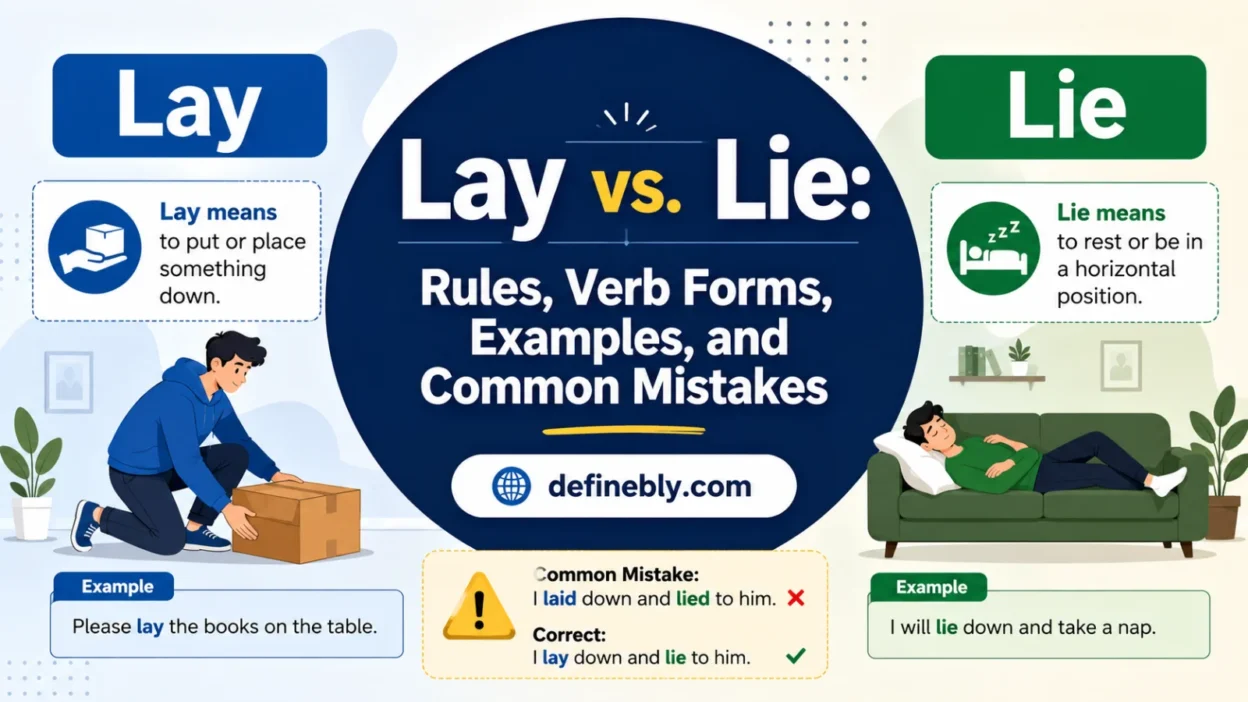
Lay vs. Lie: Rules, Verb Forms, Examples, and Common Mistakes
Lay means to put or place something down, while lie means to recline, rest, or be in a flat position. The main difference is that lay takes a direct object, but lie does not.
- Lay: Please lay the book on the table.
- Lie: I need to lie down for a few minutes.
The confusion comes from their past-tense forms: the past tense of lay is laid, while the past tense of lie is lay.
Quick Answer: Lay vs. Lie
Use lay when you put something somewhere. Use lie when you or something else reclines or rests.
| Verb Form | Lay (To Place Something) | Lie (To Recline or Rest) |
|---|---|---|
| Present | lay | lie |
| Third-person singular | lays | lies |
| Simple past | laid | lay |
| Past participle | laid | lain |
| -ing form | laying | lying |
Examples:
- Present: I lay my keys on the counter every morning.
- Past: I laid my keys on the counter yesterday.
- Present: I lie on the couch when I feel tired.
- Past: I lay on the couch after dinner.
Remember that lie has a separate meaning: to say something false. That verb follows a different pattern: lie, lied, lied, lying.
The Main Rule: Lay Takes an Object, Lie Does Not
The easiest way to choose between lay and lie is to identify what the verb means and whether it has a direct object.
When to Use Lay
Lay is a transitive verb, which means it takes a direct object. The object is the person or thing being placed.
Ask “Lay what?” If the sentence supplies an answer, lay is usually the correct verb.
Examples:
- Please lay the folder on my desk.
- She lays the baby in the crib after lunch.
- He laid the towel on the chair.
- The workers are laying new flooring in the hallway.
In each sentence, something is being placed: the folder, the baby, the towel, or the flooring.
When to Use Lie
Lie, when it means to recline or rest, is an intransitive verb. It does not take a direct object.
Examples:
- I need to lie down.
- The cat likes to lie in the sun.
- He wants to lie on the couch after work.
- The book lies flat on the table.
In these examples, the subject is resting or occupying a position. It is not placing an object somewhere.
Lay vs. Lie: Verb Forms Explained
The forms of these verbs are the main reason writers confuse them. Pay special attention to the past tense.
Lay, Laid, Laid, Laying
Use these forms when something is being placed.
| Verb Form | Example |
|---|---|
| Lay | I lay my phone on the desk every evening. |
| Lays | She lays the blanket over the sofa. |
| Laid | I laid my phone on the desk yesterday. |
| Laid | I have laid the documents beside your laptop. |
| Laying | He is laying the tiles in the kitchen. |
Notice that laid is both the simple past and the past participle of lay.
Correct: She laid the papers on the table.
Incorrect: She layed the papers on the table.
Layed is not the standard spelling. Use laid.
Lie, Lay, Lain, Lying
Use these forms when someone or something reclines or rests.
| Verb Form | Example |
|---|---|
| Lie | I lie down when I feel exhausted. |
| Lies | The dog lies by the door. |
| Lay | I lay on the couch yesterday. |
| Lain | She has lain awake for hours. |
| Lying | The cat is lying in the sun. |
The past tense of lie is lay, not laid. Its past participle is lain, used with has, have, or had.
Correct: He lay in bed all morning.
Incorrect: He laid in bed all morning.
The correct choice is lay because he was resting, not placing something.
When to Use Lay
Use Lay When You Put Something Down
Choose lay when a person or thing places an object somewhere.
Examples:
- Lay your phone on the desk.
- Please lay your coat on the chair.
- She lays the baby in the crib.
- The workers lay bricks along the path.
Each sentence has a direct object. You lay something.
Use Laid for Past Actions Involving Placement
Use laid when the placement happened in the past.
Examples:
- I laid my keys on the counter.
- She laid the towel on the chair.
- They laid the carpet yesterday.
- He laid the papers beside the laptop.
You can also use laid with has, have, or had.
Examples:
- I have laid the folder on your desk.
- They had laid the cables before the inspection.
Use Laying for Ongoing Placement
Use laying when someone is putting something somewhere or arranging something in position.
Examples:
- She is laying the baby in the crib.
- They are laying new flooring in the hallway.
- I am laying the documents on your desk.
- The crew is laying cables under the street.
The direct object makes the distinction clear: the baby, flooring, documents, and cables are being placed.
When to Use Lie
Use Lie When Someone Reclines or Rests
Choose lie when a person or thing rests, reclines, or remains in a position.
Examples:
- I need to lie down for a while.
- The cat likes to lie in the sunlight.
- He wants to lie on the couch after work.
- The book can lie flat on the table.
In each sentence, the subject is resting or remaining in a position rather than placing something.
Use Lay for the Past Tense of Lie
This is the most commonly confused form.
When lie means to recline, its simple past tense is lay.
Examples:
- Yesterday, I lay on the couch for an hour.
- She lay awake most of the night.
- The dog lay by the fire after dinner.
- He lay on the floor after his workout.
Although lay often means “to place something,” it can also be the past tense of lie. The meaning and sentence structure tell you which verb is being used.
Use Lain with Has, Have, or Had
Lain is the past participle of lie when it means to recline or rest.
Examples:
- She has lain awake since midnight.
- The papers had lain untouched for weeks.
- He had lain in bed all morning.
- The old rug has lain in the attic for years.
Lain is grammatically correct, although it may sound formal or uncommon in everyday conversation. You can often rephrase a sentence to sound more natural.
- Formal: She has lain awake for hours.
- More conversational: She has been awake for hours.
Use Lying for Resting or Reclining
Use lying when someone or something is resting or occupying a position.
Examples:
- The cat is lying in the sun.
- She is lying on the couch.
- The dog is lying by the door.
- I was lying in bed when the alarm rang.
Use laying only when something is being placed.
- Lying: She is lying on the floor.
- Laying: She is laying the blanket on the floor.
The first describes a position. The second describes an action involving an object.
Common Mistakes with Lay and Lie
Mistake 1: Using Lay Instead of Lie Down
Incorrect: I am going to lay down.
Correct: I am going to lie down.
When you mean that you will recline, use lie down. No object is being placed.
However, lay down is correct when you place something or someone down.
Correct: I am going to lay the baby down.
Here, the baby is the direct object.
Mistake 2: Using Laid for the Past Tense of Lie
Incorrect: He laid on the sofa after work.
Correct: He lay on the sofa after work.
He was resting, so the verb is lie. Its simple past form is lay.
Compare:
- He lay on the sofa after work. (He reclined.)
- He laid his jacket on the sofa after work. (He placed his jacket.)
Mistake 3: Using Laying Instead of Lying
Incorrect: The dog is laying by the door.
Correct: The dog is lying by the door.
The dog is resting rather than placing an object.
But this sentence is correct:
The worker is laying tiles by the door.
The worker is placing tiles, so laying is appropriate.
Mistake 4: Forgetting That Lay Needs an Object
Incorrect: She lays down after lunch.
Correct: She lies down after lunch.
In the intended meaning, she reclines. She is not placing anything.
Compare:
- She lies down after lunch.
- She lays the baby down after lunch.
The second sentence uses lays because the baby is the direct object.
Mistake 5: Writing Layed Instead of Laid
Incorrect: I layed the book on the table.
Correct: I laid the book on the table.
The past tense and past participle of lay are both laid. Layed is not the standard form.
Mistake 6: Confusing Lie (Recline) with Lie (Tell an Untruth)
The verb lie has two distinct meanings, and each has its own verb forms.
| Meaning | Present | Past | Past Participle | -ing Form |
|---|---|---|---|---|
| Recline or rest | lie | lay | lain | lying |
| Say something false | lie | lied | lied | lying |
Examples:
- Recline: I lay on the couch yesterday.
- Tell an untruth: I lied about being busy yesterday.
- Recline: She has lain awake all night.
- Tell an untruth: She has lied about what happened.
The context determines the meaning.
Lay vs. Lie: Correct Examples at a Glance
| Sentence | Correct Form | Why |
|---|---|---|
| Please lay the papers on my desk. | Lay | The papers is the object. |
| I need to lie down. | Lie | The speaker is reclining. |
| She laid the towel on the chair. | Laid | Past tense of lay. |
| He lay on the floor yesterday. | Lay | Past tense of lie. |
| The cat is lying in the window. | Lying | The cat is resting. |
| They are laying tile in the kitchen. | Laying | Tile is being placed. |
| She has lain awake for hours. | Lain | Past participle of lie. |
| I have laid the folder on your desk. | Laid | Past participle of lay. |
| He lied about his age. | Lied | Lie means to say something false. |
More Examples in Context
Comparing the present and past forms can make the difference easier to remember.
Using lay:
- I lay my jacket on this chair every morning.
- Yesterday, I laid my jacket on this chair.
- I have laid my jacket on the chair already.
Using lie:
- I lie on the sofa when I am tired.
- Yesterday, I lay on the sofa after dinner.
- I have lain on this sofa many times.
Using the -ing forms:
- The child is lying under a blanket.
- The workers are laying bricks near the driveway.
- The papers are lying untouched on the desk.
- Please lay the package by the door.
An Easy Memory Trick for Lay vs. Lie
Remember these two phrases:
Lay it down. Lie down.
- Lay it down: You are placing something.
- Lie down: You are reclining or resting.
When you are unsure, ask yourself, “What is being placed?”
If you can identify a direct object, lay is likely correct.
- Lay what? The book.
- Correct: Lay the book on the table.
If the sentence describes someone resting rather than placing something, use lie.
- Correct: I need to lie down.
For past-tense sentences, remember the extra distinction:
- Place something: laid
- Recline or rest: lay
Frequently Asked Questions
What Is the Difference Between Lay and Lie?
Lay means to put or place something down and takes a direct object. Lie means to recline or rest and does not take a direct object.
- Lay the book on the table.
- Lie down for a few minutes.
Is It Lay Down or Lie Down?
Use lie down when you mean to recline or rest.
- Correct: I need to lie down.
Use lay down when you are placing something or someone down.
- Correct: Lay the baby down gently.
Is It Lying or Laying in Bed?
Use lying in bed when someone is resting.
- Correct: She is lying in bed.
Use laying when someone is placing something.
- Correct: She is laying the blanket on the bed.
What Is the Past Tense of Lie?
The past tense of lie, meaning to recline or rest, is lay. Its past participle is lain.
- Past: Yesterday, I lay on the couch.
- Past participle: I have lain awake for hours.
What Is the Past Tense of Lay?
The past tense of lay is laid. Its past participle is also laid.
- Past: I laid the book on the table.
- Past participle: I have laid the book on the table.
Is “I Laid Down” Correct?
It depends on the intended meaning.
If you mean that you reclined, use “I lay down.”
If you mean that you placed something down, laid down is correct.
- Reclining: I lay down after work.
- Placing: I laid down the bag.
Is Lain Still Used?
Yes. Lain remains the standard past participle of lie meaning to recline or rest.
- She has lain awake all night.
Although correct, lain can sound formal in everyday conversation. You can rephrase the sentence as “She has been awake all night.”
Is Layed a Word?
Layed is not the standard past tense or past participle of lay. Use laid instead.
- Incorrect: I layed the keys on the counter.
- Correct: I laid the keys on the counter.
Does Lie Also Mean to Tell an Untruth?
Yes. Lie can mean either to recline or to say something false. The two meanings have different verb forms.
- Recline: lie, lay, lain, lying.
- Say something false: lie, lied, lied, lying.
Example: “He lied about his age.”
What Is the Easiest Way to Remember Lay vs. Lie?
Use “Lay it down. Lie down.” If you are placing something, use lay. If you are resting or reclining, use lie. In the past tense, use laid for placing and lay for reclining.
Conclusion
The difference between lay vs. lie comes down to meaning and verb form. Use lay when placing something, and use lie when reclining or resting. The past tense of lay is laid, while the past tense of lie is lay. Their past participles are laid and lain, respectively.
When in doubt, check whether something is being placed. Lay the book down, but lie down when you need to rest.