Their vs. There vs. They’re: Difference, Rules, and Examples
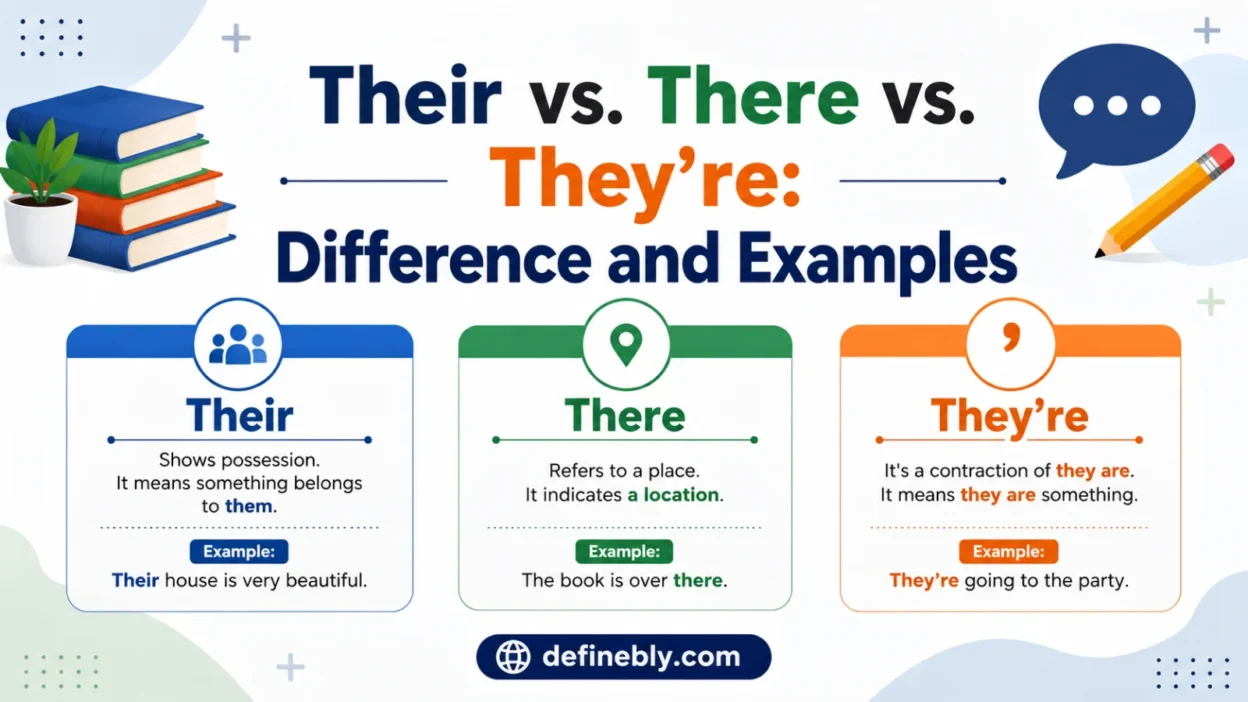
Their shows possession, there refers to a place or introduces something that exists, and they’re is a contraction of they are. Although these three words usually sound the same, they have different meanings and grammatical uses.
Compare these examples:
- Their dog is friendly.
- The dog is over there.
- They’re walking the dog.
The easiest rule to remember is: Their belongs, there points, and they’re means they are.
Quick Answer
Use their when something belongs to or is associated with people, a group, or a person referred to as they.
Example: Their car is parked outside.
Use there when referring to a place or introducing something that exists or happens.
Examples:
- The car is parked over there.
- There is a car outside.
Use they’re when you mean they are.
Example: They’re parking the car now.
| Word | Main Use | Example |
|---|---|---|
| Their | Possession or association | Their house is blue. |
| There | Place or existence | There is a house nearby. |
| They’re | They are | They’re moving tomorrow. |
Why Are Their, There, and They’re Confused?
Their, there, and they’re are homophones. Homophones are words that sound alike but have different meanings and spellings.
Because the three words usually sound the same in spoken English, it can be difficult to distinguish them by sound alone. In writing, the correct choice depends on the meaning and grammatical structure of the sentence.
Compare:
- Their bikes are outside.
- The bikes are over there.
- They’re riding their bikes.
Each word serves a different purpose: their shows possession, there indicates a location, and they’re means they are.
What Does Their Mean?
Their is a possessive determiner that shows ownership, possession, or association. It normally appears before a noun.
Examples:
- The students forgot their notebooks.
- The neighbors cleaned their yard.
- The team changed their schedule.
- Someone left their phone in the office.
- The dogs wagged their tails.
In each sentence, their connects something to the people, animals, or group associated with it.
How to Use Their in a Sentence
Use their when you are talking about something that belongs to or is associated with them.
Common combinations include:
- their house
- their teacher
- their plans
- their opinion
- their dog
- their responsibility
- their decision
Example: The employees updated their passwords.
The passwords are associated with the employees.
Can Their Refer to One Person?
Yes. Their can refer to multiple people or to one person when using singular they.
Singular they is commonly used when a person’s gender is unknown, unspecified, or when that person uses they/them pronouns.
Examples:
- Someone left their jacket in the hallway.
- Every applicant should bring their identification.
- Jordan said their appointment was at noon.
In these examples, their does not necessarily refer to multiple people.
What Does There Mean?
There has two common uses: referring to a place and introducing something that exists or happens.
There Refers to a Place
Use there when pointing to or referring to a location.
Examples:
- Put the boxes over there.
- We went there after dinner.
- The restroom is down there.
- I left my backpack there yesterday.
- Your keys are there, beside the phone.
A useful clue is that there can often be replaced with a phrase such as in that place or at that location.
Example: Wait there.
Similar meaning: Wait in that place.
There Introduces Something That Exists
There also appears in sentences that state that something exists, happens, or is present. This is often called existential there.
Examples:
- There is a meeting at noon.
- There are three messages in your inbox.
- There was a problem with the order.
- There were several options.
- There will be a short delay.
In these sentences, there does not identify a specific physical location. Instead, it introduces the existence or occurrence of something.
Should You Use There Is or There Are?
Use there is with a singular noun or an uncountable noun in standard present-tense constructions. Use there are with a plural noun.
- There is one seat left.
- There is some water in the bottle.
- There are two seats left.
- There are several options available.
For past-tense examples, use there was with a singular or uncountable noun and there were with a plural noun.
What Does They’re Mean?
They’re is a contraction of they are. The apostrophe marks the letters omitted when the two words are combined.
Examples:
- They’re ready to leave.
- They’re working late.
- They’re not home yet.
- They’re planning a surprise.
- They’re going to arrive at six.
How to Check Whether They’re Is Correct
Replace they’re with they are. If the sentence still makes sense, they’re is usually the correct choice.
Example:
They’re coming soon.
Expanded: They are coming soon.
Both versions are correct.
However, if replacing they’re with they are makes the sentence incorrect, choose their or there based on the intended meaning.
Compare:
- They’re happy. (They are happy.)
- Their house is large. (The house belongs to them.)
- The house is over there. (The house is in that place.)
Is They’re More Casual Than They Are?
Both forms are correct. They’re is a contraction commonly used in conversation and everyday writing. They are may sound more formal or place greater emphasis on are, depending on the sentence.
Conversational: They’re arriving soon.
Emphatic: They are arriving soon.
Choose the form that fits your tone and the requirements of your writing.
Their vs. There vs. They’re: How to Choose the Right Word
If you are unsure which spelling to use, follow these three steps.
1. Check for Possession
Ask whether the sentence shows that something belongs to or is associated with someone.
Example: Their keys are on the counter.
The keys belong to or are associated with them, so their is correct.
2. Check for a Place or Existence
If the sentence refers to a location, use there.
Example: The keys are over there.
If the sentence introduces something that exists or happens, there is also correct.
Example: There are two keys on the counter.
3. Replace They’re With They Are
If the sentence means they are, use they’re.
Example: They’re on the way.
Expanded: They are on the way.
If the expanded version does not make sense, choose their or there according to the sentence’s meaning.
Common Mistakes With Their, There, and They’re
Using Their Instead of There
Incorrect: Their are snacks in the kitchen.
Correct: There are snacks in the kitchen.
The sentence introduces things that exist, so there is correct.
Using There Instead of Their
Incorrect: The students raised there hands.
Correct: The students raised their hands.
Their shows that the hands belong to the students.
Using Their Instead of They’re
Incorrect: Their going to be late.
Correct: They’re going to be late.
The intended meaning is they are going to be late.
Using They’re Instead of Their
Incorrect: I borrowed they’re laptop.
Correct: I borrowed their laptop.
Their is correct because it shows whose laptop was borrowed.
Using They’re Instead of There
Incorrect: Put the bags over they’re.
Correct: Put the bags over there.
There refers to the location where the bags should be placed.
Forgetting the Apostrophe in They’re
Incorrect: Theyre ready to leave.
Correct: They’re ready to leave.
The apostrophe is required because they’re is a contraction of they are.
Everyday Examples of Their, There, and They’re
Their in Sentences
- Their team won the game.
- Their parents are waiting outside.
- The employees updated their passwords.
- Someone left their water bottle on the desk.
- The dogs wagged their tails.
- The students turned in their essays.
- The neighbors invited their friends to dinner.
- Each customer received their receipt.
There in Sentences
- The gym is over there.
- I saw your backpack there.
- There is a new café near the office.
- There are two missed calls on your phone.
- We stayed there for three nights.
- There was a mistake in the report.
- There will be an announcement tomorrow.
- The restaurant is right over there.
They’re in Sentences
- They’re celebrating after the game.
- They’re working from home today.
- They’re not ready yet.
- They’re planning to arrive at six.
- They’re asking for an update.
- They’re going to send the file later.
- They’re waiting outside the building.
- They’re excited about the trip.
All Three Words in One Sentence
- Their parents are waiting there, and they’re ready to leave.
- There are snacks in their bag, but they’re saving them for later.
- I saw their bikes over there, so I think they’re nearby.
- They’re moving their boxes over there.
- There is a problem with their order, and they’re calling customer support.
These examples show how all three words can appear in the same sentence without sharing the same meaning.
Their vs. There vs. They’re: Memory Tricks
Use these simple tricks to remember the difference.
Their = possession
Think of something that belongs to them.
Example: Their house is blue.
There = place or existence
The word here appears inside there, which can help you remember its connection to location. Remember that there also introduces existence, as in There is a problem.
Example: The house is over there.
They’re = they are
The apostrophe signals a contraction.
Example: They’re ready.
The quickest test is to expand they’re to they are. If that works, use they’re. Otherwise, decide whether you need the possessive their or the place-and-existence word there.
Frequently Asked Questions
What Is the Difference Between Their, There, and They’re?
Their shows possession or association. There refers to a place or introduces something that exists. They’re is a contraction of they are.
Examples:
- Their dog is friendly.
- The dog is over there.
- They’re walking the dog.
When Should I Use Their?
Use their when something belongs to or is associated with people, a group, or a person referred to as they.
Example: The students opened their books.
The books belong to or are associated with the students.
When Should I Use There?
Use there to refer to a location or to introduce something that exists or happens.
Examples:
- Sit over there.
- There is a message for you.
The first sentence refers to a place. The second introduces something that exists.
When Should I Use They’re?
Use they’re when you mean they are.
Example: They’re leaving soon.
Expanded: They are leaving soon.
If they are does not fit the sentence, do not use they’re.
Are Their, There, and They’re Pronounced the Same?
Yes. In standard American English, these three words are generally pronounced alike. They are homophones, which is why they are easy to confuse when writing.
Can Their Refer to One Person?
Yes. Their can refer to one person when singular they is used.
Example: Someone forgot their phone.
The word their refers to the person whose identity is unknown or unspecified, or to someone who uses they/them pronouns.
Is There’s the Same as Theirs?
No. There’s usually means there is and can also mean there has. Theirs is a possessive pronoun meaning that something belongs to them.
Examples:
- There’s a package outside.
- That package is theirs.
The first sentence says a package exists. The second identifies who the package belongs to.
Is It Their Going or They’re Going?
The correct form is they’re going when you mean they are going.
Example: They’re going to the store.
Expanded: They are going to the store.
Is It There Are or Their Are?
The correct form is there are when introducing plural things that exist.
Example: There are three chairs in the room.
Their are is incorrect in this construction because their shows possession.
What Is the Easiest Way to Remember Their, There, and They’re?
Remember these three meanings:
- Their = possession
- There = place or existence
- They’re = they are
When in doubt, replace they’re with they are. If the sentence does not make sense, check whether you need their for possession or there for a place or existence.
Conclusion
Use their for possession or association, there for a place or existence, and they’re when you mean they are.
Although these words usually sound the same, they perform different grammatical jobs:
- Their belongings are inside.
- The belongings are over there.
- They’re looking for their belongings.
Remembering what each word means—and checking how it functions in the sentence—will help you use the correct spelling in everyday and professional writing.
Their, there, and they’re sound the same, but they mean different things.
Use their for possession, there for place or existence, and they’re when you mean they are.
Correct:
- Their dog is friendly.
- The dog is over there.
- They’re walking the dog.
The easiest rule is this: their belongs, there points, and they’re means they are.
Quick Answer
Use their when something belongs to people, animals, a group, or a person referred to as they.
Example:
- Their car is parked outside.
Use there when pointing to a place or saying something exists.
Examples:
- The car is parked over there.
- There is a car outside.
Use they’re when you mean they are.
Example:
- They’re parking the car now.
Quick comparison:
| Word | Main Use | Example |
|---|---|---|
| their | possession | Their house is blue. |
| there | place or existence | There is a house nearby. |
| they’re | they are | They’re moving tomorrow. |
Why People Confuse Them
Their, there, and they’re are homophones.
Homophones sound the same but have different spellings and meanings.
When spoken, the three words sound alike. In writing, the spelling changes the meaning.
Compare:
- Their bikes are outside.
- The bikes are outside there.
- They’re riding their bikes.
Each word sounds the same, but each word does a different job.
Key Differences At A Glance
| Context | Best Choice | Why |
|---|---|---|
| Something belongs to them | their | It shows possession. |
| A place or location | there | It points to where something is. |
| Something exists | there | It works with is or are. |
| You mean they are | they’re | It is a contraction. |
| You can replace it with they are | they’re | The sentence still makes sense. |
| You can replace it with here | there | Both words can point to location. |
Meaning And Usage Difference
Their shows ownership or connection.
Examples:
- The students forgot their notebooks.
- The neighbors cleaned their yard.
- The team changed their schedule.
- Someone left their phone in the office.
In each sentence, something belongs to someone or is connected to someone.
There can point to a place.
Examples:
- Put the boxes over there.
- We went there after dinner.
- The restroom is down there.
- I left my backpack there yesterday.
There can also introduce something that exists or happens.
Examples:
- There is a meeting at noon.
- There are three messages in your inbox.
- There was a problem with the order.
- There will be a short delay.
They’re is a contraction of they are.
Examples:
- They’re ready to leave.
- They’re working late.
- They’re not home yet.
- They’re planning a surprise.
If you can replace the word with they are, use they’re.
Tone, Context, And Grammar
Their is a possessive word. It comes before a noun.
Examples:
- their house
- their teacher
- their plans
- their opinion
- their dog
Their can refer to more than one person.
Example:
- The kids packed their lunches.
It can also refer to one person when the person’s gender is unknown, unspecified, or not important.
Example:
- Someone left their jacket in the hallway.
There can work as a place word.
Examples:
- Stand there.
- We sat there.
- The keys are there.
There can also begin sentences with there is, there are, there was, or there were.
Examples:
- There is one seat left.
- There are two seats left.
- There was a loud noise outside.
- There were several options.
They’re is more conversational than they are because it is a contraction.
Casual:
- They’re coming soon.
More formal or emphasized:
- They are coming soon.
Both are correct. The full form often sounds more formal or more forceful.
Which One Should You Use?
Use their if the sentence is about ownership.
Test:
- Can you replace it with belonging to them?
Example:
- Their keys are on the counter.
Meaning:
- The keys belonging to them are on the counter.
Use there if the sentence points to a place.
Test:
- Can you replace it with here and still have a place idea?
Example:
- The keys are there.
Place test:
- The keys are here.
Use there if the sentence introduces existence.
Examples:
- There is a package at the door.
- There are cookies in the kitchen.
Use they’re if the sentence means they are.
Test:
- Can you replace it with they are?
Example:
- They’re on the way.
Expanded:
- They are on the way.
When One Choice Sounds Wrong
Use there, not their, when introducing something.
Incorrect:
- Their is a package at the door.
Correct:
- There is a package at the door.
Use their, not there, when showing possession.
Incorrect:
- The kids packed there lunches.
Correct:
- The kids packed their lunches.
Use they’re, not their, when the sentence means they are.
Incorrect:
- Their going to be late.
Correct:
- They’re going to be late.
Use their, not they’re, before a noun that belongs to someone.
Incorrect:
- I like they’re new apartment.
Correct:
- I like their new apartment.
Use there, not they’re, for a place.
Incorrect:
- Put the bags over they’re.
Correct:
- Put the bags over there.
Common Mistakes And Quick Fixes
Using Their Instead Of There
Incorrect:
- Their are snacks in the kitchen.
Correct:
- There are snacks in the kitchen.
The sentence introduces something that exists.
Using There Instead Of Their
Incorrect:
- The students raised there hands.
Correct:
- The students raised their hands.
The hands belong to the students.
Using Their Instead Of They’re
Incorrect:
- Their waiting outside.
Correct:
- They’re waiting outside.
The sentence means they are waiting outside.
Using They’re Instead Of Their
Incorrect:
- I borrowed they’re laptop.
Correct:
- I borrowed their laptop.
The laptop belongs to them.
Using There Instead Of They’re
Incorrect:
- There going to call us later.
Correct:
- They’re going to call us later.
The sentence means they are going to call us later.
Forgetting The Apostrophe In They’re
Incorrect:
- Theyre ready.
Correct:
- They’re ready.
The apostrophe shows that letters are missing from they are.
Everyday Examples
Their In Sentences
- Their team won the game.
- Their parents are waiting outside.
- The employees updated their passwords.
- Someone left their water bottle on the desk.
- The dogs wagged their tails.
- The students turned in their essays.
There In Sentences
- The gym is over there.
- I saw your backpack there.
- There is a new café near the office.
- There are two missed calls on your phone.
- We stayed there for three nights.
- There was a mistake in the report.
They’re In Sentences
- They’re celebrating after the game.
- They’re working from home today.
- They’re not ready yet.
- They’re planning to arrive at six.
- They’re asking for an update.
- They’re going to send the file later.
All Three In One Sentence
- Their parents are waiting there, and they’re ready to leave.
- There are snacks in their bag, but they’re saving them for later.
- I saw their bikes over there, so I think they’re nearby.
- They’re moving their boxes over there.
- There is a problem with their order, and they’re calling support.
Synonyms Or Closest Alternatives
Closest alternatives for their:
- belonging to them
- owned by them
- connected to them
Example:
- Their house is blue.
- The house belonging to them is blue.
Closest alternatives for there:
- in that place
- at that place
- that location
Example:
- Wait there.
- Wait in that place.
Closest alternative for they’re:
- they are
Example:
- They’re ready.
- They are ready.
These alternatives are mainly tests. They are not always the smoothest replacements in real sentences.
Quick Memory Fix Or Rule Of Thumb
Use these three memory tricks:
Their has heir inside it. An heir receives something, so their shows ownership.
There has here inside it. Both words can point to a place.
They’re has an apostrophe because it is short for they are.
Quick check:
- Their = belongs to them
- There = place or existence
- They’re = they are
If they are fits, use they’re.
If the word shows ownership, use their.
If the word points to a place or introduces something, use there.
FAQs
What is the difference between their, there, and they’re?
Their shows possession.
There points to a place or introduces something that exists.
They’re means they are.
Examples:
- Their dog is friendly.
- The dog is over there.
- They’re walking the dog.
When should I use their?
Use their when something belongs to people, animals, a group, or a person referred to as they.
Example:
- The students opened their books.
The books belong to the students.
When should I use there?
Use there for a place or to introduce something.
Examples:
- Sit over there.
- There is a message for you.
The first sentence points to a place. The second says something exists.
When should I use they’re?
Use they’re when you mean they are.
Example:
- They’re leaving soon.
Expanded:
- They are leaving soon.
If they are does not fit, do not use they’re.
Are their, there, and they’re pronounced the same?
Yes. In standard speech, their, there, and they’re are usually pronounced the same.
That is why they are easy to confuse in writing.
Is their only plural?
No. Their can refer to more than one person, but it can also refer to one person when using singular they.
Example:
- Someone forgot their phone.
This is common when the person is unknown, unspecified, or referred to with they.
Is there’s the same as theirs?
No. There’s means there is or there has.
Example:
- There’s a package outside.
Theirs means something belongs to them.
Example:
- That package is theirs.
Is it their going or they’re going?
The correct phrase is they’re going.
Correct:
- They’re going to the store.
Expanded:
- They are going to the store.
Is it there are or their are?
The correct phrase is there are.
Correct:
- There are three chairs in the room.
Use there to introduce something that exists.
What is the easiest way to remember their, there, and they’re?
Remember this:
- Their = belongs to them
- There = place or existence
- They’re = they are
The fastest test is they’re = they are. If they are does not fit, choose their or there based on meaning.
Conclusion
Use their for possession or association, there for a place or existence, and they’re when you mean they are.
Although these words usually sound the same, they perform different grammatical jobs:
- Their belongings are inside.
- The belongings are over there.
- They’re looking for their belongings.
Remembering what each word means—and checking how it functions in the sentence—will help you use the correct spelling in everyday and professional writing.