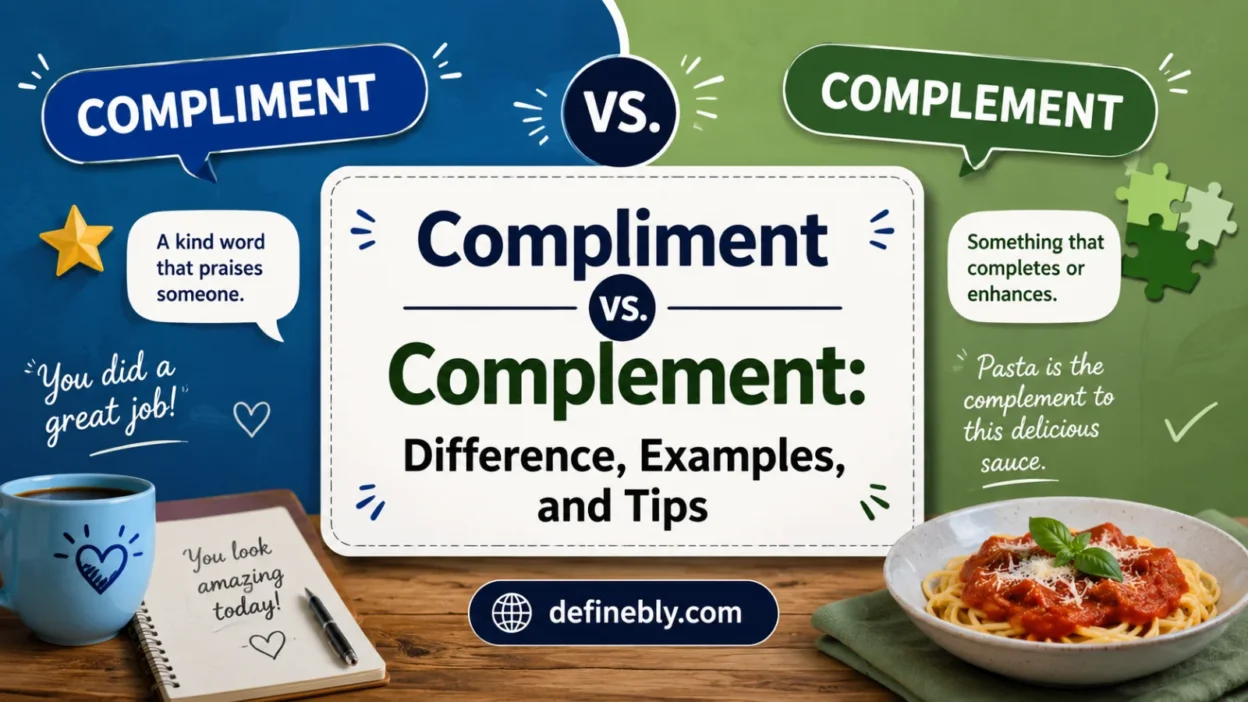
Compliment means praise.
Complement means something completes, improves, balances, or goes well with something else.
Correct:
- She gave me a compliment on my presentation.
- The blue scarf is a perfect complement to the dress.
The easiest rule is this: compliment praises; complement completes.
Quick Answer
Use compliment when someone says something kind, admiring, or approving.
Correct:
- That was a thoughtful compliment.
- I wanted to compliment you on your work.
Use complement when one thing completes, enhances, balances, or matches another thing well.
Correct:
- The sauce is a nice complement to the pasta.
- The sauce complements the pasta.
Quick test:
- If the word means praise, use compliment.
- If the word means complete, enhance, or go well with, use complement.
Why People Confuse Them
Compliment and complement are easy to confuse because they sound the same.
They also look almost identical. Only one vowel changes:
- compliment
- complement
The confusion grows because both words can be nouns and verbs.
Noun:
- She gave me a compliment.
- The rug is a perfect complement to the room.
Verb:
- She complimented my work.
- The rug complements the room.
The spelling changes the meaning, not the sound.
Key Differences At A Glance
| Context | Best Choice | Why |
|---|---|---|
| A kind or admiring comment | compliment | It means praise. |
| To praise someone | compliment | It works as a verb meaning to admire or approve. |
| Something that completes another thing | complement | It makes something feel complete. |
| Something that goes well with another thing | complement | It enhances or balances it. |
| Food, fashion, design, or color pairing | complement | It describes things that match well. |
| A polite remark about someone’s work | compliment | It describes approval or admiration. |
Meaning And Usage Difference
Compliment means praise, admiration, approval, or a kind remark.
Correct:
- Maya received a compliment on her new haircut.
- The teacher gave the class a compliment for its effort.
- That review was full of compliments.
- His comment sounded like a genuine compliment.
Compliment can also be a verb. It means to praise someone.
Correct:
- The manager complimented the team on its work.
- I complimented her on the clear design.
- Several customers complimented the staff.
- He complimented the chef on the meal.
Complement means something that completes, improves, balances, or fits well with something else.
Correct:
- The pillows are a good complement to the sofa.
- Her calm style is a strong complement to his bold approach.
- The lemon sauce is a perfect complement to the fish.
- The artwork is a nice complement to the room.
Complement can also be a verb. It means to complete, enhance, or go well with something.
Correct:
- The pillows complement the sofa.
- The colors complement each other.
- His technical skills complement her writing skills.
- The side dish complements the main course.
Tone, Context, And Grammar
Compliment is common in social, workplace, and personal contexts.
Common patterns:
- give a compliment
- receive a compliment
- pay someone a compliment
- compliment someone on something
- a sincere compliment
- a generous compliment
Examples:
- She gave me a sincere compliment.
- I want to compliment you on your patience.
- The client paid us a compliment after the meeting.
Use compliment when someone says something nice.
Complement is common in design, food, fashion, business, grammar, math, and general writing.
Common patterns:
- a perfect complement to
- complement each other
- complement the design
- complement the flavor
- complementary colors
- a full complement of staff
Examples:
- The necklace is a perfect complement to the outfit.
- The sweet sauce complements the spicy chicken.
- Their skills complement each other.
- The hotel has a full complement of staff today.
Use complement when one thing adds to, completes, balances, or improves another.
Which One Should You Use?
Use compliment if the sentence is about praise.
Ask:
- Is someone saying something nice?
- Is someone expressing admiration?
- Could I replace the word with praise?
Correct:
- I wanted to compliment you on your essay.
- Her compliment made my day.
- The coach complimented the team’s effort.
Use complement if the sentence is about completion, balance, fit, or improvement.
Ask:
- Does one thing complete another?
- Does one thing go well with another?
- Could I replace the word with enhance, match, or complete?
Correct:
- The lamp complements the room.
- The new feature is a useful complement to the app.
- Their strengths complement each other.
When One Choice Sounds Wrong
Use complement, not compliment, when something goes well with something else.
Incorrect:
- The shoes compliment your dress.
Correct:
- The shoes complement your dress.
The shoes are not saying something nice. They go well with the dress.
Use compliment, not complement, when someone gives praise.
Incorrect:
- He gave me a nice complement.
Correct:
- He gave me a nice compliment.
The sentence refers to a kind comment.
Use complimented, not complemented, when someone praised another person.
Incorrect:
- She complemented him on his speech.
Correct:
- She complimented him on his speech.
She praised him.
Use complemented, not complimented, when one thing improved or completed another.
Incorrect:
- The wine complimented the meal.
Correct:
- The wine complemented the meal.
The wine went well with the meal.
Common Mistakes And Quick Fixes
Using Compliment When You Mean Go Well With
Incorrect:
- The rug compliments the room.
- The sauce compliments the tacos.
- His skills compliment the team.
Correct:
- The rug complements the room.
- The sauce complements the tacos.
- His skills complement the team.
Quick fix:
If the word means matches, enhances, or goes well with, use complement.
Using Complement When You Mean Praise
Incorrect:
- I appreciate your kind complement.
- She gave me a complement after the meeting.
- The teacher complemented my essay.
Correct:
- I appreciate your kind compliment.
- She gave me a compliment after the meeting.
- The teacher complimented my essay.
Quick fix:
If the word means praise, use compliment.
Confusing Complimentary And Complementary
Complimentary usually means praising or free.
Correct:
- She wrote a complimentary review.
- The hotel offers complimentary breakfast.
Complementary means completing, matching, or working well together.
Correct:
- The two colors are complementary.
- Their skills are complementary.
Do not write complimentary colors if you mean colors that go well together. Use complementary colors.
Forgetting That Both Words Can Be Verbs
Both words can show action, but the actions are different.
Praise:
- The manager complimented the employee.
Complete or enhance:
- The new logo complemented the website.
Do not choose by part of speech alone. Choose by meaning.
Using The Wrong Word In Professional Writing
Incorrect:
- Thank you for your complement on my report.
Correct:
- Thank you for your compliment on my report.
Incorrect:
- This feature is a strong compliment to the product.
Correct:
- This feature is a strong complement to the product.
In emails, reports, product descriptions, and resumes, the wrong word can make the sentence look careless.
Everyday Examples
Compliment In Sentences
- She gave me a compliment after the meeting.
- I complimented him on his clear explanation.
- That was a generous compliment.
- The teacher complimented the class on its effort.
- I appreciate the compliment.
- His boss complimented his leadership.
- The customer left a compliment about the service.
- She smiled at the compliment.
Complement In Sentences
- The jacket complements your outfit.
- The spicy sauce complements the tacos.
- His calm style complements her bold approach.
- The artwork is a perfect complement to the room.
- The new feature complements the existing design.
- The salad is a fresh complement to the pasta.
- Their skills complement each other.
- The warm lighting complements the wood furniture.
Compliment And Complement In The Same Sentence
- I gave her a compliment because the scarf complemented her outfit.
- The chef received a compliment because the sauce complemented the meal.
- His manager complimented his work, and his skills complemented the team.
- The designer accepted the compliment and explained how the colors complemented each other.
- The customer left a compliment about the room, especially how the artwork complemented the décor.
Complement In Grammar
In grammar, a complement is a word or phrase that completes the meaning of another part of a sentence.
Example:
- She is a doctor.
In this sentence, a doctor completes the meaning of she is.
Another example:
- They elected him president.
In this sentence, president completes the meaning by telling what he became after the election.
This grammar meaning still connects to the main idea of complement: something completes something else.
Do not confuse this with compliment, which is always about praise or admiration.
Synonyms Or Closest Alternatives
Closest alternatives for compliment include:
- praise
- admiration
- kind remark
- approval
- flattering comment
Example:
- She gave me a compliment.
- She gave me praise.
Closest alternatives for complement include:
- match
- enhancement
- addition
- counterpart
- finishing touch
Example:
- The rug complements the room.
- The rug enhances the room.
These alternatives are not always exact, but they help test the meaning.
Quick Proofreading Checklist
Before choosing compliment or complement, ask these questions:
- Is someone saying something nice?
- Does the word mean praise or admiration?
- Does one thing complete another?
- Does one thing match, balance, or improve another?
- Am I writing about food, fashion, design, colors, or skills?
- Do I mean complimentary as in free?
- Do I mean complementary as in matching or working well together?
Use compliment for praise.
Use complement for completion, fit, balance, or enhancement.
Quick Memory Fix Or Rule Of Thumb
Use this simple rule:
Compliment = praise.
Complement = complete.
Memory trick:
Compliment has i, as in I praise you.
Complement has e, as in complete and enhance.
Examples:
- A compliment says something nice.
- A complement completes or improves something.
FAQs
What is the difference between compliment and complement?
Compliment means praise or a kind remark.
Complement means something that completes, improves, balances, or goes well with something else.
Examples:
- She gave me a compliment.
- The scarf is a perfect complement to the dress.
When should I use compliment?
Use compliment when the sentence is about praise, admiration, or a polite remark.
Example:
- I wanted to compliment you on your presentation.
The sentence means you wanted to praise someone.
When should I use complement?
Use complement when one thing completes, enhances, balances, or fits well with another.
Example:
- The sauce complements the pasta.
The sauce goes well with the pasta.
Can compliment be a verb?
Yes. Compliment can be a verb meaning to praise someone.
Example:
- The teacher complimented the student on her essay.
Can complement be a verb?
Yes. Complement can be a verb meaning to complete, enhance, or go well with something.
Example:
- The colors complement each other.
Is it “compliment your outfit” or “complement your outfit”?
It depends on the meaning.
If someone praises the outfit, use compliment.
Example:
- I want to compliment your outfit.
If something goes well with the outfit, use complement.
Example:
- Those shoes complement your outfit.
Is it complimentary or complementary?
Complimentary means praising or free.
Examples:
- a complimentary review
- complimentary breakfast
Complementary means matching, completing, or working well together.
Examples:
- complementary colors
- complementary skills
What does complement mean in grammar?
In grammar, a complement is a word or phrase that completes the meaning of part of a sentence.
Example:
- She became a lawyer.
The phrase a lawyer completes the meaning of became.
Do compliment and complement sound the same?
Yes. Compliment and complement are pronounced the same in standard English.
That is why they are easy to confuse in writing.
What is the easiest way to remember compliment vs. complement?
Remember this:
- Compliment praises.
- Complement completes.
If the word means something nice someone says, use compliment. If it means something completes or improves something else, use complement.
Conclusion
Use compliment when you mean praise or a kind comment.
Use complement when one thing completes, improves, balances, or goes well with another thing.
The easiest rule is simple: compliment praises; complement completes.