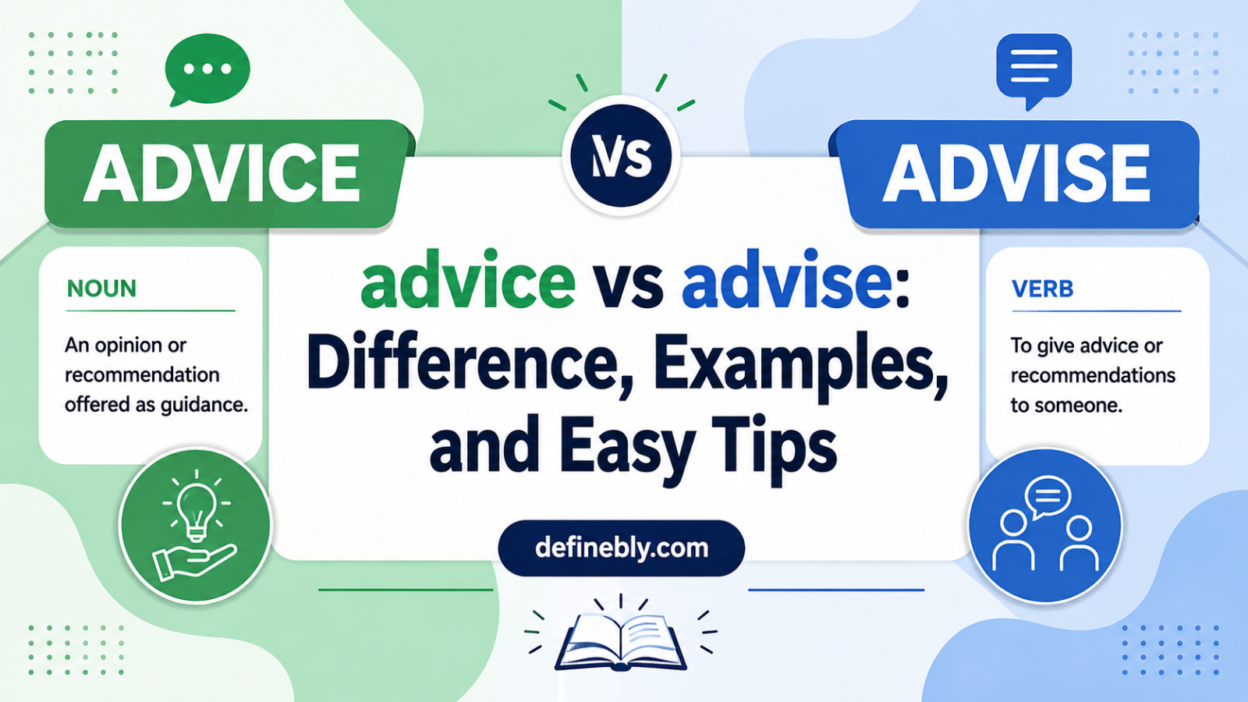
Advice is a noun. It means guidance, a suggestion, or a recommendation.
Advise is a verb. It means to give guidance, recommend something, or inform someone.
Correct:
- She gave me good advice.
- She advised me to save the receipt.
The easiest rule is this: advice is the thing; advise is the action.
Quick Answer
Use advice when the sentence names the guidance itself.
Correct:
- I need advice about buying a car.
- That was helpful advice.
- My teacher gave me advice about college applications.
- I followed your advice and called the office.
Use advise when the sentence describes the action of giving guidance, recommending, or informing.
Correct:
- Can you advise me on the next step?
- The doctor advised me to rest.
- The lawyer advised us before we signed.
- Please advise by Friday.
Quick test:
- If the sentence needs a noun, use advice.
- If the sentence needs a verb, use advise.
Why People Confuse Them
People confuse advice and advise because the words differ by only one letter.
They also belong to the same meaning family. Both are about guidance, suggestions, recommendations, and information.
The difference is grammar.
Advice names the guidance.
Example:
- I need advice.
Advise names the action of giving guidance.
Example:
- Please advise me.
They are also pronounced differently.
- Advice ends with an s sound.
- Advise ends with a z sound.
Think:
- advice = ad-VICE
- advise = ad-VIZE
Key Differences At A Glance
| Context | Best Choice | Why |
|---|---|---|
| A suggestion or recommendation | advice | It names the guidance. |
| Guidance someone gives or receives | advice | It works as a noun. |
| To give a suggestion | advise | It is an action verb. |
| To recommend a course of action | advise | It tells what someone does. |
| After words like good, bad, or helpful | advice | These words describe a noun. |
| After words like will, can, or please | advise | These words often need a verb. |
| One suggestion | a piece of advice | Advice is usually uncountable. |
Meaning And Usage Difference
Advice means guidance, a suggestion, a recommendation, or helpful information.
Correct:
- My counselor gave me advice about choosing classes.
- I asked my manager for advice before the interview.
- That was the best advice I received all year.
- Her financial advice helped me plan a budget.
In each sentence, advice is a thing someone gives, asks for, receives, takes, or follows.
Common phrases with advice include:
- good advice
- bad advice
- helpful advice
- legal advice
- medical advice
- career advice
- financial advice
- a piece of advice
Advise means to give advice, recommend an action, or inform someone.
Correct:
- The doctor advised me to drink more water.
- The teacher advised students to start early.
- The lawyer advised against signing too quickly.
- Please advise us of any changes.
In each sentence, advise shows an action.
Common phrases with advise include:
- advise a client
- advise students
- advise someone to wait
- advise against it
- advise us of a change
- please advise
Tone, Context, And Grammar
Advice is a noun. It can be described by adjectives.
Correct:
- good advice
- bad advice
- useful advice
- honest advice
- practical advice
It can also follow verbs such as give, need, take, ask for, and follow.
Correct:
- give advice
- need advice
- take advice
- ask for advice
- follow advice
Advice is usually uncountable in standard English. That means you normally do not say an advice or advices.
Incorrect:
- She gave me an advice.
- I received many advices.
Correct:
- She gave me a piece of advice.
- I received a lot of advice.
- She gave me two pieces of advice.
Advise is a verb, so it changes form.
Correct forms:
- advise
- advises
- advised
- advising
Examples:
- I advise you to check the date.
- The coach advises players to stretch.
- The lawyer advised us to wait.
- She is advising the new team.
Which One Should You Use?
Use advice if the sentence needs a thing, idea, suggestion, or recommendation.
Ask:
- Can I put good, bad, helpful, or useful before it?
- Can someone give it, take it, follow it, or ask for it?
- Does the sentence refer to guidance itself?
Correct:
- That was helpful advice.
- I need advice about my resume.
- He ignored my advice.
- Thank you for your advice.
Use advise if the sentence needs an action.
Ask:
- Can someone do this?
- Does the word mean recommend, guide, or inform?
- Can it follow can, will, please, or should?
Correct:
- Can you advise me?
- I will advise the team.
- Please advise on the next step.
- The doctor may advise rest.
When One Choice Sounds Wrong
Use advice, not advise, after possessive words such as my, your, his, her, our, and their when the sentence means guidance.
Incorrect:
- Thank you for your advise.
Correct:
- Thank you for your advice.
Use advise, not advice, when asking someone to give guidance.
Incorrect:
- Can you advice me?
Correct:
- Can you advise me?
Use a piece of advice, not an advice, for one suggestion.
Incorrect:
- She gave me an advice.
Correct:
- She gave me a piece of advice.
Use a lot of advice, not many advices.
Incorrect:
- I received many advices.
Correct:
- I received a lot of advice.
Use please advise, not please advice, in emails.
Incorrect:
- Please advice by tomorrow.
Correct:
- Please advise by tomorrow.
Common Mistakes And Quick Fixes
Using Advise As A Noun
Incorrect:
- I appreciate your advise.
- That was great advise.
- She gave me helpful advise.
- I need some advise.
Correct:
- I appreciate your advice.
- That was great advice.
- She gave me helpful advice.
- I need some advice.
Quick fix:
If the word means guidance itself, use advice.
Using Advice As A Verb
Incorrect:
- Please advice me.
- The teacher advice us to study.
- The doctor advice rest.
- I will advice the group.
Correct:
- Please advise me.
- The teacher advised us to study.
- The doctor advised rest.
- I will advise the group.
Quick fix:
If the word means to recommend or give guidance, use advise.
Writing An Advice
Incorrect:
- Let me give you an advice.
- That is an advice I will remember.
Correct:
- Let me give you a piece of advice.
- That is advice I will remember.
Quick fix:
Use a piece of advice for one suggestion.
Writing Advices
Incorrect:
- My parents gave me many advices.
- I wrote down three advices from the coach.
Correct:
- My parents gave me a lot of advice.
- I wrote down three pieces of advice from the coach.
Quick fix:
Use advice as a mass noun. Use pieces of advice when counting suggestions.
Misusing Please Advise
Incorrect:
- Please advice if you need anything.
- Please advice on the next step.
Correct:
- Please advise if you need anything.
- Please advise on the next step.
Please advise is a formal workplace phrase. It means please tell me what to do, please respond, or please give guidance.
Everyday Examples
Advice In Sentences
- I need advice about buying a car.
- My uncle gave me useful advice before the interview.
- That was the best advice I received.
- I followed your advice and called the office.
- She asked for advice about her college essay.
- The website offers basic travel advice.
- A good piece of advice can save time.
- His advice helped me avoid a mistake.
Advise In Sentences
- My uncle advised me to compare prices first.
- The counselor advised her to apply early.
- Please advise us before Friday.
- The coach advises players to stretch before practice.
- The doctor advised against heavy exercise.
- The manager advised the team to keep records.
- I would advise you to save a copy.
- The school will advise parents of any schedule changes.
Advice And Advise In The Same Sentence
- My teacher’s advice was helpful, and she advised me to revise the introduction.
- I asked for advice, and the lawyer advised me not to sign yet.
- Her advice saved time because she advised us to prepare early.
- The doctor gave clear advice and advised rest for two days.
- I appreciate your advice, and I hope you can advise me again.
Please Advise In Emails
Please advise is common in business emails, customer service, and formal workplace messages.
It means:
- Please tell me what to do.
- Please give your recommendation.
- Please respond with guidance.
- Please inform me of the next step.
Correct:
- Please advise on the next step.
- Please advise whether the report is approved.
- Please advise if you need any changes.
- Please advise us of your decision by Friday.
Do not write please advice.
Incorrect:
- Please advice on the next step.
Correct:
- Please advise on the next step.
In more natural everyday writing, you can often replace please advise with a clearer phrase.
Formal:
- Please advise on the next step.
Clearer:
- Please let me know the next step.
Pronunciation Difference
Advice and advise do not sound exactly the same in careful speech.
Advice ends with an s sound.
- ad-VICE
Advise ends with a z sound.
- ad-VIZE
This pronunciation difference matches the grammar difference.
- Advice = noun
- Advise = verb
Memory examples:
- Your advice was nice.
- I advise you to revise.
Synonyms Or Closest Alternatives
Closest alternatives for advice include:
- guidance
- suggestion
- recommendation
- counsel
- tip
Examples:
- I need advice.
- I need guidance.
- That was helpful advice.
- That was a helpful suggestion.
Closest alternatives for advise include:
- recommend
- suggest
- guide
- inform
- counsel
- warn
Examples:
- They advised me to wait.
- They recommended that I wait.
- Please advise us of any changes.
- Please inform us of any changes.
These alternatives are not always exact, but they help test whether the sentence needs a noun or a verb.
Quick Proofreading Checklist
Before choosing advice or advise, ask these questions:
- Does the sentence need a noun?
- Does the word mean guidance or a suggestion?
- Could good, bad, helpful, or useful describe it?
- Does the sentence need a verb?
- Does the word mean recommend, guide, or inform?
- Does the phrase say please advise?
- Did I write an advice or advices by mistake?
- Does the word sound like ad-VICE or ad-VIZE?
Use advice for the guidance.
Use advise for the action of giving guidance.
Quick Memory Fix Or Rule Of Thumb
Use this simple rule:
Advice = noun.
Advise = verb.
Memory trick:
Advice has c, like counsel.
Advise has s, like suggest.
Examples:
- I need advice.
- Can you advise me?
Another easy rule:
Advice is what you get. Advise is what someone does.
FAQs
What is the difference between advice and advise?
Advice is a noun. It means guidance, a suggestion, or a recommendation.
Advise is a verb. It means to give guidance, recommend, or inform someone.
Examples:
- I need advice.
- Can you advise me?
When should I use advice?
Use advice when the sentence names the guidance itself.
Examples:
- She gave me good advice.
- I followed your advice.
- That was helpful advice.
When should I use advise?
Use advise when the sentence needs an action meaning to recommend, guide, or inform.
Examples:
- I advise you to wait.
- The doctor advised rest.
- Please advise us by Friday.
Is it thank you for your advice or advise?
The correct phrase is thank you for your advice.
Correct:
- Thank you for your advice.
The sentence refers to the guidance, so it needs the noun advice.
Is it please advise or please advice?
The correct phrase is please advise.
Correct:
- Please advise on the next step.
The sentence asks someone to give guidance, so it needs the verb advise.
Can I say an advice?
No. In standard English, an advice is incorrect.
Incorrect:
- She gave me an advice.
Correct:
- She gave me a piece of advice.
Can advice be plural?
Advice is usually uncountable, so do not write advices in standard everyday English.
Incorrect:
- I received many advices.
Correct:
- I received a lot of advice.
- I received several pieces of advice.
Is advise a noun?
No. Advise is a verb.
Correct:
- I will advise the team.
Use advice when you need the noun.
Correct:
- I gave the team advice.
What is the difference between advise and advisor?
Advise is the verb.
Example:
- She will advise the students.
Advisor or adviser is the person who gives advice.
Example:
- She is my academic advisor.
How do you pronounce advice and advise?
Advice ends with an s sound: ad-VICE.
Advise ends with a z sound: ad-VIZE.
This sound difference can help you remember that advice is the noun and advise is the verb.
Conclusion
Use advice when you mean guidance, a suggestion, or a recommendation.
Use advise when you mean to give guidance, recommend, or inform someone.
The easiest rule is simple: advice is the thing; advise is the action.