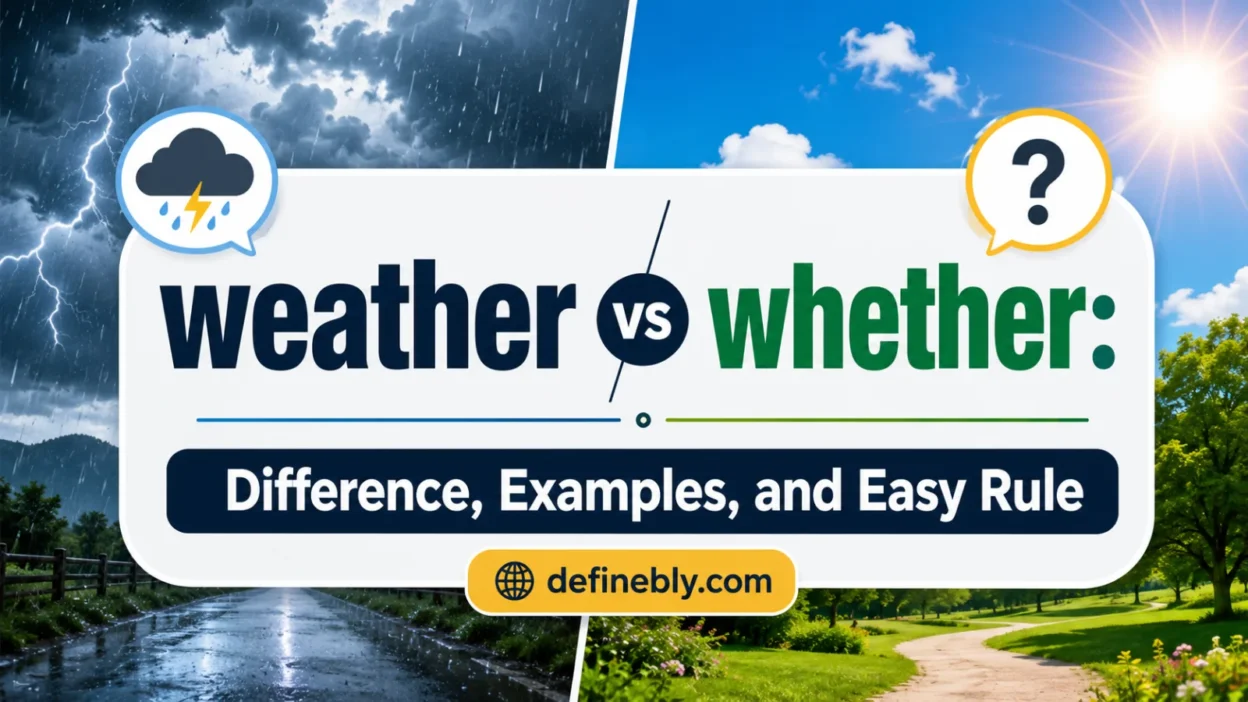
Weather is about outdoor conditions such as rain, sun, wind, snow, heat, and storms.
Whether is about a choice, doubt, question, or possibility.
Correct:
- The weather is sunny today.
- I do not know whether I can go.
The easiest rule is this: weather is sky; whether is choice.
Quick Answer
Use weather when talking about the condition of the air and sky.
Correct:
- The weather looks bad.
- We checked the weather before leaving.
- Bad weather delayed the flight.
- The weather forecast says it may snow.
Use whether when the sentence involves uncertainty, alternatives, or a decision.
Correct:
- I wonder whether the flight will leave on time.
- We need to decide whether to drive or fly.
- Let me know whether you need a ride.
- She asked whether the office was open.
Quick test:
- If the sentence is about rain, sun, wind, snow, storms, or forecasts, use weather.
- If the sentence is about a choice, doubt, or possibility, use whether.
Why People Confuse Them
Weather and whether are homophones.
Homophones sound the same but have different spellings and meanings.
When spoken aloud, weather and whether usually sound identical. In writing, the spelling tells the reader which meaning you want.
Compare:
- The weather looks bad.
- I wonder whether the flight will leave on time.
The first sentence is about outdoor conditions.
The second sentence is about uncertainty.
Because both words sound the same, reading aloud may not catch the mistake. You need to check the meaning.
Key Differences At A Glance
| Context | Best Choice | Why |
|---|---|---|
| Rain, snow, heat, wind, or storms | weather | It refers to atmospheric conditions. |
| A forecast or outdoor conditions | weather | It describes what is happening outside. |
| To survive or endure something hard | weather | It can work as a verb. |
| A choice between options | whether | It introduces alternatives. |
| Doubt or uncertainty | whether | It shows that something is unknown. |
| The phrase or not follows | whether | The standard phrase is whether or not. |
| You can replace it with if | whether | The sentence likely involves uncertainty. |
Meaning And Usage Difference
Weather is usually a noun. It refers to the condition of the atmosphere.
Correct:
- Bad weather delayed the game.
- The weather changed quickly.
- We stayed home because of the cold weather.
- This weather is perfect for hiking.
Common weather words include:
- rain
- snow
- wind
- heat
- humidity
- storms
- sunshine
- temperature
- forecast
Weather can also be a verb. As a verb, it means to survive, endure, or come through something difficult.
Correct:
- The company weathered a difficult year.
- The team weathered several problems during the project.
- The old fence has weathered many storms.
- They managed to weather the crisis.
Whether is a conjunction. It introduces a choice, doubt, indirect question, or possibility.
Correct:
- She asked whether we needed help.
- We have to decide whether to drive or fly.
- I am not sure whether he called.
- Please check whether the store is open.
In each sentence, whether introduces something unknown, possible, or undecided.
Tone, Context, And Grammar
Weather is most often a noun in everyday writing.
Common patterns:
- bad weather
- cold weather
- warm weather
- stormy weather
- weather forecast
- weather report
- weather app
- weather warning
Examples:
- The weather forecast predicts rain.
- We canceled the picnic because of bad weather.
- Check the weather app before the hike.
As a verb, weather often appears in figurative phrases.
Common patterns:
- weather the storm
- weather a crisis
- weather a difficult season
- weather the pressure
Examples:
- The business can weather the storm.
- She helped the team weather a stressful month.
Whether appears when a sentence involves uncertainty or alternatives.
Common patterns:
- whether or not
- whether to go
- whether it works
- whether we should wait
- whether he knows
- whether this is correct
Examples:
- I am not sure whether he knows.
- They asked whether the office was open.
- We need to choose whether to stay or leave.
Which One Should You Use?
Use weather if the sentence is about outdoor conditions.
Ask:
- Is this about rain?
- Is this about sun?
- Is this about wind?
- Is this about heat, snow, storms, or forecasts?
Correct:
- The weather is getting colder.
- The weather report says rain is likely.
- We need better weather for the outdoor event.
Use weather if the sentence means to endure or survive something difficult.
Correct:
- The company can weather the downturn.
- The team weathered early setbacks.
Use whether if the sentence is about choice or uncertainty.
Ask:
- Is there a decision?
- Is there doubt?
- Are there two or more possibilities?
- Could if fit the sentence?
Correct:
- I do not know whether she is coming.
- We are deciding whether to rent or buy.
- Tell me whether you agree.
Use whether in the phrase whether or not.
Correct:
- Let me know whether or not you can attend.
- We will leave at noon whether or not it rains.
When One Choice Sounds Wrong
Use whether, not weather, for uncertainty.
Incorrect:
- I do not know weather I can come.
Correct:
- I do not know whether I can come.
The sentence is about doubt, not the sky.
Use weather, not whether, for outdoor conditions.
Incorrect:
- The whether is cold today.
Correct:
- The weather is cold today.
The sentence is about temperature and outdoor conditions.
Use whether, not weather, in whether or not.
Incorrect:
- Tell me weather or not you agree.
Correct:
- Tell me whether or not you agree.
The phrase is about a choice.
Use weather, not whether, in weather reports and forecasts.
Incorrect:
- The whether forecast says it will rain.
Correct:
- The weather forecast says it will rain.
A forecast is about outdoor conditions.
Common Mistakes And Quick Fixes
Using Weather When You Mean Whether
Incorrect:
- I wonder weather the meeting is still happening.
- Please tell me weather you need help.
- We need to decide weather to stay or leave.
- I am not sure weather this works.
Correct:
- I wonder whether the meeting is still happening.
- Please tell me whether you need help.
- We need to decide whether to stay or leave.
- I am not sure whether this works.
Quick fix:
If the sentence involves a question, doubt, or decision, use whether.
Using Whether When You Mean Weather
Incorrect:
- The whether was perfect for a picnic.
- Bad whether delayed the game.
- The whether app says it will snow.
- We stayed home because of the whether.
Correct:
- The weather was perfect for a picnic.
- Bad weather delayed the game.
- The weather app says it will snow.
- We stayed home because of the weather.
Quick fix:
If the sentence is about outdoor conditions, use weather.
Writing Weather Or Not Instead Of Whether Or Not
Incorrect:
- Tell me weather or not you can come.
- I do not know weather or not she agrees.
- We need to decide weather or not to continue.
Correct:
- Tell me whether or not you can come.
- I do not know whether or not she agrees.
- We need to decide whether or not to continue.
Quick fix:
If the phrase means if or if not, use whether or not.
Confusing Weather With Wether
Wether is a rare word for a castrated male sheep or goat.
It is not the correct spelling when you mean outdoor conditions or choice.
Incorrect:
- The wether is nice today.
- I do not know wether I can go.
Correct:
- The weather is nice today.
- I do not know whether I can go.
Most everyday writing needs weather or whether, not wether.
Forgetting Weather As A Verb
Weather can mean to endure or survive.
Correct:
- The company weathered the crisis.
- The hikers weathered the storm.
- The team can weather the pressure.
Do not use whether for this meaning.
Incorrect:
- The company whethered the crisis.
Correct:
- The company weathered the crisis.
Whether Vs. If
Whether and if can sometimes overlap.
Casual:
- I do not know if she is coming.
More precise:
- I do not know whether she is coming.
Use whether when the sentence clearly involves alternatives.
Correct:
- We need to decide whether to drive or fly.
- She asked whether we wanted coffee or tea.
- Tell me whether you agree or disagree.
- I cannot decide whether to accept or decline.
Use if for conditions.
Correct:
- We will go if it stops raining.
- Call me if you need help.
- I will join if the meeting ends early.
Quick difference:
- Whether = which possibility?
- If = under what condition?
Everyday Examples
Weather In Sentences
- The weather was perfect for a picnic.
- We stayed home because of the bad weather.
- The weather forecast says snow is possible.
- Check the weather before you leave.
- Warm weather always puts me in a better mood.
- The game was postponed because of severe weather.
- The company weathered several problems during the project.
- The old sign has weathered years of rain and sun.
Whether In Sentences
- I am not sure whether the picnic is still happening.
- Please check whether the store is open.
- I cannot decide whether to call or email.
- Let me know whether you need a ride.
- We need to know whether the file is ready.
- She asked whether I wanted more coffee.
- Tell me whether or not you can attend.
- The manager is deciding whether to approve the request.
Weather And Whether In The Same Sentence
- I do not know whether the bad weather will delay the flight.
- Check the weather, then decide whether we should drive.
- The weather looks good, but I am not sure whether the park is open.
- We need to know whether the team can weather another delay.
- The weather report will help us decide whether to cancel the event.
Synonyms Or Closest Alternatives
Closest alternatives for weather include:
- atmospheric conditions
- outdoor conditions
- forecast
- climate conditions
Examples:
- The weather is changing.
- The outdoor conditions are changing.
- Check the weather before leaving.
- Check the forecast before leaving.
Closest alternatives for whether include:
- if
- whether or not
- if it is true that
- which option
Examples:
- I wonder whether he knows.
- I wonder if he knows.
- We must decide whether to stay or leave.
- We must decide which option to choose: stay or leave.
These alternatives are not always exact, but they help test the meaning.
Quick Proofreading Checklist
Before choosing weather or whether, ask these questions:
- Is the sentence about rain, sun, wind, snow, heat, or storms?
- Is the sentence about a forecast or outdoor conditions?
- Does the word mean endure or survive?
- Is the sentence about a choice?
- Is the sentence about doubt or uncertainty?
- Could if fit the meaning?
- Does or not appear after the word?
- Did I accidentally write wether?
Use weather for the sky, forecasts, outdoor conditions, or enduring hardship.
Use whether for choices, doubts, indirect questions, and possibilities.
Quick Memory Fix Or Rule Of Thumb
Use this simple rule:
Weather = sky.
Whether = choice.
Examples:
- The weather is rainy.
- I wonder whether it will rain.
Another trick:
Weather has a, like air.
Whether has whether or not, which signals a choice.
If the sentence is about the sky, use weather. If it is about a choice or uncertainty, use whether.
FAQs
What is the difference between weather and whether?
Weather means outdoor or atmospheric conditions, such as rain, sun, wind, snow, heat, or storms.
Whether introduces a choice, doubt, question, or possibility.
Examples:
- The weather is sunny.
- I do not know whether I can go.
When should I use weather?
Use weather when talking about outdoor conditions, forecasts, or the atmosphere.
Examples:
- The weather is cold today.
- The weather forecast predicts rain.
You can also use weather as a verb meaning to endure or survive.
Example:
- The company weathered a hard year.
When should I use whether?
Use whether when the sentence involves a choice, doubt, indirect question, or possibility.
Examples:
- I am not sure whether she is coming.
- We need to decide whether to stay or leave.
Is it weather or not or whether or not?
The correct phrase is whether or not when talking about choice, doubt, or possibility.
Correct:
- Tell me whether or not you can attend.
Use weather only when the sentence is literally about outdoor conditions.
Can whether mean if?
Sometimes, yes. Whether can often mean if in indirect questions.
Example:
- I do not know whether she called.
- I do not know if she called.
Use whether when the sentence clearly presents choices or alternatives.
What does weather the storm mean?
Weather the storm means to survive or endure a difficult situation.
Example:
- The company managed to weather the storm.
The phrase can refer to a real storm or a figurative challenge.
Is weather a verb?
Yes. Weather can be a verb meaning to endure, survive, or be affected by exposure.
Examples:
- The team weathered the crisis.
- The paint has weathered over time.
Is whether a noun?
No. Whether is not a noun in everyday English.
It is a conjunction used for choices, doubts, indirect questions, and possibilities.
Example:
- She asked whether we needed help.
Is wether the same as weather or whether?
No. Wether is a rare word for a castrated male sheep or goat.
It is not the right word for outdoor conditions or choices.
Use weather for the sky. Use whether for choices.
Do weather and whether sound the same?
Yes. In standard speech, weather and whether are usually pronounced the same.
That is why the mistake is common in writing. Use the meaning test instead of relying on sound.
Conclusion
Use weather for rain, sun, wind, snow, heat, storms, forecasts, or enduring something difficult.
Use whether for choices, doubts, indirect questions, and possibilities.
The easiest rule is simple: weather is sky; whether is choice.