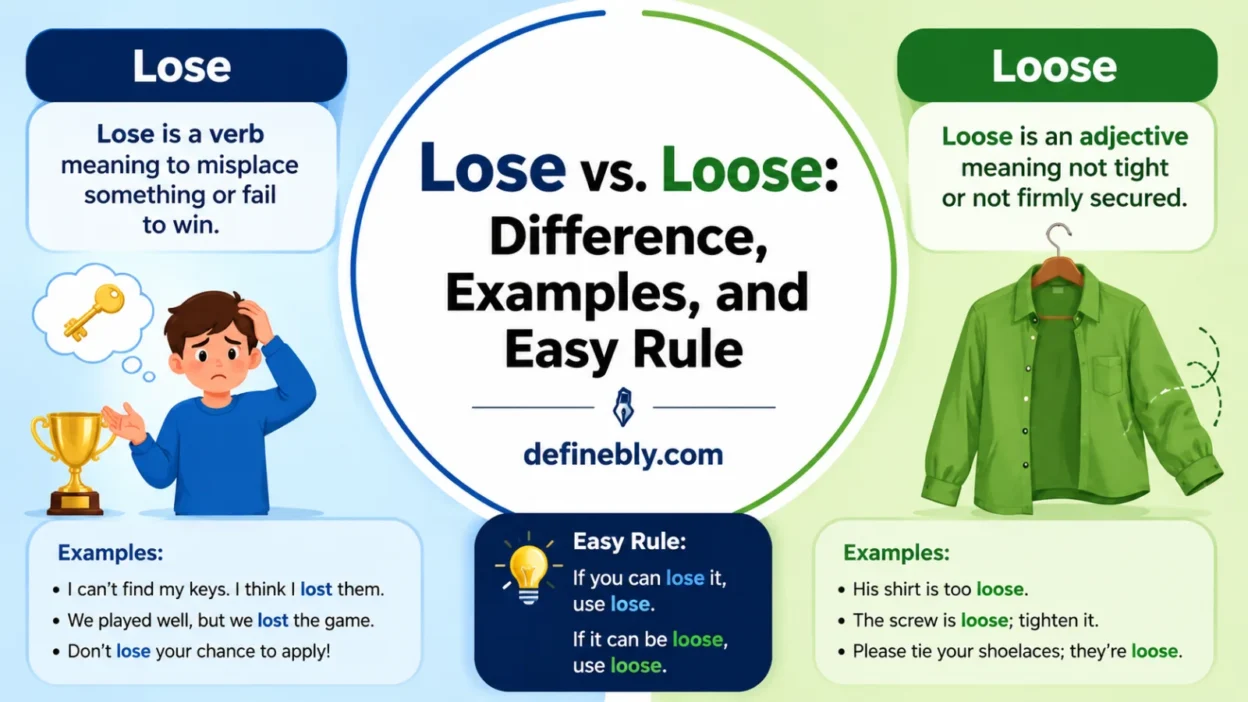
Lose means to misplace something, fail to keep something, fail to win, or reduce something.
Loose means not tight, not secure, not fixed, or free.
Correct:
- Do not lose your keys.
- This screw is loose.
The easiest rule is this: lose means gone; loose means not tight.
Quick Answer
Use lose when the sentence is about something missing, gone, not kept, not won, or reduced.
Correct:
- I do not want to lose my phone.
- Our team might lose the game.
- She wants to lose weight.
- Try not to lose focus.
Use loose when the sentence describes something not tight, not secure, not firmly attached, or free.
Correct:
- This shirt is too loose.
- The dog got loose.
- The shelf has a loose bracket.
- My tooth is loose.
Quick pronunciation tip:
- Lose rhymes with choose.
- Loose rhymes with goose.
Why People Confuse Them
People confuse lose and loose because the spellings differ by only one letter.
That extra o changes both the meaning and the pronunciation.
Compare:
- I do not want to lose my phone.
- My phone case is loose.
The first sentence means the phone might be misplaced.
The second sentence means the case is not tight.
The mistake is common in fast typing because both words look similar at a glance. Spellcheck may not always help if the wrong word still creates a grammatical sentence.
Key Differences At A Glance
| Context | Best Choice | Why |
|---|---|---|
| To misplace something | lose | It means no longer have or cannot find. |
| To fail to win | lose | It is used for games, contests, and arguments. |
| To reduce weight | lose | The correct phrase is lose weight. |
| To stop having patience, focus, or hope | lose | It means fail to keep. |
| Not tight | loose | It describes fit or attachment. |
| Not firmly fixed | loose | It describes something unstable or unsecured. |
| Free or not contained | loose | It can describe something that has gotten free. |
Meaning And Usage Difference
Lose is usually a verb. It shows an action or change.
It can mean to misplace something.
Correct:
- I always lose my earbuds.
- Please do not lose the receipt.
- Did you lose your wallet?
- I might lose the file if I do not save it.
It can also mean to fail to win.
Correct:
- Our team did not lose the final game.
- She hates to lose an argument.
- They could lose the championship.
- No one wants to lose the bet.
It can also mean to stop having or reduce something.
Correct:
- I lose focus when the room is noisy.
- Try not to lose your patience.
- He wants to lose weight.
- The company may lose money this quarter.
Loose is usually an adjective. It describes a noun.
It can mean not tight.
Correct:
- These jeans are too loose now.
- He wore a loose hoodie.
- The bandage should not be too loose.
- The lid feels loose.
It can also mean not secure or not firmly attached.
Correct:
- The door handle is loose.
- The shelf has a loose bracket.
- The bike has a loose chain.
- My tooth is loose.
It can also mean free or not contained.
Correct:
- The dog got loose during the storm.
- The horse broke loose from the fence.
- The papers came loose from the folder.
- The suspect is still on the loose.
Tone, Context, And Grammar
Lose is usually a verb, so it often follows a subject and shows what someone does or what happens.
Common patterns:
- lose a wallet
- lose a game
- lose weight
- lose focus
- lose money
- lose patience
- lose track
- lose hope
- lose your temper
Examples:
- I might lose my ticket.
- We cannot lose another customer.
- Do not lose track of the deadline.
- She did not lose her confidence.
Loose is usually an adjective, so it often comes before a noun or after a linking verb such as is, feels, looks, or seems.
Common patterns:
- loose shirt
- loose screw
- loose wire
- loose tooth
- loose pants
- loose rules
- loose change
- on the loose
Examples:
- The screw is loose.
- These pants feel loose.
- The puppy is on the loose.
- Check for loose wires behind the desk.
Loose can also be a verb meaning to release or set free, but this use is uncommon in everyday writing.
Example:
- The workers loosed the ropes.
Most readers will rarely need that use. In normal writing, loose usually describes something.
Which One Should You Use?
Use lose if the sentence is about misplacing, failing to keep, failing to win, or reducing something.
Ask:
- Can I replace it with misplace?
- Can I replace it with fail to win?
- Can I replace it with no longer have?
- Can I replace it with reduce?
Correct:
- I hope we do not lose the file.
- The team may lose tonight.
- She does not want to lose her place in line.
- He wants to lose ten pounds.
Use loose if the sentence is about something not tight, not fixed, not controlled, or free.
Ask:
- Can I replace it with not tight?
- Can I replace it with not secure?
- Can I replace it with free?
Correct:
- The lid is loose.
- My tooth feels loose.
- The dog got loose.
- The shirt is too loose.
When One Choice Sounds Wrong
Use lose, not loose, when the sentence means misplace.
Incorrect:
- I do not want to loose my phone.
Correct:
- I do not want to lose my phone.
Use lose, not loose, in the phrase lose weight.
Incorrect:
- He wants to loose weight.
Correct:
- He wants to lose weight.
Use loose, not lose, when something is not tight.
Incorrect:
- This shirt is too lose.
Correct:
- This shirt is too loose.
Use loose, not lose, for teeth, wires, screws, handles, and clothing that are not firmly fixed or fitted.
Incorrect:
- My tooth is lose.
Correct:
- My tooth is loose.
Common Mistakes And Quick Fixes
Writing Loose When You Mean Lose
Incorrect:
- Do not loose your keys.
- I might loose my job.
- We cannot loose this game.
- Try not to loose hope.
Correct:
- Do not lose your keys.
- I might lose my job.
- We cannot lose this game.
- Try not to lose hope.
Quick fix:
If the meaning is misplace, fail to win, or fail to keep, use lose.
Writing Lose When You Mean Loose
Incorrect:
- This wire is lose.
- These shoes are too lose.
- The screw came lose.
- The dog is on the lose.
Correct:
- This wire is loose.
- These shoes are too loose.
- The screw came loose.
- The dog is on the loose.
Quick fix:
If the meaning is not tight, not secure, or free, use loose.
Writing Loose Weight Instead Of Lose Weight
Incorrect:
- I want to loose weight.
Correct:
- I want to lose weight.
The phrase means reduce weight, so lose is correct.
Confusing Losing And Loosening
Losing means misplacing, failing to win, or no longer keeping something.
Correct:
- We are losing time.
- The team is losing by five points.
- I keep losing my charger.
Loosening means making something less tight.
Correct:
- He is loosening the bolt.
- The knot is loosening.
- She is loosening her shoelaces.
Do not use loosing when you mean losing.
Incorrect:
- We are loosing the game.
Correct:
- We are losing the game.
Forgetting The Pronunciation Difference
Lose sounds like looz.
Correct:
- Do not lose the receipt.
Loose sounds like loos.
Correct:
- The receipt came loose from the folder.
If the word sounds like choose, use lose. If it sounds like goose, use loose.
Everyday Examples
Lose In Sentences
- Please do not lose the receipt.
- I always lose my earbuds.
- Our team did not lose the final game.
- I lose focus when the room is noisy.
- Try not to lose your patience.
- She wants to lose weight before the race.
- The company cannot afford to lose customers.
- He did not lose confidence after the mistake.
- I do not want to lose my place in line.
- We might lose power during the storm.
Loose In Sentences
- The dog got loose during the storm.
- These jeans are too loose now.
- The shelf has a loose bracket.
- The baby has a loose tooth.
- The handle feels loose.
- A loose wire caused the problem.
- He wore a loose sweater.
- The papers came loose from the binder.
- Keep loose change in the jar.
- The horse is on the loose.
Lose And Loose In The Same Sentence
- Do not lose the screw; it is already loose.
- I might lose my ring because it feels loose.
- The dog got loose, and we were afraid we would lose him.
- She wants to lose weight, so her old jeans are getting loose.
- Do not lose track of the loose wires behind the desk.
Synonyms Or Closest Alternatives
Closest alternatives for lose include:
- misplace
- fail to win
- no longer have
- drop
- give up
- surrender
- reduce
Examples:
- I might lose my ticket.
- I might misplace my ticket.
- They could lose the game.
- They could fail to win the game.
Closest alternatives for loose include:
- not tight
- slack
- unfastened
- unsecured
- free
- detached
- not fixed
Examples:
- The rope is loose.
- The rope is slack.
- The handle is loose.
- The handle is not secure.
These alternatives are not always exact, but they help test the meaning.
Quick Proofreading Checklist
Before choosing lose or loose, ask these questions:
- Does the sentence mean misplace?
- Does it mean fail to win?
- Does it mean no longer have?
- Does it mean reduce, as in lose weight?
- Does it describe something not tight?
- Does it describe something not secure?
- Does it mean something has become free?
- Does the word rhyme with choose or goose?
Use lose for actions involving loss.
Use loose for conditions involving looseness.
Quick Memory Fix Or Rule Of Thumb
Use this simple rule:
Lose = gone.
Loose = not tight.
Memory trick:
Lose has lost an o.
Loose has extra room for an extra o.
Examples:
- Do not lose your keys.
- These pants are loose.
If something is missing, gone, not won, or reduced, use lose.
If something has extra room or is not secure, use loose.
FAQs
What is the difference between lose and loose?
Lose means to misplace something, fail to keep something, fail to win, or reduce something.
Loose means not tight, not secure, not fixed, or free.
Examples:
- Do not lose your wallet.
- This button is loose.
When should I use lose?
Use lose when the sentence is about misplacing, failing to keep, failing to win, or reducing something.
Examples:
- I might lose my keys.
- We do not want to lose the game.
- She wants to lose weight.
When should I use loose?
Use loose when describing something not tight, not secure, not firmly attached, or free.
Examples:
- The screw is loose.
- The dog got loose.
- These pants are too loose.
Is it lose weight or loose weight?
The correct phrase is lose weight.
Correct:
- He wants to lose weight.
Use lose because the meaning is to reduce weight.
Is it loose tooth or lose tooth?
The correct phrase is loose tooth.
Correct:
- The child has a loose tooth.
Use loose because the tooth is not firmly fixed.
Is it lose my mind or loose my mind?
The correct phrase is lose my mind.
Correct:
- I thought I was going to lose my mind.
Use lose because the phrase means to lose control, patience, or sanity.
Is it loose or lose a game?
The correct phrase is lose a game.
Correct:
- Our team might lose the game.
Use lose because it means fail to win.
Can loose be a verb?
Yes, loose can be a verb meaning to release or set free.
Example:
- The workers loosed the ropes.
This use is uncommon in everyday writing. Most of the time, loose is an adjective.
How do you pronounce lose and loose?
Lose rhymes with choose.
Loose rhymes with goose.
That pronunciation difference can help you remember the spelling.
What is the easiest way to remember lose vs. loose?
Remember this:
- Lose has lost an o.
- Loose has extra room for an extra o.
Use lose when something is gone, missing, reduced, or not won.
Use loose when something is not tight, not secure, or free.
Conclusion
Use lose when you mean misplace, fail to keep, fail to win, or reduce.
Use loose when you mean not tight, not secure, not fixed, or free.
The easiest rule is this: lose has lost an “o,” and loose has extra room for an extra “o.”