Then vs. Than: Difference, Examples, Rules, and Tips
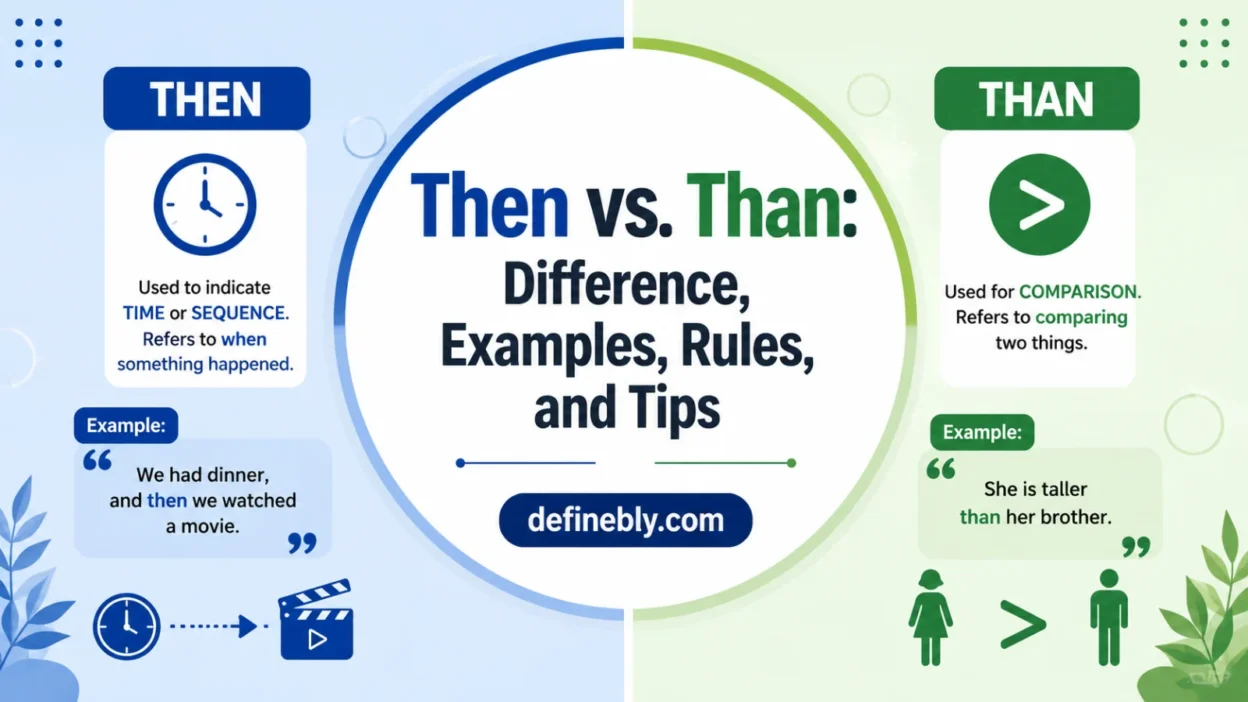
Then refers to time, sequence, or consequence. Than introduces a comparison. Although the words look and sound similar, they have different meanings and cannot be used interchangeably.
- Then: We ate dinner, then watched a movie.
- Than: This movie is better than the last one.
The easiest way to remember the difference is simple: then is for time and order; than is for comparison.
Quick Answer: Then vs. Than
Use then when you mean at that time, next, or in that case.
Examples:
- I lived in Chicago back then.
- Save the file, then close the app.
- If you are ready, then we can start.
Use than when comparing people, things, amounts, actions, or ideas.
Examples:
- This route is faster than the highway.
- She is taller than her brother.
- I would rather walk than wait.
Quick test: If after that fits the sentence, you probably need then. If the sentence makes a comparison, you need than.
Then vs. Than: Key Differences
| Context | Correct Word | Example |
|---|---|---|
| Time | Then | I was younger then. |
| Sequence or order | Then | We ate, then left. |
| Consequence | Then | If it rains, then we will stay home. |
| Comparison | Than | This book is better than that one. |
| Amount or degree | Than | The repair cost less than $100. |
| Comparing choices | Than | I would rather walk than drive. |
What Does Then Mean?
Then is commonly used as an adverb to describe when something happened, what happens next, or what follows from a condition.
1. Then Means At That Time
Use then to refer to a particular time in the past, present, or future.
Examples:
- I lived in Denver back then.
- We did not have smartphones then.
- The office was smaller then.
- I will see you then.
In these examples, then refers to a time or point in time.
2. Then Means Next or After That
Use then to show the order of events or actions.
Examples:
- First, check your email. Then reply to the client.
- We packed our bags, then left for the airport.
- She finished the draft, then sent it to her teacher.
- Save your work, then close the application.
In each sentence, then identifies what happens next.
3. Then Means In That Case
Then can also introduce or emphasize the consequence of a condition. It often appears in sentences containing if.
Examples:
- If the store is closed, then we will order online.
- If you need help, then call me.
- If the price drops, then we should buy it.
- If you are finished, then submit the assignment.
In these sentences, then connects a condition with what follows from it.
The word is sometimes optional after if, but it is grammatically correct in these examples.
What Does Than Mean?
Than is used to compare people, things, amounts, actions, or ideas. It commonly follows comparative adjectives, comparative adverbs, and expressions of preference.
1. Than After Comparative Adjectives
Use than after adjectives that compare two people or things.
Examples:
- My phone is newer than yours.
- The second test was harder than the first.
- Her explanation was clearer than mine.
- This option is safer than the alternative.
Words such as newer, harder, clearer, and safer signal comparisons.
2. Than After More, Less, and Fewer
Use than when comparing amounts, quantities, or degrees.
Examples:
- The repair cost more than expected.
- This plan costs less than the old one.
- We waited longer than 20 minutes.
- Fewer than ten people attended the meeting.
Common expressions include more than, less than, and fewer than.
3. Than With Rather Than
Use rather than to express a preference or identify an alternative.
Examples:
- I would rather email than call.
- She chose to walk rather than drive.
- We should fix the problem rather than ignore it.
- He prefers reading rather than watching television.
In each sentence, than connects the two alternatives being considered.
How to Choose Between Then and Than
Use these simple tests to identify the correct word.
Test 1: Replace Then With After That
If after that makes sense, then is likely correct.
Correct:
We finished lunch, then went outside.
We finished lunch. After that, we went outside.
Both sentences describe the order of events, so then is correct.
Test 2: Look for a Comparison
If the sentence compares two people, things, amounts, or actions, use than.
Correct:
This plan is better than the old one.
Her explanation was clearer than mine.
The package arrived later than expected.
The words better, clearer, and later indicate comparisons.
Test 3: Check Common Expressions
Certain phrases almost always point to one of the two words.
Use then in expressions such as:
- Back then
- Since then
- Until then
- Just then
- Now and then
- First, then
- And then
Use than in expressions such as:
- Better than
- Worse than
- More than
- Less than
- Fewer than
- Other than
- Rather than
- Sooner than
- Later than
Learning these expressions can help you catch mistakes quickly.
Common Then vs. Than Mistakes
1. Using Then After a Comparison Word
Incorrect: This version is better then the first one.
Correct: This version is better than the first one.
Incorrect: The hotel was cheaper then we expected.
Correct: The hotel was cheaper than we expected.
Incorrect: She arrived later then usual.
Correct: She arrived later than usual.
Why: The sentences make comparisons, so than is required.
2. Using Than to Show Sequence
Incorrect: Finish the form, than send it to me.
Correct: Finish the form, then send it to me.
Incorrect: We ate dinner, than watched television.
Correct: We ate dinner, then watched television.
Incorrect: First, save the file, than close the app.
Correct: First, save the file, then close the app.
Why: Each sentence describes what happens next, so then is correct.
3. Writing More Then Instead of More Than
Incorrect: We waited more then 20 minutes.
Correct: We waited more than 20 minutes.
Why: More than compares the length of the wait with a specific amount of time.
4. Writing Rather Then Instead of Rather Than
Incorrect: I would rather stay home then go out.
Correct: I would rather stay home than go out.
Why: Rather than introduces an alternative or preference.
5. Confusing Back Then With Back Than
Incorrect: I lived near the beach back than.
Correct: I lived near the beach back then.
Why: Back then refers to a time in the past. The expression does not make a comparison.
Then and Than in Everyday Sentences
Examples of Then
- I woke up early, then made coffee.
- Back then, we lived near the beach.
- First, save the file, then close the app.
- If the package arrives today, then I will bring it to you.
- We finished the meeting, then returned to work.
- She checked the address, then mailed the card.
- The store was smaller then.
- If you are unsure, then ask for help.
Examples of Than
- This coffee tastes better than yesterday’s.
- The hotel was cheaper than we expected.
- I would rather call than text.
- The new model is lighter than the old one.
- She works faster than I do.
- The repair cost less than $100.
- The movie was longer than I expected.
- He is more patient than his brother.
Examples Using Both Then and Than
You can use both words in the same sentence when you describe a sequence and make a comparison.
- We ate lunch, then chose a route faster than the highway.
- She studied first, then scored higher than last time.
- I checked the price, then found a cheaper option than the first one.
- We waited until then, but the delay was longer than expected.
- Finish the draft, then make it clearer than the old version.
In each example, then shows the order of events, while than introduces a comparison.
Do Then and Than Sound the Same?
Then and than can sound very similar in everyday speech, particularly when people speak quickly. However, their vowel sounds differ in careful pronunciation.
- Then has the vowel sound heard in hen.
- Than has the vowel sound heard in can in many American pronunciations.
Because the distinction may be subtle in conversation, listening alone is not always a reliable way to choose the correct spelling.
Instead, focus on meaning. If the sentence describes time, order, or a consequence, use then. If it makes a comparison, use than.
Quick Proofreading Checklist
Before publishing, sending, or submitting a sentence, ask yourself:
- Does the word refer to a time or a point in the past? Use then.
- Does it show what happens next? Use then.
- Does it introduce the consequence of a condition? Use then.
- Does the sentence compare two things or amounts? Use than.
- Does the word follow better, more, less, or a comparative word ending in -er? Check whether than is needed.
- Does after that fit the sentence? If so, then is likely correct.
Easy Memory Trick for Then vs. Than
Remember this simple rule:
Then = time or next.
Than = comparison.
Examples:
- We ate, then left.
- This is better than that.
You can also remember that then appears in expressions such as back then and since then, while than appears in comparison phrases such as more than and rather than.
When in doubt, identify the meaning of the sentence before choosing the spelling.
Frequently Asked Questions
What Is the Difference Between Then and Than?
Then refers to time, sequence, or consequence. Than introduces a comparison.
Examples:
- We ate dinner, then left.
- Dinner was better than lunch.
When Should I Use Then?
Use then when you mean at that time, next, or in that case.
Examples:
- I lived in Texas back then.
- Finish your homework, then watch television.
- If you agree, then sign the form.
When Should I Use Than?
Use than when comparing people, things, actions, amounts, or ideas.
Examples:
- This bag is heavier than mine.
- She arrived earlier than expected.
- I would rather walk than wait.
Is It Better Then or Better Than?
Better than is correct when making a comparison.
Example: This plan is better than the old one.
The word than introduces the comparison between the two plans.
Is It More Then or More Than?
More than is correct when comparing an amount or degree.
Example: The meeting lasted more than an hour.
Is It Rather Then or Rather Than?
Rather than is the correct expression when presenting a preference or alternative.
Example: I would rather call than text.
Is It And Then or And Than?
And then is correct when showing what happens next.
Example: We ate dinner and then watched a movie.
Use than when making a comparison, not simply to connect two events in sequence.
Is It Other Then or Other Than?
Other than is the standard expression when referring to an exception or alternative.
Example: No one other than Jordan knew the answer.
Can Then Mean In That Case?
Yes. Then can show what follows from a condition.
Example: If the store is closed, then we will order online.
In this sentence, then introduces the consequence of the store being closed.
What Is the Easiest Way to Remember Then vs. Than?
Remember that then is for time or sequence, while than is for comparison.
- We finished work, then went home.
- The new version is better than the old one.
Conclusion
The difference between then and than comes down to meaning.
- Then refers to time, sequence, or consequence.
- Than introduces a comparison.
Write then when explaining when something happened or what happens next. Write than when comparing people, things, amounts, actions, or ideas.
Once you recognize whether a sentence describes an order of events or makes a comparison, choosing the correct word becomes much easier.