Its vs. It’s: Difference, Examples, Rules, and Tips
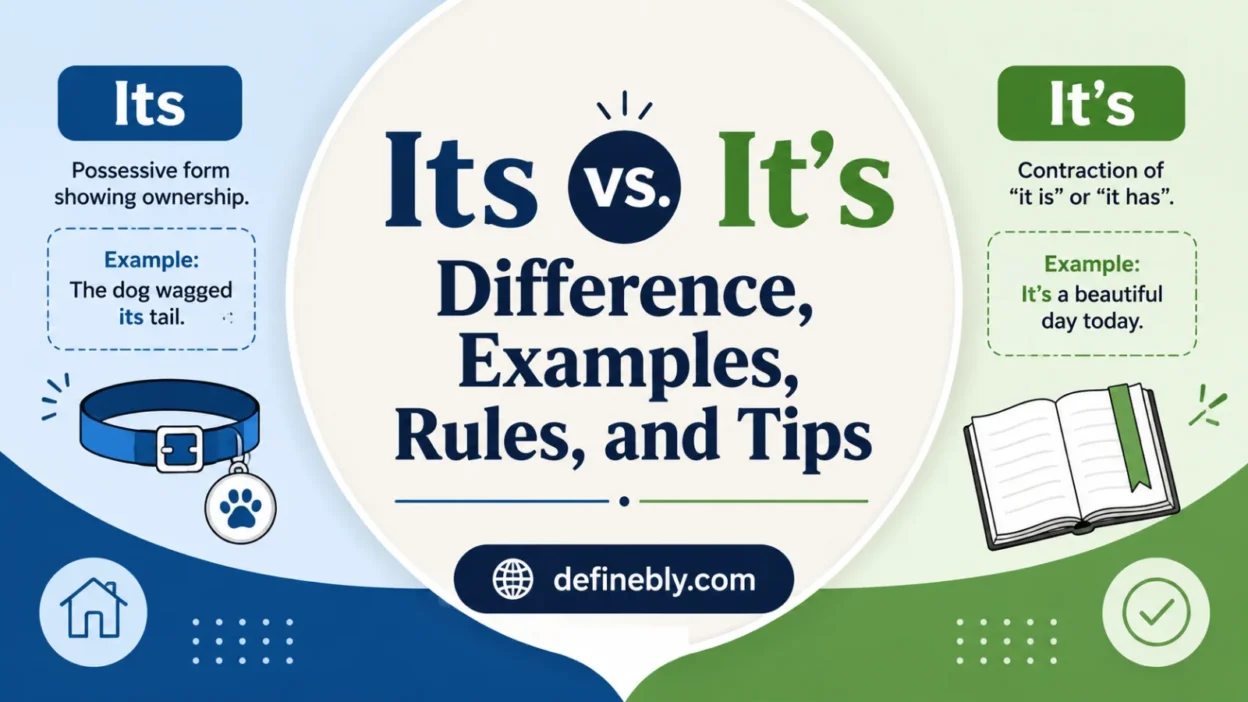
Its shows possession, while it’s is a contraction of it is or it has. Although the two words sound the same, they have different meanings and grammatical uses.
Compare these examples:
- The dog wagged its tail.
- It’s raining outside.
- It’s been a long week.
The easiest rule to remember is: Its shows possession; it’s means it is or it has.
Quick Answer
Use its when something belongs to or is associated with an animal, object, organization, or other thing.
Examples:
- The company changed its logo.
- The bird spread its wings.
- The phone lost its signal.
Use it’s when you mean it is or it has.
Examples:
- It’s cold outside. (It is cold outside.)
- It’s been a long week. (It has been a long week.)
- It’s almost time to leave. (It is almost time to leave.)
The replacement test: If you can replace the word with it is or it has and preserve the intended meaning, use it’s. If neither expansion works, its may be the correct choice.
Its vs. It’s: Key Differences
| Feature | Its | It’s |
|---|---|---|
| Meaning | Belonging to or associated with it | It is or it has |
| Grammatical role | Possessive determiner | Contraction |
| Apostrophe | No | Yes |
| Example | The cat licked its paw. | It’s getting late. |
| Quick test | Does it show possession? | Can it expand to it is or it has? |
What Does Its Mean?
Its is a possessive determiner that shows ownership, connection, or association. It usually appears before a noun.
Examples:
- The tree lost its leaves.
- The laptop needs its charger.
- The store changed its hours.
- The book lost its cover.
- The app updated its settings.
- The company announced its new policy.
In each sentence, its connects the noun to something already mentioned. The leaves belong to the tree, the charger is associated with the laptop, and the hours belong to the store.
How to Use Its in a Sentence
Use its when you want to identify something as belonging to or being associated with an animal, object, organization, or other thing.
Common combinations include:
- its screen
- its battery
- its name
- its meaning
- its purpose
- its design
- its final chapter
- its main feature
Examples:
- The phone lost its charge.
- The dog found its toy.
- The machine finished its cycle.
- The movie has its funny moments.
- The company updated its website.
Its does not always mean literal ownership. It can also show a relationship or characteristic.
Example: The plan has its advantages and disadvantages.
Here, its connects the advantages and disadvantages to the plan.
Why Does Its Have No Apostrophe?
Its is already the possessive form. Unlike many possessive nouns, it does not need an apostrophe.
Compare:
- the dog’s leash
- the company’s policy
- the teacher’s desk
- the dog wagged its tail
The apostrophe in dog’s, company’s, and teacher’s marks possession. However, its shows possession without an apostrophe.
This pattern is similar to other possessive forms such as his, hers, ours, yours, and theirs.
What Does It’s Mean?
It’s is a contraction of it is or it has. The apostrophe marks the omitted letters.
Examples:
- It’s a beautiful day. (It is a beautiful day.)
- It’s not working. (It is not working.)
- It’s been a long morning. (It has been a long morning.)
- It’s already on the table. (It is already on the table.)
- It’s important to check the details. (It is important to check the details.)
It’s as a Contraction of It Is
Use it’s when the sentence means it is.
Examples:
- It’s almost noon.
- It’s too late to call.
- It’s your turn.
- It’s a good idea.
- It’s on the desk.
- It’s going to rain.
- It’s easy to forget.
In each example, you can replace it’s with it is without changing the intended meaning.
It’s as a Contraction of It Has
Use it’s when the sentence means it has, often before a past participle.
Examples:
- It’s been a busy day.
- It’s taken longer than expected.
- It’s become a serious issue.
- It’s already happened twice.
- It’s helped the team move faster.
- It’s changed significantly over time.
For example:
It’s been a long week.
Expanded: It has been a long week.
The sentence uses the present perfect construction has been, so it’s is correct.
How to Choose Between Its and It’s
If you are unsure which form to use, follow these steps.
1. Try Replacing It’s With It Is
If the sentence still makes sense, it’s is likely correct.
Example: It’s almost time.
Expanded: It is almost time.
The sentence works, so use it’s.
2. Try Replacing It’s With It Has
Some sentences use it’s to mean it has rather than it is.
Example: It’s been a long day.
Expanded: It has been a long day.
The sentence works, so it’s is correct.
3. Check Whether the Sentence Shows Possession
If neither it is nor it has fits, check whether the word shows possession or association.
Example: The bird spread its wings.
The bird spread it is wings does not make sense. The wings belong to the bird, so its is correct.
4. Look at the Words Around It
Its usually appears before a noun or noun phrase:
- its screen
- its name
- its new design
- its main purpose
It’s often appears before an adjective, a noun phrase, or a verb phrase:
- it’s ready
- it’s a problem
- it’s working
- it’s been updated
These patterns are useful clues, but the replacement test is more reliable than looking at the next word alone.
Common Mistakes With Its and It’s
Using It’s to Show Possession
Incorrect: The company changed it’s logo.
Correct: The company changed its logo.
The logo belongs to or is associated with the company. No apostrophe is needed.
More examples:
- Incorrect: The bird spread it’s wings.
- Correct: The bird spread its wings.
- Incorrect: The store updated it’s website.
- Correct: The store updated its website.
- Incorrect: The book lost it’s cover.
- Correct: The book lost its cover.
Using Its When the Sentence Means It Is
Incorrect: Its almost time.
Correct: It’s almost time.
The intended meaning is it is almost time.
Other examples:
- Incorrect: Its cold outside.
- Correct: It’s cold outside.
- Incorrect: Its not your fault.
- Correct: It’s not your fault.
- Incorrect: Its easy to forget.
- Correct: It’s easy to forget.
Using Its When the Sentence Means It Has
Incorrect: Its been a long week.
Correct: It’s been a long week.
The sentence means it has been a long week.
More examples:
- Incorrect: Its taken too much time.
- Correct: It’s taken too much time.
- Incorrect: Its already started.
- Correct: It’s already started.
- Incorrect: Its helped a lot.
- Correct: It’s helped a lot.
Writing Its’
Incorrect: The team celebrated its’ win.
Correct: The team celebrated its win.
Its’ is not a standard possessive form. Use its without an apostrophe when showing possession.
More examples:
- Incorrect: The laptop lost its’ charge.
- Correct: The laptop lost its charge.
- Incorrect: The company changed its’ name.
- Correct: The company changed its name.
- Incorrect: The dog chased its’ tail.
- Correct: The dog chased its tail.
Trusting the Apostrophe Instead of the Meaning
An apostrophe often appears in possessive nouns, which can make it tempting to write it’s when you mean possession.
Incorrect: The restaurant changed it’s menu.
Correct: The restaurant changed its menu.
The menu belongs to or is associated with the restaurant. The correct form is its.
Everyday Examples of Its and It’s
Its in Sentences
- The dog chased its ball.
- The phone needs its charger.
- The store changed its hours.
- The book lost its cover.
- The car needs its oil changed.
- The app saved its settings automatically.
- The company released its annual report.
- The plant dropped its leaves in winter.
- The camera turned off its flash.
- The team improved its record.
It’s in Sentences
- It’s time to leave.
- It’s raining outside.
- It’s not easy to learn every rule at once.
- It’s already on the table.
- It’s been a great week.
- It’s going to be fine.
- It’s important to double-check the file.
- It’s taken longer than we expected.
- It’s clear that we need another plan.
- It’s your turn to speak.
Its and It’s in the Same Sentence
- The phone lost its signal, but it’s working again now.
- The dog hurt its paw, so it’s resting.
- The app changed its layout, and it’s easier to use.
- The company updated its policy because it’s required by law.
- The book has its flaws, but it’s still worth reading.
- The store changed its hours, and it’s now open later.
These examples demonstrate that the correct spelling depends on what the word means in each part of the sentence.
Its vs. It’s: Closest Alternatives
Alternatives for Its
Depending on the sentence, its may express a meaning similar to:
- belonging to it
- associated with it
- connected to it
- related to it
Example: The machine lost its power.
Similar meaning: The machine lost the power associated with it.
This substitution can help you recognize possession or association, although it may sound less natural than the original sentence.
Alternatives for It’s
It’s has two direct expansions:
- it is
- it has
Examples:
- It’s cold. → It is cold.
- It’s been fixed. → It has been fixed.
- It’s important. → It is important.
- It’s changed. → It has changed.
If either expansion preserves the intended meaning and grammatical structure, it’s is correct.
Quick Proofreading Checklist
Before publishing, sending, or submitting a sentence containing its or it’s, ask yourself:
- Does the sentence mean it is?
- Does the sentence mean it has?
- Can I expand the contraction without changing the intended meaning?
- Does the word show possession or association?
- Did I accidentally write its’?
Use it’s only when it is or it has fits. Use its when showing possession or association.
Easy Memory Trick for Its vs. It’s
Remember this simple rule:
It’s expands. Its owns.
Examples:
- It’s cold. = It is cold.
- It’s been fixed. = It has been fixed.
- Its screen cracked. = The screen belongs to or is associated with it.
Another helpful reminder is: No expansion, no apostrophe. If you cannot replace it’s with it is or it has, check whether you need its instead.
Frequently Asked Questions
What Is the Difference Between Its and It’s?
Its shows possession or association. It’s is a contraction of it is or it has.
Examples:
- The dog wagged its tail.
- It’s raining outside.
- It’s been a long day.
When Should I Use Its?
Use its when something belongs to or is associated with an animal, object, organization, or other thing.
Example: The laptop lost its charge.
When Should I Use It’s?
Use it’s when you mean it is or it has.
Examples:
- It’s cold outside. (It is cold outside.)
- It’s been a long day. (It has been a long day.)
Is It Its or It’s for Possession?
Use its for possession.
Correct: The cat cleaned its paws.
Incorrect: The cat cleaned it’s paws.
The apostrophe in it’s marks a contraction, not possession.
Is Its’ Ever Correct?
No. Its’ is not a standard form in English. Use its when showing possession.
Correct: The dog wagged its tail.
Is It “It’s Been” or “Its Been”?
The correct phrase is it’s been.
Example: It’s been a long week.
This means it has been a long week.
Is It “Its Own” or “It’s Own”?
The correct phrase is its own.
Example: The company has its own style.
Its shows possession. It’s own would expand to it is own or it has own, neither of which fits the intended meaning.
Is It “It’s OK” or “Its OK”?
The correct phrase is it’s OK when you mean it is OK.
Example: It’s OK to ask questions.
Why Does It’s Have an Apostrophe?
It’s has an apostrophe because it combines it with is or has.
- it is → it’s
- it has → it’s
The apostrophe marks the omitted letters. It does not indicate possession.
Do Its and It’s Sound the Same?
Yes. Its and it’s are generally pronounced the same in standard English. Because pronunciation does not distinguish them, use the it is / it has test to choose the correct spelling.
Conclusion
Use its when something belongs to or is associated with it. Use it’s when you mean it is or it has.
Compare:
- The dog wagged its tail.
- It’s getting late.
- It’s been a busy day.
Remember the simple rule: its shows possession; it’s means it is or it has.