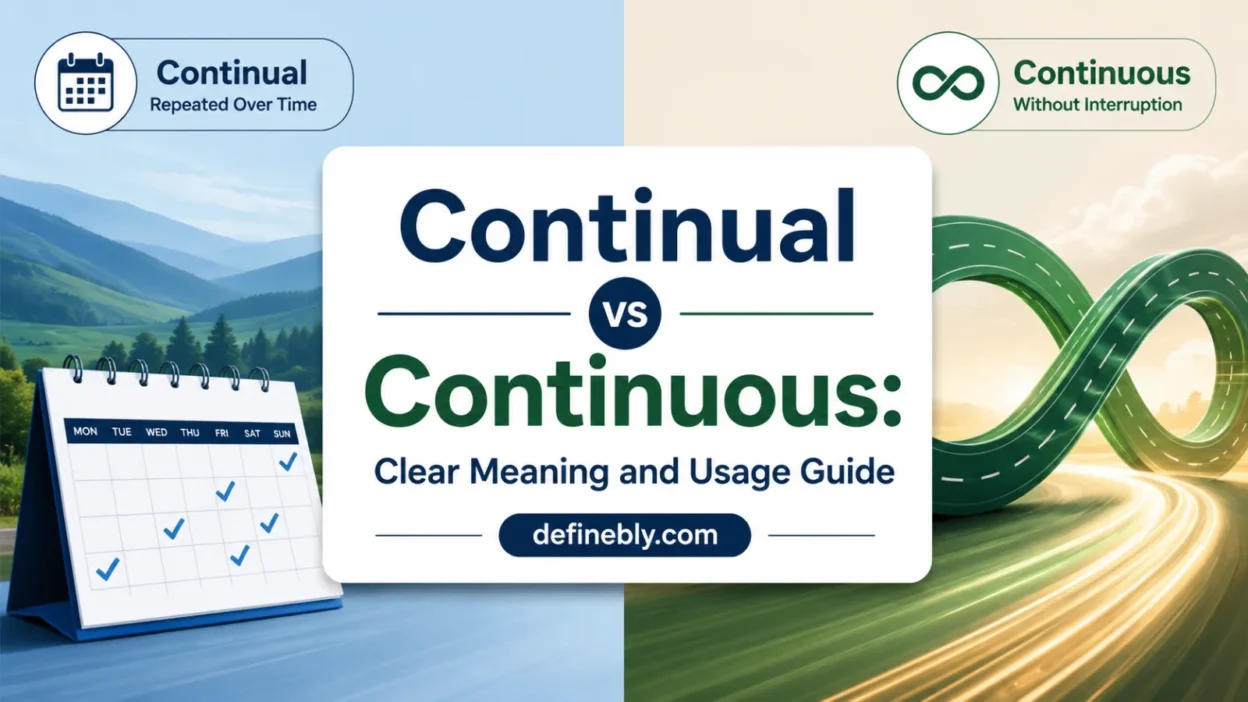
“Continual” and “continuous” are closely related words that both describe something happening over time. However, they are not interchangeable in careful writing.
The key difference is simple:
- Continual means repeated with interruptions.
- Continuous means nonstop and uninterrupted.
This distinction matters in academic writing, business communication, technical contexts, and everyday English. While casual conversation sometimes blurs the line, formal writing usually keeps the meanings separate.
Quick Answer
Use continual when something happens again and again with breaks in between.
Use continuous when something happens without stopping.
Examples:
- continual interruptions during a meeting
- continuous rain for six hours
The Core Difference In One Sentence
- Continual = recurring
- Continuous = uninterrupted
If pauses exist, continual is usually the better choice.
If there are no pauses, continuous is usually correct.
Why People Confuse Continual And Continuous
These words are confusing because:
- they share the same root
- they both describe ongoing activity
- they overlap in casual conversation
- the difference can feel subtle in everyday speech
For example, many people casually say “continuous interruptions,” even though interruptions naturally involve breaks.
In formal or precise writing, however, the distinction becomes more important.
Continual Vs Continuous At A Glance
| Situation | Correct Word | Why |
|---|---|---|
| Repeated phone notifications | continual | They happen repeatedly with pauses |
| A nonstop machine operation | continuous | No interruption occurs |
| Constant customer complaints throughout the week | continual | Repeated over time |
| A flowing stream of water | continuous | Unbroken flow |
| Frequent distractions during work | continual | Stops and starts repeatedly |
| Background music without pauses | continuous | Ongoing without interruption |
What Does Continual Mean?
Continual describes something that keeps happening repeatedly over time but includes interruptions or pauses.
The activity returns again and again instead of remaining nonstop.
Examples Of Continual
- continual interruptions during class
- continual software updates
- continual questions from customers
- continual delays in traffic
In these examples, the action repeats frequently but does not happen every second without stopping.
What Does Continuous Mean?
Continuous describes something unbroken, uninterrupted, or nonstop.
Once it begins, it keeps going without pause during the period being described.
Examples Of Continuous
- continuous rainfall
- continuous electricity supply
- continuous background noise
- continuous machine operation
This word often appears in technical, scientific, and engineering contexts because it emphasizes uninterrupted duration.
Continually Vs Continuously
The adverb forms follow the same distinction.
Continually
Means repeatedly with interruptions.
Example:
- The phone rang continually throughout the afternoon.
The calls stopped and restarted many times.
Continuously
Means nonstop or without interruption.
Example:
- The machine operated continuously for 12 hours.
The operation never stopped.
Continual Vs Continuous In Real Life
Workplace Examples
- continual meeting interruptions
- continuous customer support coverage
Technology Examples
- continual software notifications
- continuous internet connection
Education Examples
- continual classroom disruptions
- continuous monitoring during exams
Health And Fitness Examples
- continual coughing throughout the night
- continuous heart monitoring in a hospital
Why “Continuous” Sounds More Technical
“Continuous” is common in:
- engineering
- mathematics
- science
- manufacturing
- computing
Examples include:
- continuous data
- continuous production
- continuous monitoring
- continuous integration in software development
The word often suggests precision and uninterrupted operation.
Can Continual And Continuous Ever Overlap?
In casual conversation, yes.
Some native speakers use the words loosely when the distinction is not important.
For example:
- continual noise
- continuous noise
Both may sound acceptable informally depending on context.
However, careful writing still prefers:
- continual for repeated interruptions
- continuous for uninterrupted duration
Common Mistakes And Quick Fixes
Using Continuous For Repeated Interruptions
Less accurate:
- continuous phone notifications
Better:
- continual phone notifications
Why? Notifications stop and restart repeatedly.
Using Continual For Nonstop Activity
Less accurate:
- continual machine operation for 24 hours
Better:
- continuous machine operation for 24 hours
Why? The operation never stopped.
Assuming They Always Mean The Same Thing
These words overlap slightly in informal speech, but they are not exact synonyms in precise writing.
Sentence Correction Practice
- ❌ The baby cried continual for hours.
✔ The baby cried continuously for hours. - ❌ We faced continuous interruptions during the call.
✔ We faced continual interruptions during the call. - ❌ The engine ran continually without stopping.
✔ The engine ran continuously without stopping.
Memory Tricks To Remember The Difference
Continual
Think:
- recurring
- repeated
- stopping and restarting
Continuous
Think:
- nonstop
- uninterrupted
- flowing without breaks
Simple shortcut:
- Continual = comes back repeatedly
- Continuous = never stops
Common Phrases In English
Common Continual Phrases
- continual interruptions
- continual complaints
- continual delays
- continual reminders
Common Continuous Phrases
- continuous improvement
- continuous learning
- continuous operation
- continuous monitoring
These patterns reflect how native speakers naturally use the words.
Synonyms And Related Words
Continual
- repeated
- recurring
- frequent
- periodic
Continuous
- nonstop
- uninterrupted
- constant
- unbroken
Word Origins And Language Development
Both words come from Latin roots connected to continuation and duration.
Over time, English usage gradually separated them:
- continual became associated with repeated recurrence
- continuous became associated with uninterrupted flow
Modern American English still generally follows this distinction.
FAQ
What is the difference between continual and continuous?
Continual means repeated with interruptions, while continuous means nonstop and uninterrupted.
Can continual and continuous be used interchangeably?
Sometimes in casual conversation, but careful writing usually keeps the meanings separate.
What is an example of continual?
Continual phone notifications happen repeatedly throughout the day with pauses between them.
What is an example of continuous?
Continuous rain falls without stopping during the time being described.
What is the difference between continually and continuously?
Continually means repeatedly over time, while continuously means nonstop.
Why is “continuous improvement” correct?
Because the phrase describes an ongoing process intended to continue without interruption.
Conclusion
The difference between “continual” and “continuous” comes down to interruptions.
- Use continual for repeated actions that stop and restart.
- Use continuous for actions that never stop during the period being described.
Remember:
- continual = recurring
- continuous = nonstop
Once you connect interruptions with continual and uninterrupted flow with continuous, choosing the correct word becomes much easier in both formal and everyday writing.