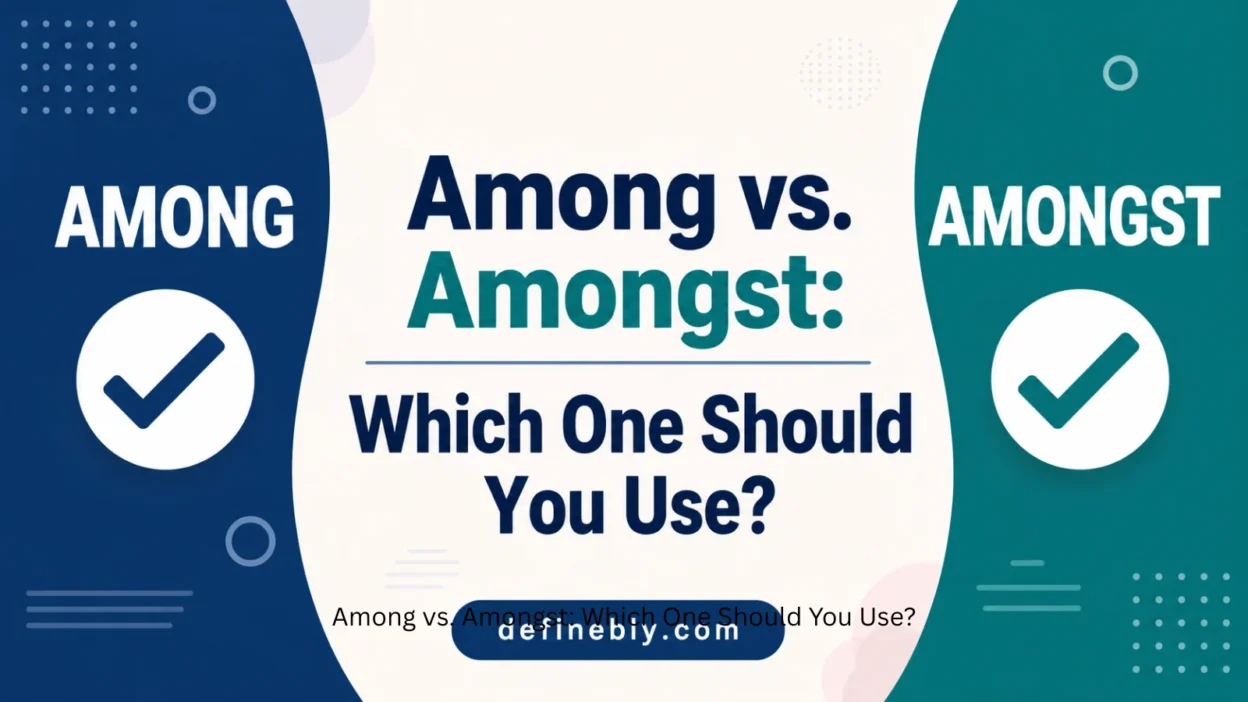
For American English, use among. It is the standard form in US journalism, business writing, academic prose, and everyday conversation. Both the AP Stylebook and Garner’s Modern American Usage recommend among as the default, and Garner’s specifically classifies amongst in American English as a “needless variant.”
Amongst is not incorrect — it is a fully recognized English word with a long history. But in American writing it reads as formal, literary, or British-inflected, which is either a feature or a flaw depending on what you’re writing. For nearly everything most people produce, among is the cleaner, more natural choice.
Both words mean exactly the same thing. Swapping one for the other never changes a sentence’s meaning — only its register.
Which Word Is Actually Older
This surprises most people: among is the older word. Amongst came later.
Among is a 12th-century Old English word, derived from ongemang, itself from on (“in”) + gemang (“assemblage, mingling”). The variant amongst appeared in Middle English around the 13th century as amonges, adding an adverbial genitive -s. The parasitic -t appeared from the 16th century, probably by association with superlatives ending in -st.
The same pattern that produced amongst also yielded against, betwixt, whilst, and amidst — a cluster of -st forms that developed in Middle and Early Modern English and have been gradually receding from everyday use ever since. Most are now archaic or restricted to formal and literary contexts. Against and amidst survive in current English; betwixt and whilst are rare in American writing. Amongst falls somewhere in the middle of that spectrum — still grammatically valid, but increasingly marked as formal or literary, particularly in American usage.
Amongst may feel more archaic to speakers of American English — but among is actually the older word. The counterintuitive reality is that the seemingly more “traditional” form is the later one.
What the Style Guides Say
The AP Stylebook recommends among for American journalistic and professional writing and does not list amongst as a preferred form. Garner’s Modern American Usage is more direct: it classifies amongst in American English as a needless variant — a word that serves no purpose among does not already serve, and that adds an unnecessary formality marker in most American contexts.
The Chicago Manual of Style does not issue a strong preference between the two, treating them as interchangeable. In practice, CMOS-following publishers — book publishers, academic journals, long-form magazines — are the contexts where amongst appears most naturally, when used deliberately for literary effect.
Some British publications, including major newspapers, issue style guides that insist on among. Even in British English, among is generally preferred overall. The idea that amongst is the default British form oversimplifies the picture — it is more common in British English than American English, but it is not the British standard by any authoritative measure.
The Meaning They Share
Both words function as prepositions with identical meanings across all their uses.
Surrounded by, in the midst of:
She felt calm among the old trees.
He wandered amongst the ruins, taking notes.
As part of a group, included in:
The letter was found among her personal papers.
Amongst her many skills, design was the strongest.
Shared by or occurring within a group:
The plan was well received among the team.
There was debate amongst the committee members.
Distributed between three or more:
Divide the remaining funds among the three departments.
The proceeds were split amongst the founding members.
In every case, the two forms are fully interchangeable in meaning. The choice is always about register and context, never about what the sentence conveys.
When to Use “Among”
Use among as your default in American English — in all registers, from casual to formal.
- Business writing, emails, memos, reports
- Journalism and news writing
- Academic writing and research papers
- Everyday conversation and social writing
- Any context where amongst would call attention to itself
The proposal was shared among all three partners.
I found the note among a stack of old receipts.
She was widely respected among her colleagues.
When “Amongst” Works
Amongst is appropriate when the register is deliberately elevated, literary, or archaic — or when you are writing for a British publication that uses it.
- Poetry and literary fiction with a formal or historical voice
- Deliberately formal or ceremonial prose
- Writing in which a British register is intentional
- Creative nonfiction that adopts a vintage or classical tone
Amongst the ruins of the old cathedral stood a single stone arch.
He had lived amongst scholars his entire adult life.
Outside these contexts, amongst in American English reads as a stylistic affectation rather than a natural choice. That is not a grammar judgment — it is a register one.
The “Amongst Before a Vowel” Myth
Some older style guides claimed amongst should be used before words beginning with a vowel sound — amongst us, not among us — the same logic that requires an before vowels rather than a. This rule has no basis in how either word actually behaves. The word’s actual use in modern English doesn’t bear out the vowel-based distinction. Both words appear freely before vowels and consonants alike in all published sources. Ignore this rule entirely and choose based on register and audience.
Among and Amongst vs. Amid and Amidst
These two pairs are linguistic cousins and follow identical patterns. Amidst developed from amid by the same mechanism that produced amongst from among — an adverbial genitive -s plus the parasitic -t.
The practical guidance is the same: in American English, amid is the standard form; amidst carries the same elevated, literary, or British-leaning register as amongst. If you use among in general prose, use amid when that preposition is needed. If you use amongst for deliberate literary effect, amidst fits the same register.
The protesters gathered amid rising tension. (American standard)
Amidst the chaos, one voice remained calm. (more literary or formal)
Common Mistakes and Quick Fixes
Mistake: Using amongst in a business email, news article, or casual professional context.
Fix: Replace with among. In American writing, amongst creates a formality or Britishness that most contexts don’t call for.
Mistake: Believing amongst is more grammatically correct or traditional than among.
Fix: Among is the older word. Neither form is more correct. Amongst carries a register signal, not a correctness signal.
Mistake: Following the “use amongst before a vowel” rule.
Fix: Ignore it. No major modern authority supports this distinction.
Mistake: Mixing among and amongst in the same document without a stylistic reason.
Fix: Pick one and apply it throughout. Consistency matters more than which form you choose.
Examples Side by Side
The decision was made among the senior partners. (American standard)
Amongst the senior partners, the decision was unanimous. (more formal, slightly literary)
She was known among her friends as the reliable one. (everyday register)
She was known amongst her friends as the reliable one. (British or formal register)
He distributed the workload among the team evenly. (standard)
He distributed the workload amongst the team evenly. (noticeably formal in American English)
Quick Practice
Choose the more natural form for standard American English.
- The document was circulated [among / amongst] all the department heads.
- She stood [among / amongst] a group of old friends, laughing.
- [Among / Amongst] the trees, a narrow path wound toward the river.
- The award was divided [among / amongst] three equally deserving candidates.
- He wandered [among / amongst] the ruins of the once-great palace. (formal literary context)
Answers: 1. among — 2. among — 3. among — 4. among — 5. either (amongst fits the literary register; among is always acceptable)
FAQs
Is “amongst” a real word?
Yes, fully. It is recognized by Merriam-Webster, the OED, and every major dictionary as a standard English preposition. It means exactly the same as among. The difference is register — not correctness.
Is “amongst” British or American?
Both, historically — but the register split is real. In American English, amongst is uncommon and reads as formal or literary. In British English, it is more accepted, though among is preferred even there in most major newspapers and style guides.
Which form does the AP Stylebook recommend?
The AP Stylebook recommends among for American journalistic and professional writing and does not treat amongst as a preferred form.
Is it wrong to use “amongst” in American English?
Not wrong, but marked. In formal literary or ceremonial contexts, it is a defensible stylistic choice. In standard professional, business, or journalistic American writing, it will read as unnecessarily elevated or British-inflected.
Which word is older — “among” or “amongst”?
Among is older. It traces to Old English ongemang, used from around 1000 CE. Amongst appeared in Middle English around 1200 CE, adding an adverbial genitive -s and later a parasitic -t. The form that feels more archaic is actually the newer one.
Should I use “amongst” before words starting with a vowel?
No. The guideline that amongst belongs before vowels has no support in actual modern usage and is not recommended by any major current style guide. Choose based on register and audience, not the following letter.
How do “amid” and “amidst” relate to this pair?
They follow the same pattern. Amid is the older, simpler form preferred in American English; amidst is the later -st variant with the same formal or literary register as amongst. In American prose, treat them the same way: use amid and among as your defaults; reach for amidst and amongst only when the register calls for it.
The Bottom Line
Among and amongst mean the same thing in every sentence they appear in. For American English in 2026 — journalistic, professional, academic, or conversational — among is the standard form recommended by the AP Stylebook and Garner’s Modern American Usage. Amongst is grammatically valid, historically legitimate, and appropriate when the register is deliberately formal or literary. The counterintuitive footnote worth remembering: among is actually the older word; amongst came later. Neither is more correct, but they send different signals — and in most American writing, the signal amongst sends is one you probably didn’t intend.
Conclusion
Pick the Word That Matches Your Tone
“Among” and “amongst” will never mislead your reader about meaning. What changes is the feel of your sentence. For nearly everything you write, “among” is the safer, more natural choice. Save “amongst” for the moments you want your writing to sound a little more formal or timeless.