
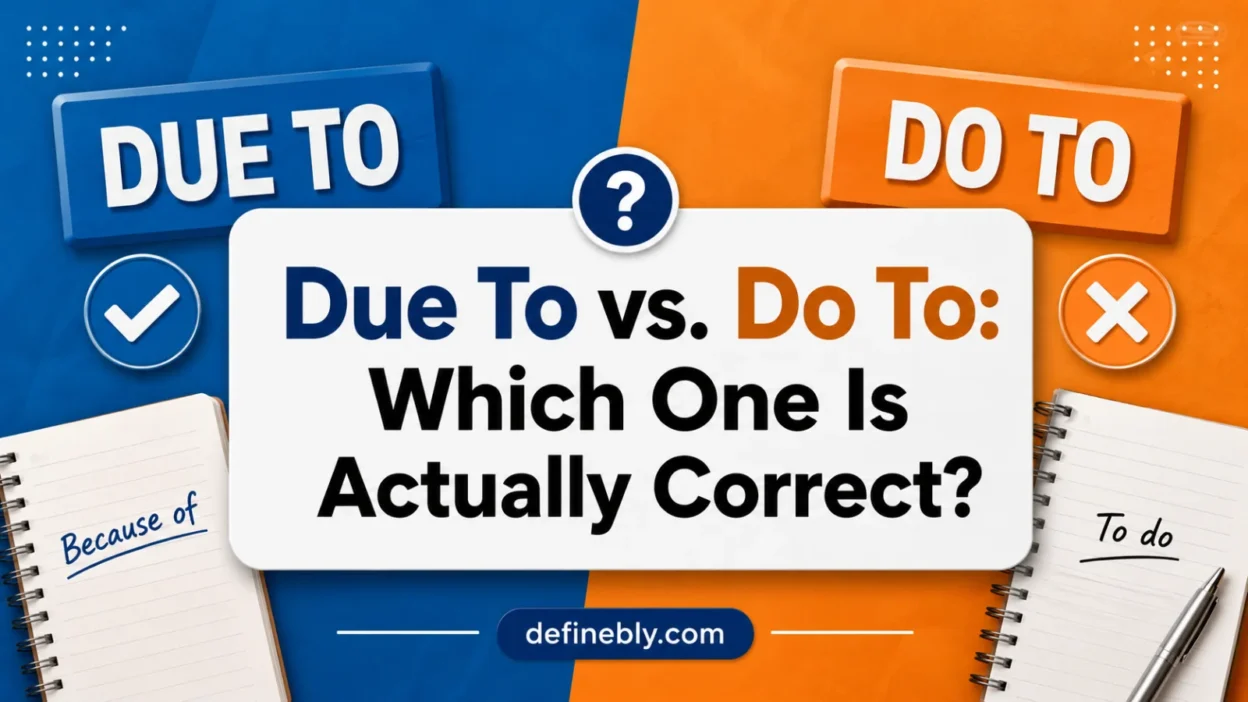
In a cause-and-effect phrase, the answer is always due to. Never do to. Writing do to where you mean because of or caused by is a spelling error — one that happens because the two phrases sound identical in speech, and one that spellcheck will not catch.
Do to is a real English phrase, but only when do is functioning as an action verb: What did you do to the engine? That use is entirely separate. The confusion almost always runs in one direction: people typing do to when they mean due to in a causal sentence.
Why This Mistake Happens
Due and do are homophones. In natural American speech, “due to” and “do to” are indistinguishable. Nobody hears the difference when someone says “the flight was canceled due to weather” at normal conversational speed. The confusion is phonetic, not grammatical — which is why it’s so persistent and why it shows up even in professional writing.
Spellcheck doesn’t help. Both do and due are real, correctly spelled words. A spellchecker has no way of knowing which one you intended, so it passes both through without a flag. You have to catch this one yourself.
What “Due To” Actually Means
Due traces to Old French deu, the past participle of devoir, meaning “to owe.” That etymology is the key to understanding the phrase: due to means “owed to” or “attributable to.” When something is due to a cause, that cause is what the outcome is attributable to.
The delay was due to heavy fog. = The delay is attributable to heavy fog.
Due to is an adjective phrase. In its traditional, strict use, it modifies a noun by following a linking verb (is, was, were, has been):
The cancellation was due to rain. ✔ (modifies cancellation after the linking verb was)
Her exhaustion is due to a three-day work sprint. ✔ (modifies exhaustion after is)
The error was due to a software glitch. ✔ (modifies error after was)
The Chicago Manual of Style and Strunk & White both specify that due to should be synonymous with attributable to in formal usage, following a linking verb and directly connected to a noun. This is the cleanest, most formal use — and it’s always correct.
The “Due To” vs. “Because Of” Distinction
This is the real grammar question careful writers have — and it’s worth knowing.
In strict, traditional grammar, due to is an adjective phrase (modifies nouns) while because of is a prepositional phrase (modifies verbs). That means:
The cancellation was due to rain. ✔ (due to modifies the noun cancellation — strictly correct)
The game was postponed because of rain. ✔ (because of modifies the verb postponed — strictly correct)
The game was postponed due to rain. ✗ (prescriptively, due to can’t modify a verb)
In practice, however, modern usage has widened due to to work as a preposition equivalent to because of, even after action verbs and even at the start of sentences. The AMA Manual of Style now accepts this broader use, and the Random House Dictionary notes that due to has been used this way since the 14th century. Most American publications, the AP Stylebook included, accept due to as a preposition in everyday contexts.
The practical bottom line: In formal, academic, or legal writing, test your sentence by substituting attributable to. If that substitution reads cleanly, due to is the safest choice. If it reads awkwardly, use because of instead.
| Context | Best Choice | Why |
|---|---|---|
| After a linking verb, modifying a noun | due to | Attributable to test passes: “The delay was attributable to fog” |
| After an action verb (formal writing) | because of | Traditional rule: due to should not modify verbs |
| After an action verb (modern/general use) | Either | Both widely accepted; because of is the safer choice |
| At the start of a sentence | because of | Avoids the dangling adjective phrase problem |
| Explaining a cause in any context | due to or because of | Both correct; match your style guide |
What “Do To” Actually Is
Do to is a valid English phrase — when do is the main action verb in the sentence. In this construction, do performs an action and to introduces the thing being acted on.
What did she do to the report? ✔ (action verb do + preposition to)
I’m not sure what the cold will do to the pipes. ✔ (action verb do + preposition to)
What can we do to improve morale? ✔ (action verb do + infinitive marker to)
None of these involve a cause. They all involve an action being performed on something. Do to and due to are not interchangeable in any direction — one explains a cause, the other performs an action. The confusion only ever runs one way: mistakenly typing do to when you mean due to in a causal phrase.
The Substitution Tests
Two substitution tests settle virtually every case.
Test 1 — “Caused by.” Replace due to with caused by. If the sentence reads naturally, due to is correct.
The delay was caused by heavy fog. ✔ → The delay was due to heavy fog.
What did she caused by the report? ✗ → do to is the right phrase here.
Test 2 — “Attributable to.” This is the more precise test for formal writing. If attributable to fits cleanly, you have the strictest correct use of due to.
The outcome is attributable to careful preparation. ✔ → The outcome is due to careful preparation.
If neither substitution works in a causal context, reach for because of instead.
Common Mistakes and Quick Fixes
Mistake: The game was canceled do to rain.
Fix: The game was canceled due to rain. — cause-and-effect phrase, always due to.
Mistake: Her promotion was do to hard work.
Fix: Her promotion was due to hard work. — due is the adjective, not the verb do.
Mistake: Do to the traffic, we missed the opening.
Fix: Due to the traffic, we missed the opening — or, more formally, Because of the traffic, we missed the opening.
Mistake: The results are due to the fact that the team trained harder.
Fix: The results are due to harder training — or more directly: The team trained harder, which explains the results. Every major style guide treats “due to the fact that” as verbose padding for because.
A Related Error: “Make Do” vs. “Make Due”
The same homophone confusion produces a second common error. The correct phrase is make do — meaning to manage with limited resources. Make due is always wrong, regardless of context.
We’ll have to make do with what we have. ✔
We’ll have to make due with what we have. ✗
Examples Side by Side
The flight was canceled due to mechanical issues. (cause — adjective phrase)
I need to know what the new policy will do to our timeline. (action — verb phrase)
Her absence was due to a family emergency. (cause — modifies “absence”)
What did the renovation do to the resale value? (action — “do” is the verb)
Due to ongoing repairs, the library will be closed Monday. (cause — widely accepted modern use)
I don’t know what to do to fix the error. (action — verb phrase)
FAQs
Is “do to” ever a correct phrase?
Yes — when do is functioning as the main action verb. “What did you do to the car?” and “What can we do to help?” are both correct. The error occurs when “do to” is written in place of “due to” in a causal phrase, where do has no action to perform.
Why doesn’t spellcheck catch the “do to” mistake?
Because both do and due are correctly spelled English words. A spellchecker checks individual words, not the intent behind them. Since “do to” is a real phrase in other contexts, no automated checker can determine that you meant “due to” without knowing the meaning of your sentence.
Can “due to” start a sentence?
In modern American writing, yes — it’s common and widely accepted. Traditional grammar purists object because due to is an adjective phrase and technically has nothing to modify at the start of a sentence. If you follow strict style guides like CMOS, use because of to open a sentence instead. In general or informal writing, “Due to the weather, the event was moved indoors” is entirely standard.
What is the difference between “due to” and “because of”?
In strict traditional grammar, due to is an adjective phrase that modifies nouns (it follows a linking verb like is or was), while because of is a prepositional phrase that modifies verbs. In modern practice, many publications and style guides accept due to as a synonym for because of in most positions. When in doubt in formal writing, use because of after an action verb or at the start of a sentence.
Is “due to the fact that” acceptable?
It’s grammatically fine but almost always wordy. The phrase “due to the fact that” does the work of the single word because. Style guides across the board — CMOS, AP, Strunk and White — recommend cutting it to because whenever possible.
What is “make do” and why do people write “make due”?
“Make do” means to manage with limited resources: “We’ll make do until the replacement arrives.” “Make due” is always wrong — the same do/due homophone confusion that produces “do to” for “due to.” The verb is make do, and it has nothing to do with the adjective due.
The Bottom Line
In any cause-and-effect phrase, due to is always the correct spelling. Do to in that context is a spelling error caused by mishearing, not a legitimate alternative. When you need a quick check, try substituting caused by — if it fits, use due to. For formal writing, substitute attributable to for the most precise test. And when due to feels awkward after an action verb, because of is always the safe fallback. The only time do to belongs in a sentence is when do is the actual verb performing an action — and in that case, you’re not thinking about due to at all.
Conclusion
“Due to” explains a cause. “Do to” describes an action. They sound identical, but they’re built from different parts of speech and never substitute for each other. When you’re tempted to write one, pause and ask whether you’re answering “why” or “what action” — that one question settles it every time.