SEO Title: Allusion vs. Illusion: Meaning, Differences, and Examples
Meta Description: Learn the difference between allusion and illusion with clear definitions, pronunciation tips, examples, memory tricks, and common mistakes.
URL Slug: allusion-vs-illusion
Allusion vs. Illusion: Meaning, Differences, and Examples
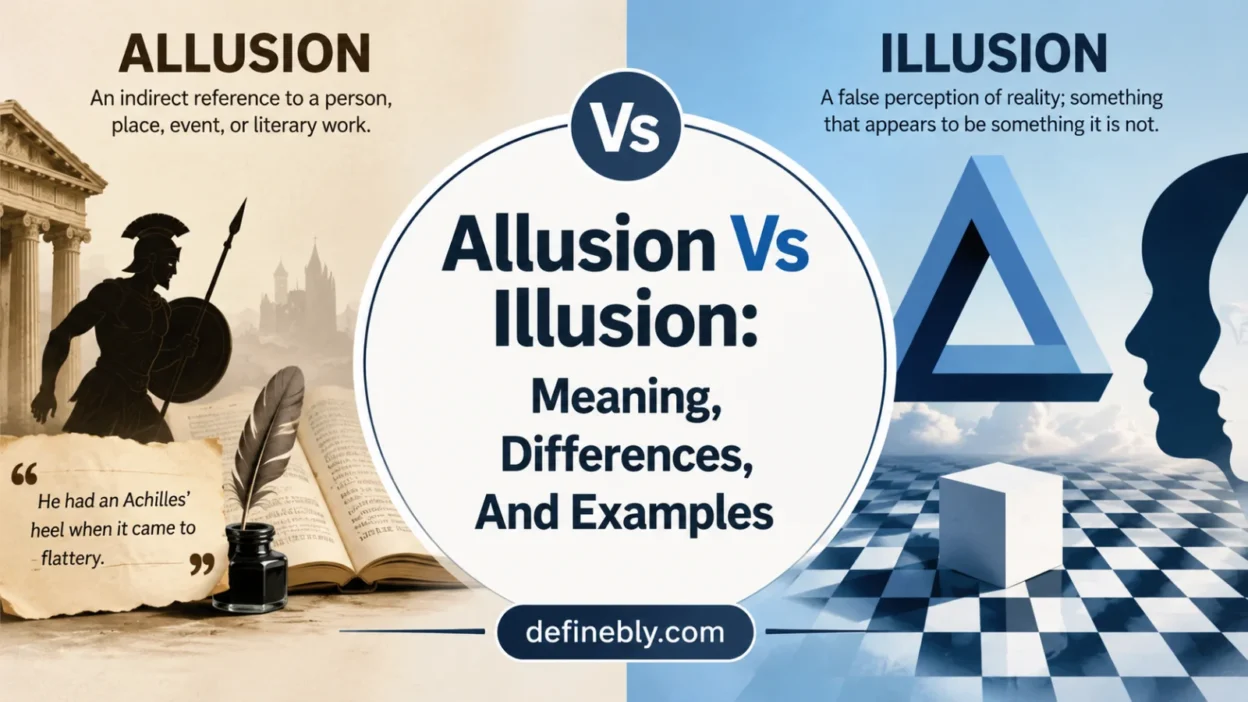
Allusion and illusion are easily confused because they look and sound similar, but they have different meanings. An allusion is an indirect reference to a person, event, story, or work of art. An illusion is something that creates a false or misleading impression, making something seem different from reality.
For example, a writer who hints at Shakespeare’s Romeo and Juliet makes an allusion. A magician who makes an object appear to disappear creates an illusion.
The easiest way to remember the difference is this: an allusion refers to something, while an illusion makes something seem real or different from what it is.
Allusion vs. Illusion: Quick Answer
- Allusion (noun): An indirect reference to something familiar or recognizable.
Example: The novel contains an allusion to Greek mythology. - Illusion (noun): A misleading appearance or perception that does not accurately represent reality.
Example: The magician created the illusion that the coin had vanished.
Use allusion when discussing references in writing, speech, or art. Use illusion when discussing appearances, perception, tricks, or false impressions.
Allusion vs. Illusion: Key Differences
| Feature | Allusion | Illusion |
|---|---|---|
| Meaning | An indirect reference | A misleading appearance or perception |
| Part of speech | Noun | Noun |
| Common contexts | Literature, speeches, films, and conversation | Magic, visual perception, media, and everyday life |
| Related word | Allude | Illusory |
| Example | The poem makes an allusion to Greek mythology. | The mirror created an optical illusion. |
| Main idea | Referring indirectly to something | Making something appear different from reality |
Although the words share a similar ending, they are not synonyms and cannot normally replace each other.
What Does Allusion Mean?
An allusion is an indirect reference to a person, event, place, story, historical moment, or cultural work. The speaker or writer often expects the audience to recognize the reference without explaining it fully.
Allusions appear in novels, poems, films, speeches, advertisements, and everyday conversations. They can communicate an idea quickly by connecting it to something the audience already knows.
Examples of Allusion in Sentences
- The novel contains an allusion to Greek mythology.
- Her speech included an allusion to the American Civil Rights Movement.
- The film makes an allusion to an earlier superhero movie.
- His description of the garden was an allusion to the Garden of Eden.
- The songwriter included an allusion to a famous historical event.
In each example, the reference points toward something beyond the immediate words.
Allusion in Literature
Writers use allusions to add meaning, establish connections, and communicate ideas without lengthy explanations.
For example:
After years of struggling, the young entrepreneur finally met his Waterloo.
The word Waterloo alludes to Napoleon Bonaparte’s decisive defeat at the Battle of Waterloo. In modern usage, meeting one’s Waterloo means encountering a decisive defeat or challenge.
Another example:
She opened the box, unleashing a Pandora’s box of problems.
This alludes to the Greek myth of Pandora’s box and suggests that an action has caused many unexpected problems.
Key point: An allusion is a reference. The reference may add meaning, but it does not necessarily deceive anyone.
What Does Illusion Mean?
An illusion is a misleading appearance or perception that makes something seem different from reality. It can involve what people see, hear, or otherwise experience, or it can describe a false impression about a situation.
Illusions can occur naturally, result from how the brain processes information, or be deliberately created through art, entertainment, and technology.
Examples of Illusion in Sentences
- The magician created the illusion that the card had disappeared.
- The hot road appeared to contain water, creating a mirage.
- The painting creates an illusion of depth on a flat surface.
- The advertisement gave viewers the illusion of a perfect lifestyle.
- The optical illusion made the two lines appear to be different lengths.
In these examples, something appears or seems a certain way, but that appearance may not match reality.
Common Types of Illusions
Optical illusion: A visual effect that causes an object, image, or pattern to appear differently from its physical properties.
Example: The optical illusion made a stationary image appear to move.
Magical illusion: A trick or performance that creates the impression of an impossible event.
Example: The magician created the illusion of levitation.
Cognitive illusion: A misleading impression that results from how people interpret information or make judgments.
Example: A familiar mental shortcut can sometimes lead to a mistaken judgment.
Illusion in media: An impression created through editing, staging, filters, or carefully selected images.
Example: Social media posts can create the illusion that someone’s life is always perfect.
Key point: An illusion concerns appearance or perception, not an indirect reference.
Allusion vs. Illusion: Pronunciation
The words have similar pronunciations, which contributes to the confusion.
| Word | Common Pronunciation | Stress |
|---|---|---|
| Allusion | uh-LOO-zhun | Second syllable |
| Illusion | ih-LOO-zhun | Second syllable |
Both words contain the same stressed sound, represented by LOO-zhun. Their opening vowel sounds differ slightly, but they can be difficult to distinguish in fast speech.
Because the words sound similar, pay attention to their meanings and spellings when writing.
How to Remember Allusion vs. Illusion
These simple memory tricks can help you choose the correct word.
1. Allusion Comes From Allude
The verb allude means to refer to something indirectly.
Remember:
- Allusion = allude = reference
- Example: The writer alludes to Shakespeare.
If the sentence is about a hint or reference, allusion is usually the word you need.
2. Illusion Is About Appearance
Think of the related word illusory, which means based on or producing an illusion.
Remember:
- Illusion = appearance or perception
- Example: The mirror created an illusion of extra space.
If something looks real but creates a misleading impression, illusion is the better choice.
3. Use the Reference-or-Reality Test
Ask yourself one question: Is the sentence referring to something, or is something appearing different from reality?
- An indirect reference to a story or historical event: allusion
- A visual trick or misleading appearance: illusion
This test works for most everyday and academic uses.
Allusion vs. Illusion vs. Delusion
Another commonly confused word is delusion. Although all three words can relate to something indirect, misleading, or unreal, they have distinct meanings.
| Word | Meaning | Example |
|---|---|---|
| Allusion | An indirect reference | The speech contains an allusion to history. |
| Illusion | A misleading appearance or perception | The mirror creates an illusion of depth. |
| Delusion | A firmly held false belief, especially one resistant to contrary evidence | The character lives under the delusion that everyone admires him. |
An illusion concerns how something appears or is perceived. A delusion concerns a belief. An allusion is different from both because it is a reference to something else.
These terms are not interchangeable, and a delusion should not be used as a casual label for every mistaken belief.
Common Mistakes With Allusion and Illusion
Mistake 1: Using Illusion When You Mean a Reference
Incorrect: The poem contains an illusion to Greek mythology.
Correct: The poem contains an allusion to Greek mythology.
The sentence discusses a reference to mythology, so allusion is correct.
Mistake 2: Using Allusion for a Magic Trick
Incorrect: The magician created an allusion that made the coin disappear.
Correct: The magician created an illusion that made the coin appear to disappear.
The magician creates a misleading appearance, not an indirect reference.
Mistake 3: Treating Allusion and Illusion as Synonyms
Incorrect: The author used an illusion to refer indirectly to Shakespeare.
Better: The author used an allusion to refer indirectly to Shakespeare.
Use allusion for the reference itself. Use illusion when the focus is on a misleading appearance or perception.
Mistake 4: Confusing Illusion With Delusion
An illusion is a misleading appearance or perception. A delusion is a false belief.
For example, a visual effect that makes a straight line look curved is an illusion. A character who firmly believes something false despite strong contrary evidence may be described as having a delusion.
Allusion vs. Illusion: Practice Quiz
Choose the correct word to complete each sentence.
- The author included an ______ to Shakespeare’s famous tragedy.
- The magician created the ______ that the table was floating.
- The hot road appeared to contain water, creating a visual ______.
- The politician made an ______ to a historic speech.
- The advertisement created the ______ of a worry-free lifestyle.
- The poem contains an ______ to Greek mythology.
Answers
- Allusion — It refers indirectly to Shakespeare’s work.
- Illusion — It describes a misleading appearance.
- Illusion — The apparent water is a mirage.
- Allusion — The politician refers to a historic speech.
- Illusion — The advertisement creates a particular impression.
- Allusion — The poem refers to Greek mythology.
Frequently Asked Questions
What Is the Difference Between Allusion and Illusion?
An allusion is an indirect reference to a person, event, story, or other recognizable subject. An illusion is a misleading appearance or perception that makes something seem different from reality.
What Is an Example of an Allusion?
“The hero faced his Waterloo” is an example of an allusion. It refers to Napoleon’s defeat at Waterloo and suggests a decisive defeat or challenge.
What Is an Example of an Illusion?
A mirage that makes a distant road appear to contain water is an example of an illusion. The appearance is misleading because the water is not actually there.
Why Are Allusion and Illusion Confused?
They have similar spellings, share the same ending, and sound nearly identical in speech. Their meanings, however, are different: allusion means a reference, while illusion means a misleading appearance or perception.
Is Allusion a Literary Device?
Yes. Allusion is a literary device that refers indirectly to a recognizable person, story, event, place, or cultural work. Writers use it to add depth and connect their work with ideas the audience may already know.
Can Illusion Be Used in a Sentence About Social Media?
Yes. Illusion can describe a misleading impression created by carefully selected images or edited content.
Example: The constant stream of perfect vacation photos created the illusion that everyone was always happy.
What Is the Difference Between Illusion and Delusion?
An illusion is a misleading appearance or perception. A delusion is a false belief, particularly one that persists despite evidence against it. The words describe different experiences and should not be used interchangeably.
How Can I Remember Allusion vs. Illusion?
Connect allusion with allude, meaning to refer indirectly. Connect illusion with appearance, perception, or a trick. In short, allusion means reference; illusion means misleading appearance.
Key Takeaways
- Allusion means an indirect reference to a recognizable person, event, story, or cultural work.
- Illusion means a misleading appearance or perception.
- Both words are stressed on the second syllable and sound similar.
- Allusions commonly appear in literature, speeches, films, and everyday communication.
- Illusions commonly appear in magic, visual perception, art, advertising, and media.
- Delusion refers to a false belief and has a different meaning from both words.
Conclusion
The difference between allusion vs. illusion becomes clear when you focus on what each word describes. An allusion refers indirectly to something familiar, while an illusion creates a misleading appearance or perception.
Remember this simple rule: allusion is a reference; illusion is an appearance that can mislead. Choosing the right word makes your writing clearer and helps readers understand exactly what you mean.