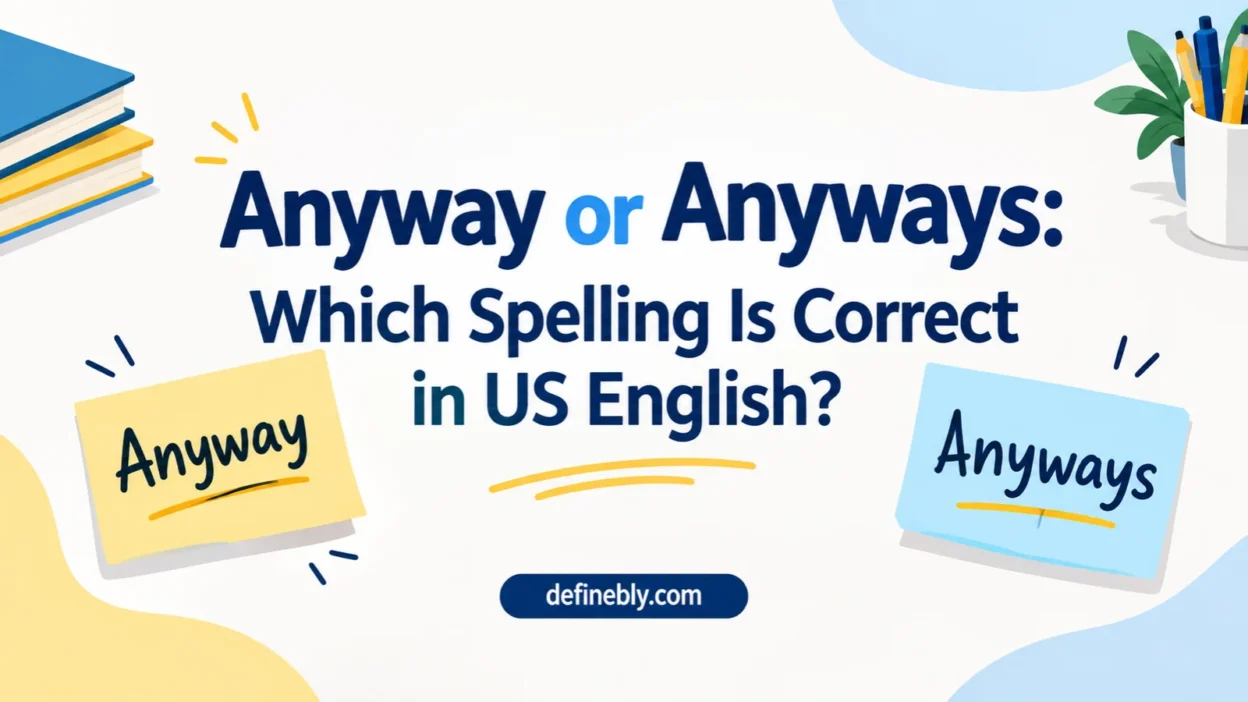
You’re writing a text, a work email, or a cover letter, and you reach the word. Anyway or anyways? You hear both every day, and neither sounds odd.
The short answer is easy. The reasoning behind it, plus one look-alike that really can trip you up, is worth two minutes.
Quick Answer
Use anyway. It’s the standard form in American English and works in every setting.
Anyways is a real word with the same meaning, but dictionaries label it informal. Keep it for casual speech, texts, and dialogue. And if you mean “in any manner,” write any way as two words.
Anyway, Anyways, and Any Way at a Glance
| Form | What It Is | Meaning | Best Use |
|---|---|---|---|
| Anyway | Adverb | In any case; regardless; shifts the topic | Every setting, formal or casual |
| Anyways | Informal adverb | Same as anyway | Casual speech, texts, dialogue |
| Any way | “Any” + the noun “way” | In any manner; by any method | Whenever “any method” or “any manner” fits |
Is Anyways a Real Word?
Yes. Merriam-Webster lists it as an adverb and labels the modern sense “US, informal.” Dictionaries that include it attach a label such as informal, colloquial, or nonstandard. So “anyways isn’t a word” isn’t accurate.
Sources do differ on how harshly to judge it. Dictionaries call it informal. Some usage guides go further and call it incorrect. In practice both views point the same way: edited, professional writing uses anyway.
Why Does Anyways Exist?
Anyways isn’t a text-message invention. Merriam-Webster’s earliest recorded use dates to the 13th century, with an older meaning of “in any manner or respect.”
Merriam-Webster ties it to the older adverb anywise. Earlier English often added an -s to adverbs, and always and unawares still carry that ending. The -s isn’t random, but age doesn’t make a word formal. Today anyways reads as casual.
The dictionary also lists an archaic sense and a dialect sense (“to any degree at all”). Neither matters for everyday writing.
How Anyway Works
Anyway does several jobs:
- Regardless or in spite of that: “The store was closed, so we ordered online anyway.”
- In any case: “I can’t afford a ticket, and the show is sold out anyway.”
- Shifting the topic or resuming after a tangent: “Anyway, back to the budget.”
- Adding a supporting point: “Skip the highway. Your tires are worn anyway.”
When anyway opens a sentence to change the subject, follow it with a comma. Close alternatives include anyhow, regardless, in any case, all the same, and nonetheless.
Anyway vs Any Way
This is the choice that can genuinely be wrong. Any way is two words: “any” describes the noun “way.” It means “in any manner” or “by any method.”
Use two quick swaps:
- Replace the word with regardless. If it fits, write anyway.
- Replace it with any method or any manner. If that fits, write any way.
| Sentence | Swap That Fits | Correct Form |
|---|---|---|
| We went ___ . | regardless | anyway |
| Is there ___ to move my appointment? | any method | any way |
| Finish the report ___ you like. | any manner | any way |
| The delay wasn’t in ___ your fault. | (always two words after “in”) | any way |
When to Use Anyways
| Context | Best Choice | Why |
|---|---|---|
| Cover letters, reports, essays | Anyway | Standard form; anyways can look careless |
| Job interviews and presentations | Anyway | The same standard applies to speech |
| Email to a client or manager | Anyway | Keeps the tone professional |
| Texts and chats with friends | Either | Both are understood |
| Dialogue in fiction or scripts | Either | Anyways can capture how people really talk |
Tone matters too. In conversation, anyways can come across as dismissive or impatient, especially when it cuts off a topic: “Anyways, I don’t want to talk about it.”
Common Mistakes (and Quick Fixes)
- Using anyways in formal writing. Fix: switch to anyway.
- Treating anyways as a typo. Fix: it’s a real word. It’s just informal.
- Writing anyway when you mean any way. Fix: “Is there anyway to fix this?” needs two words: “any way.”
- Writing any way when you mean anyway. Fix: “We finished any way” should be “We finished anyway.”
- Skipping the comma after an opening anyway. Fix: write “Anyway, let’s begin.”
Everyday Examples
- Standard: “I know the deadline moved, but we’ll aim for Friday anyway.”
- Standard: “Anyway, let’s review the numbers before the meeting.”
- Informal: “Anyways, I’ll text you when I get there.”
- Informal: “Who needs a car in the city anyways?”
- Two words: “Let me know if there’s any way I can help.”
- Two words: “Pick the seat any way you like.”
Frequently Asked Questions
Is anyways a real word?
Yes. Merriam-Webster lists it as an informal adverb meaning the same as anyway. It just isn’t the standard choice for formal writing.
Is anyways grammatically incorrect?
It works like anyway in a sentence, so it isn’t a grammar error in the usual sense. Dictionaries mark it informal, and some usage guides call it nonstandard or incorrect. For anything formal, use anyway.
Can I use anyways in an email?
Use anyway in professional email, including messages to clients, managers, and hiring teams. Anyways is fine in a casual note to a close coworker.
What’s the difference between anyway and any way?
Anyway is an adverb meaning “regardless” or “in any case.” Any way is two words meaning “in any manner.” If “any method” fits the sentence, write two words.
Where did anyways come from?
Merriam-Webster records it as early as the 13th century and links it to the older word anywise. Early English often added -s to adverbs, which is why always and unawares still end that way.
Do I need a comma after anyway?
Yes, when it opens a sentence to shift or resume a topic: “Anyway, back to the budget.” You don’t need one when it ends a sentence or sits mid-clause: “We went anyway.”
Conclusion
Anyway is the safe, standard choice in American English. Anyways is a real, centuries-old word that stays informal, and any way is a different phrase entirely. Choose anyway unless the setting is truly casual, and reach for the two swap tests whenever you’re unsure about any way.