
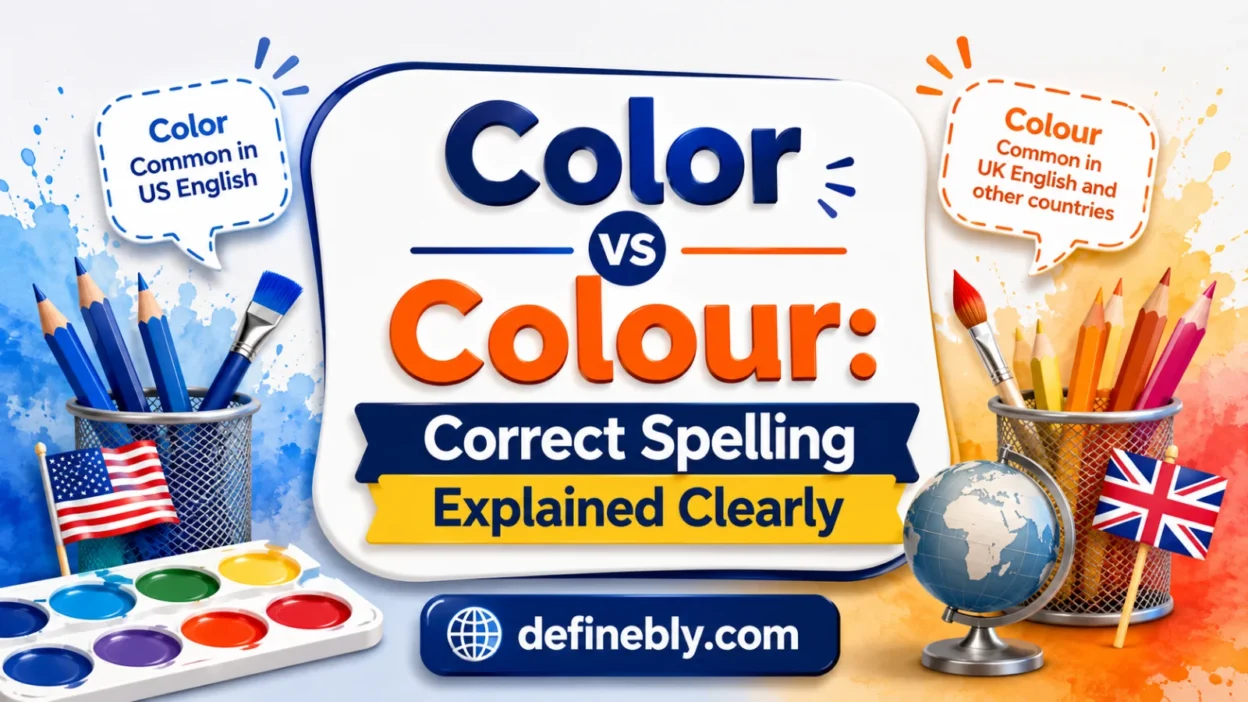
“Color” and “colour” are two valid spellings of the same word. The difference is not about meaning or correctness—it is about regional English conventions.
American English uses color, while British English and most Commonwealth regions use colour. Understanding this difference is important for writing consistency, especially in SEO, academic, and professional content.
Quick Answer
- Color → Standard in American English
- Colour → Standard in British English, Canada, Australia, and other Commonwealth countries
- Both are correct depending on regional usage
Why There Are Two Spellings
The difference comes from historical spelling reforms.
In the early 1800s, American linguist Noah Webster simplified many English spellings to make them more phonetic and consistent. One of his changes was removing the “u” from words like:
- colour → color
- favour → favor
- honour → honor
British English retained the original Latin-influenced spelling, while American English adopted simplified forms.
What Style Guides Say
- AP Stylebook (US) → color
- Merriam-Webster (US) → color
- Oxford English Dictionary (UK) → colour
- Cambridge Dictionary (UK) → colour
These references are widely used in journalism, publishing, and academic writing.
Color vs Colour in Real Usage
American English (Color)
- The color of the sky is beautiful.
- She prefers neutral color palettes.
- The website uses bold color contrast.
British English (Colour)
- The colour of the sky is beautiful.
- He chose warm colour tones for the design.
- The theatre uses bright colours on stage.
Both versions communicate the same meaning—only spelling changes.
Word Family: Related Forms
Understanding related forms helps avoid inconsistency:
- Color / Colour (noun & verb)
- Colorful / Colourful (adjective)
- Coloring / Colouring (noun/gerund)
- Colorize / Colourise (verb)
- Discolor / Discolour (verb)
Even in American English, some derived forms may vary depending on dictionary conventions.
Global English Usage
Different regions prefer different standards:
- United States → color
- United Kingdom → colour
- Canada → mostly colour (mixed influence)
- Australia & New Zealand → colour
- India & Pakistan → mixed usage depending on education system
In global content writing, consistency matters more than geography once a style is chosen.
Which One Should You Use?
Choose based on your audience:
- Use color for US-based readers, brands, or SEO targeting American traffic
- Use colour for UK/Commonwealth audiences or British-style publications
For websites, blogs, and SEO content, the best practice is:
Pick one spelling system and stay consistent across all pages.
Branding and Exceptions
Not all spelling follows regional rules.
Some companies intentionally use one form for branding:
- “Color” in product names (even outside the US)
- “Colour” in brand identity for stylistic preference
In these cases, always match the official brand spelling.
Common Mistakes
Mixing both spellings in one document
This is the most common error in digital content and reduces professionalism.
Switching between forms in SEO content
Search engines may not penalize it, but it harms readability and consistency.
Assuming one spelling is incorrect
Both are correct—context determines usage.
SEO Writing Tip
For SEO content, consistency is more important than preference.
- Targeting US traffic → use color throughout
- Targeting UK traffic → use colour throughout
- Mixed audiences → choose one variant and stay consistent site-wide
FAQ
Is color wrong in British English?
No. It is understood, but “colour” is the standard British spelling.
Is colour wrong in American English?
It is not used in standard US writing, but it is still understood.
Why does British English use colour?
It preserves older Latin-based spelling conventions.
Who changed colour to color?
American lexicographer Noah Webster simplified the spelling in the 1800s.
Which spelling is better for SEO?
Neither is better universally—use the version that matches your target audience.
Conclusion
“Color” and “colour” mean exactly the same thing, but their spelling reflects different English traditions. American English uses color, while British and Commonwealth English use colour.
For professional writing, SEO, and publishing, consistency is the real rule—choose one system and apply it everywhere.