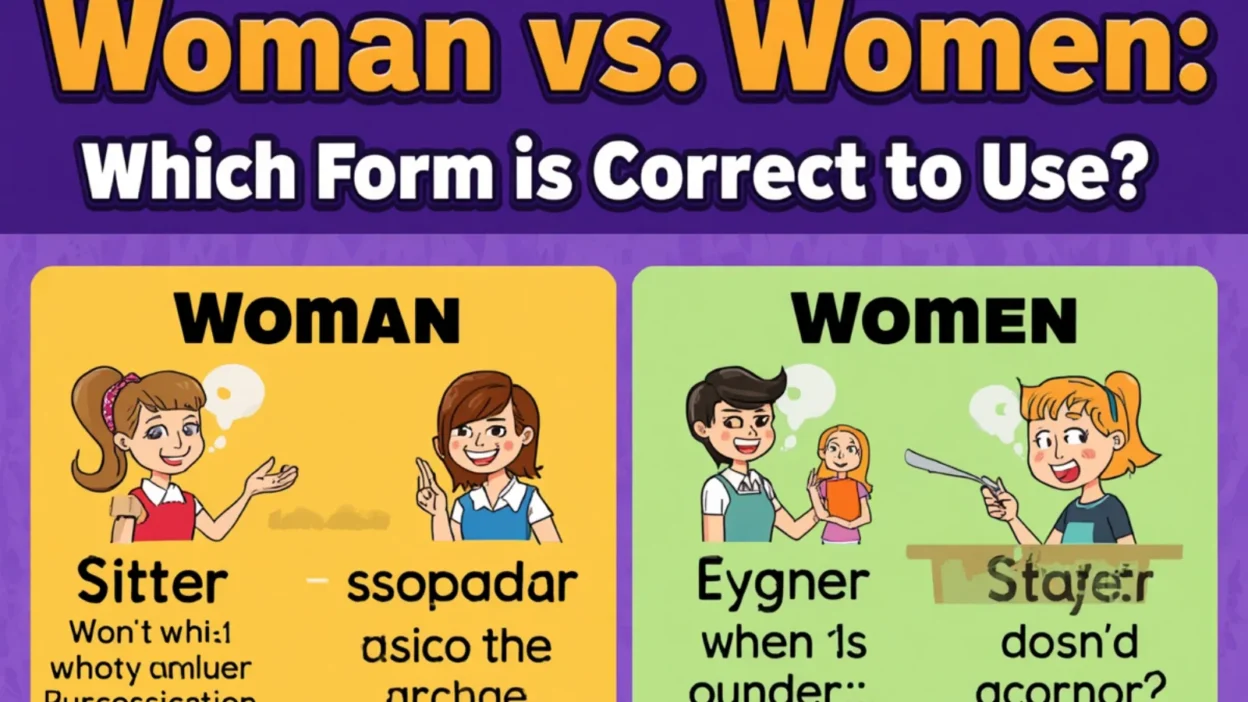
Woman is singular — one person. Women is plural — two or more. They are not interchangeable, they are not style variants, and there is no context in standard English where you choose between them based on tone or formality. The correct form depends entirely on how many people you mean.
The two words are also pronounced differently — which is the most practical check available. Woman is pronounced “WUH-mun.” Women is pronounced “WIH-min.” If you say the sentence aloud and hear “WUH-mun,” write woman. If you hear “WIH-min,” write women. The vowel shift is real and audible.
Why the Spelling Changes — The Short History
English has a small group of nouns that form their plurals through internal vowel changes rather than by adding -s. The most familiar pairs: man/men, foot/feet, tooth/teeth, goose/geese, mouse/mice. Woman/women follows the same ancient Germanic pattern.
Old English wīfmann meant “female person” — wīf (“female, woman”) combined with mann (“person,” at that time not yet gender-specific). Its plural was wīfmenn. Over centuries of contraction and sound change:
wīfmann → wimman → woman
wīfmenn → wimmen → women
The -o- in woman and the -e- in women both descended from these contractions by different sound paths. The vowel shift in the plural mirrors exactly what happened with man → men, because both words shared the same Old English suffix. The change is not arbitrary — it is a direct inheritance from the Old English root.
This is why womans is not a word. This noun forms its plural through a vowel change, not by adding -s. There is no womans, no womens, and no standard exception to this.
The Grammar Rules
Singular: “Woman”
Woman is always singular. It takes singular verbs (is, was, has) and singular determiners (a, one, this, that).
A woman called the office this morning.
The woman at the counter was extremely helpful.
One woman on the committee dissented.
Plural: “Women”
Women is always plural. It takes plural verbs (are, were, have) and plural determiners (several, many, these, those, two, three).
Several women arrived early.
The women are meeting in Conference Room B.
Those women have been with the organization for a decade.
The Most Common Error: Verb Mismatch
Writers who know the spelling distinction still sometimes mismatch the verb, especially in longer sentences where the subject and verb are far apart.
The women was running late. ✗ (plural noun, singular verb)
The women were running late. ✔
A woman are expected to present. ✗ (singular noun, plural verb)
A woman is expected to present. ✔
Possessive Forms — And a Common Sign Error
The possessives of woman and women follow standard apostrophe rules, but they trip people up because the base words already look so similar.
Singular possessive — woman’s: Something belonging to one woman.
The woman’s coat was left at the restaurant.
She handled the woman’s case personally.
Plural possessive — women’s: Something belonging to or associated with multiple women, or with women as a group.
The women’s locker room is on the third floor.
Women’s rights have been central to the debate.
She’s shopping in the women’s section.
The sign-error form — womens’ or womens: Frequently appears on retail signs, category labels, clothing tags, and informal notices. Neither is correct. The word is women’s — the apostrophe comes before the s, because the base plural word is women (no s), and possession is added with ‘s.
Women’s restroom. ✔
Womens restroom. ✗
Womens’ restroom. ✗
“Woman” and “Women” as Modifiers
When these words appear before another noun as a modifier — often called an attributive noun — the form should match the number of the noun they describe.
Singular noun → use woman:
She is a woman entrepreneur.
The award recognized a woman CEO for the first time.
Plural noun → use women:
The firm has hired several women engineers this year.
Women athletes have seen major policy changes in recent years.
This distinction is documented in AP Stylebook usage guidance. The common error is using woman as a universal modifier regardless of singular or plural: “three woman doctors” is incorrect; “three women doctors” is correct.
The broader question of whether to use woman/women as a modifier at all — versus female — involves style preferences that vary by publication. Many editors now prefer women’s (possessive) or simply restructure the sentence rather than use the attributive form: doctors who are women rather than women doctors. AP guidance generally accepts the attributive use when the gender is relevant to the story.
“Womyn” and “Womxn” — What Are These?
Readers who encounter these spellings in print, in institutional communications, or in advocacy writing may wonder what they mean.
Womyn is an alternative spelling developed by some feminist communities beginning in the 1970s, intended to remove the word man or men from the written form of the word and assert linguistic independence. It appears in the names of some publications, events, and organizations.
Womxn is a more recent alternate form used in some activist and academic contexts, intended to be inclusive of transgender women and nonbinary individuals while avoiding the man/men visible in the standard spelling.
Neither form is used in mainstream American journalism or general writing. Neither is listed as a standard entry in Merriam-Webster, the Oxford English Dictionary, or major style guides for general use. If you encounter them, they are deliberate political or community-specific spellings, not errors. If you are writing for a general or mainstream audience, use woman and women.
Common Mistakes and Quick Fixes
Mistake: Two woman applied for the position.
Fix: Two women applied for the position. — plural count requires women.
Mistake: She is a talented women.
Fix: She is a talented woman. — singular subject requires woman.
Mistake: The women is expected to speak at noon.
Fix: The woman is expected to speak at noon (if singular) or The women are expected to speak at noon (if plural).
Mistake: The womens room is on the left.
Fix: The women’s room is on the left. — apostrophe before the s.
Mistake: Three woman doctors will be presenting.
Fix: Three women doctors will be presenting. — plural noun modified by women, not woman.
Examples Side by Side
A woman in the front row raised her hand. (singular — one person)
Three women in the front row raised their hands. (plural — more than one)
The woman’s presentation was the strongest of the day. (singular possessive)
The women’s network meets every first Thursday. (plural possessive)
She is a woman historian who specializes in the 20th century. (singular modifier)
Several women historians are contributing to the project. (plural modifier)
Quick Practice
Choose the correct form.
- Two [woman / women] from the legal team will attend the conference.
- [A woman / Women] called while you were out — she didn’t leave a name.
- The [woman’s / women’s] restroom is located down the hall on the right.
- She’s a [woman / women] of remarkable patience.
- The department has hired four [woman / women] engineers this year.
- [A woman / Women] CEO was named to lead the division.
Answers: 1. women — 2. A woman — 3. women’s — 4. woman — 5. women — 6. A woman
FAQs
What is the simple rule for woman vs. women?
Woman = one person; women = two or more. The verb must match: woman takes is/was; women takes are/were. There are no exceptions and no contexts where the forms are interchangeable.
How are “woman” and “women” pronounced?
Woman is pronounced “WUH-mun.” Women is pronounced “WIH-min.” They sound distinctly different — saying the sentence aloud is the fastest check available when you’re unsure which to write.
Why isn’t the plural just “womans”?
Woman is an irregular noun with a plural formed by an internal vowel change, not by adding -s. This mirrors the man/men pattern, and both stem from the same Old English word-building pattern. Womans is not a word in standard English in any context.
What is the correct possessive form?
Woman’s for one woman; women’s for more than one or for women as a group. The common sign error — womens’ or womens — is always incorrect. The apostrophe goes before the s: women’s.
When should I write “woman” vs. “women” as a modifier before a noun?
Match the modifier to the number of the noun being modified: a woman engineer (singular), three women engineers (plural). Using woman before a plural noun is incorrect.
What are “womyn” and “womxn”?
These are alternative spellings used in specific feminist and activist communities to alter the visible connection to man or men in the standard spelling. They are not used in mainstream journalism or general writing and are not entries in major style guides for general audiences. They represent deliberate political or community-specific choices, not standard variants.
The Bottom Line
Woman is singular; women is plural. They’re pronounced differently (“WUH-mun” and “WIH-min”), and the verb must match whichever you use. The plural is formed through a vowel change — not by adding -s — so womans and womens are never correct. Possessives follow standard rules: woman’s and women’s, with the apostrophe before the s. As a modifier, match the form to the noun it describes: a woman doctor but three women doctors. Count, then choose — that’s the only decision this pair requires.
Conclusion
“Woman” means one person; “women” means more than one. The spelling change is irregular, not optional, and the verb always has to match. Count first, then pick the form — that one habit prevents almost every mistake with this pair.