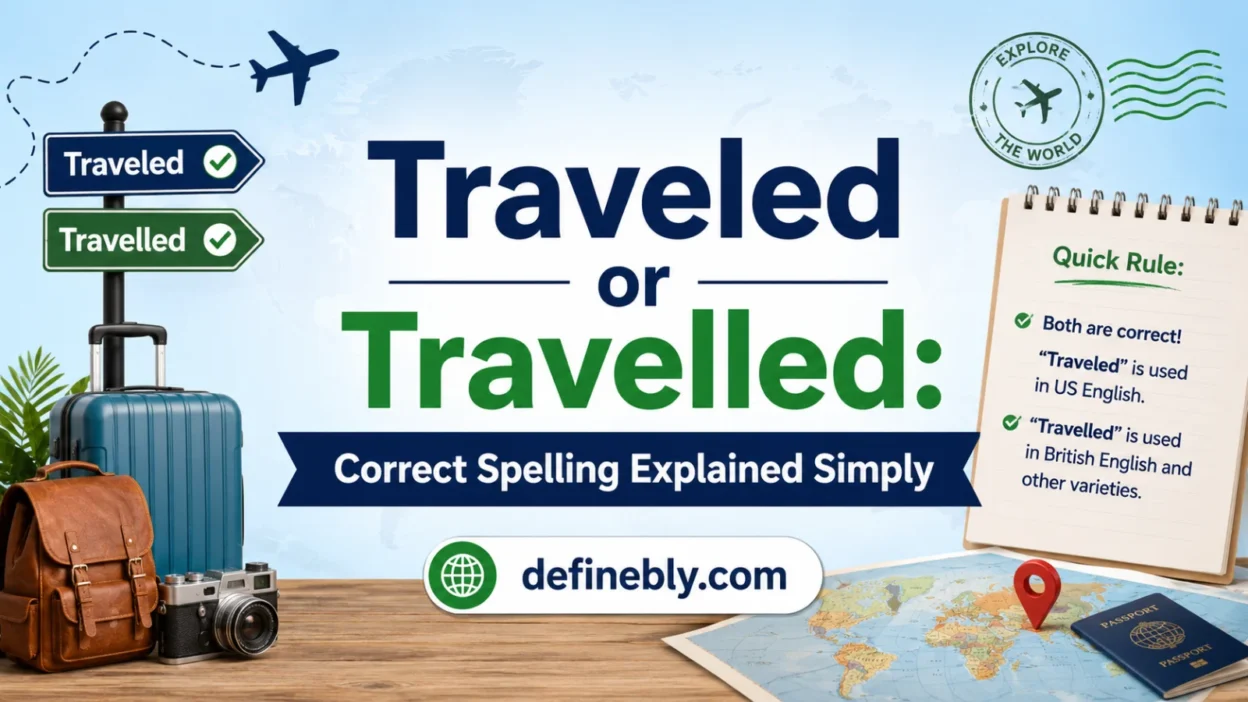
“Traveled” and “travelled” are two correct spellings of the same verb. The difference is not about meaning but about spelling conventions in American and British English.
The variation comes from how English handles consonant doubling when adding verb endings like -ed and -ing. Once you understand that rule, the difference becomes predictable rather than memorized.
Quick Answer
Use traveled in American English.
Use travelled in British English and most Commonwealth English.
Both are correct within their own systems.
Why There Are Two Spellings
The difference comes from a general spelling pattern in English:
- American English usually simplifies double consonants in past tense forms
- British English often keeps the original double consonant
So:
- travel → traveled (US)
- travel → travelled (UK)
This is part of a broader pattern seen in words like:
- cancel → canceled / cancelled
- label → labeled / labelled
Grammar Rule Behind The Difference
The key rule is consonant doubling before suffixes:
In British English:
- If a word ends in a stressed vowel + consonant, the consonant is often doubled before -ed or -ing
- travel → travelled, travelling
In American English:
- The consonant is usually not doubled
- travel → traveled, traveling
This is why both forms are logically consistent, not random variations.
American English vs British English Usage
| Context | Preferred Form | Reason |
|---|---|---|
| United States writing | traveled | Standard US spelling system |
| United Kingdom writing | travelled | Traditional British spelling |
| Canada / Australia / NZ | travelled | Follows British convention |
| Global tech/business writing | depends on audience | Consistency matters more than region |
Related Word Forms You Should Know
The difference also appears in other forms of the verb:
- travel → traveled / travelled
- traveling → travelling
- traveler → traveller
These follow the same regional pattern.
When Each Form Is Used
Traveled (US usage):
- I traveled to California for work.
- She traveled across Asia last year.
- They traveled by train through the Midwest.
Travelled (UK usage):
- He travelled through Europe for six months.
- We travelled together after graduation.
- She travelled extensively for research.
Which One Should You Use in Writing?
The correct choice depends on your audience, not grammar correctness.
- Writing for the US → use traveled
- Writing for the UK or Commonwealth → use travelled
- Writing for global audiences → choose one system and stay consistent
Consistency is more important than the spelling choice itself.
Common Mistakes
- Mixing “traveled” and “travelled” in the same document
- Using US spelling in a UK-style article (or vice versa)
- Assuming one version is incorrect
Both spellings are valid; inconsistency is the only real error.
Memory Trick
- US English removes extra letters → traveled (shorter form)
- UK English keeps traditional spelling → travelled (double “l” preserved)
FAQs
Is traveled incorrect in British English?
No. It is understandable, but not the standard British spelling.
Is travelled incorrect in American English?
It is not used in standard American writing, but it is not “wrong” in meaning.
Why does British English double the “l”?
It preserves older English spelling patterns where consonants were doubled before suffixes.
Which spelling should I use for SEO writing?
Use the version that matches your target audience’s region and stay consistent throughout the content.
Do traveled and travelled have different meanings?
No. They mean exactly the same thing; only spelling differs.
Conclusion
“Traveled” and “travelled” are region-based spelling variants governed by English spelling conventions, not meaning differences. American English prefers the simplified form, while British English preserves the double consonant pattern.
The most important rule in modern writing is consistency aligned with your audience.