License vs Licence: Which Spelling Is Correct?
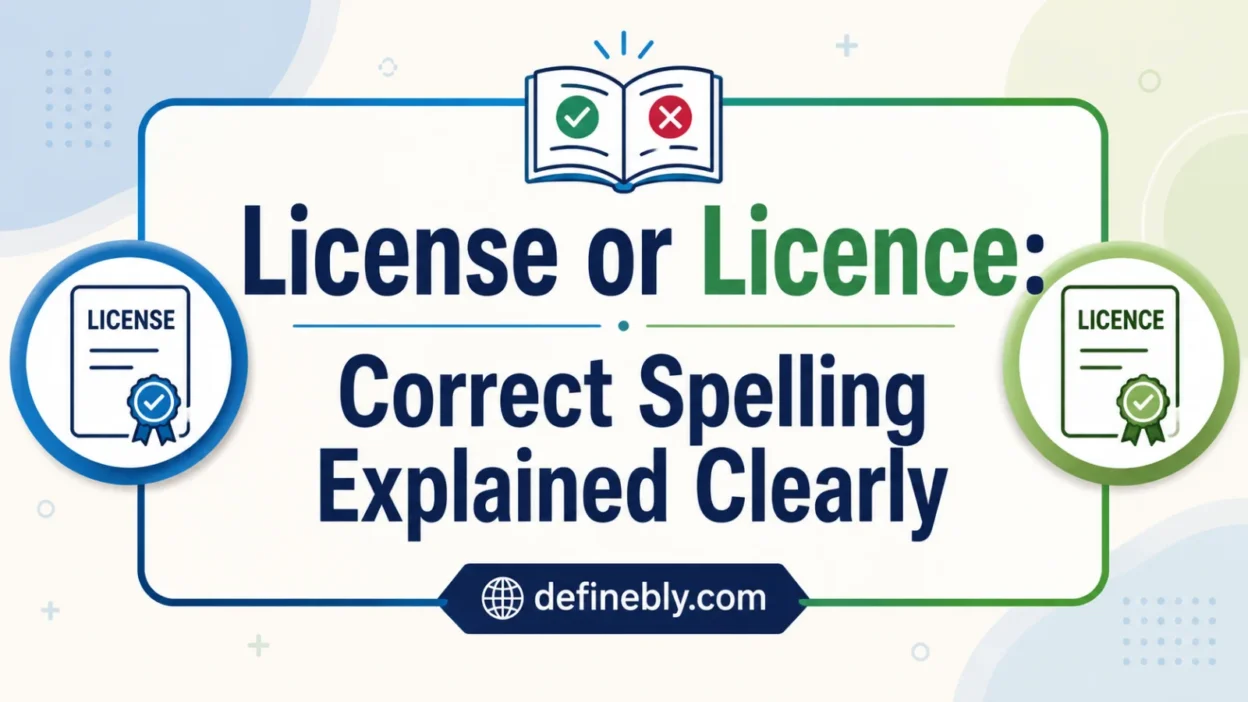
“License” and “licence” refer to the same thing: official permission granted by an authority. The difference lies in regional spelling and grammar. American English uses license for both noun and verb, while British English uses licence for the noun and license for the verb.
Which Spelling Is Correct?
Both are correct, depending on region:
- American English: license (noun and verb)
- British English: licence (noun), license (verb)
The meaning is the same in both: official permission to do something.
Why Are There Two Spellings?
The word comes from the Latin licentia, meaning “freedom” or “permission.” As English developed:
- American English simplified the spelling to license for all uses
- British English kept a grammatical distinction between noun and verb
This makes it one of the few English spelling pairs where the difference is tied to grammar.
What the Style Guides Say
- AP Style (US): license for all forms
- Chicago Manual of Style: license (US standard)
- Oxford Dictionaries (UK): licence (noun), license (verb)
- Cambridge Dictionary: follows the UK distinction
- British Council: supports the UK pattern
American sources simplify; British sources preserve the noun/verb split.
Examples in Real Use
American English (license for everything)
- I need to renew my driver’s license.
- The state will license the business next month.
- A software license agreement is required.
British English (noun vs verb)
- He renewed his driving licence.
- The authority will license the company.
- She lost her fishing licence.
Legal, Government, and Technical Contexts
- Driver’s license / driving licence: permission to drive
- Software license: a legal agreement granting usage rights
- Broadcast license: permission to operate media channels
- Professional license/licence: certification for doctors, lawyers, and others
In these contexts, matching the spelling of the relevant jurisdiction is essential for legal accuracy.
Related Word Family
- Licensed: officially permitted (adjective)
- Licensing: granting permission (noun/verb)
- Licensure: the formal certification process
- License agreement: a legal contract, common in software and business
These follow the same regional spelling rules.
Common Mistakes
- Using “licence” in American English writing
- Using “license” as a noun in British English
- Mixing US and UK spellings in one document
- Ignoring spelling consistency in official or legal documents
- Assuming the two forms are interchangeable in grammar (UK English separates them)
Quick Decision Rule
| Situation | Spelling |
|---|---|
| US English | license (all uses) |
| UK English | licence (noun), license (verb) |
| Legal/technical writing | match the jurisdiction exactly |
| SEO/global content | US spelling often has higher search volume |
| Any writing | stay consistent |
FAQs
Is “license” correct in American English?
Yes. It is the standard spelling for both noun and verb.
Is “licence” wrong in the US?
It is understood, but not standard in American writing.
Why does British English use both spellings?
To mark grammatical role: “licence” is the noun and “license” is the verb.
Do the two spellings mean the same thing?
Yes. Both refer to official permission granted by an authority.
Which spelling is used for software?
American English uses “software license,” while British English may use “software licence.”
Is it “driver’s license” or “driving licence”?
Both, depending on region: “driver’s license” in the US, “driving licence” in the UK.
Can I mix the two spellings in one document?
No. Mixing looks inconsistent and unprofessional.
Where does the word come from?
From the Latin licentia, meaning permission or freedom.
Which is better for SEO?
“License” is generally preferred for US-focused and global search traffic.
Are there similar spelling pairs?
Yes. In British English, practice/practise and advice/advise work the same way.
Conclusion
“License” and “licence” are both correct, depending on region. American English uses “license” for everything, while British English uses “licence” for the noun and “license” for the verb.