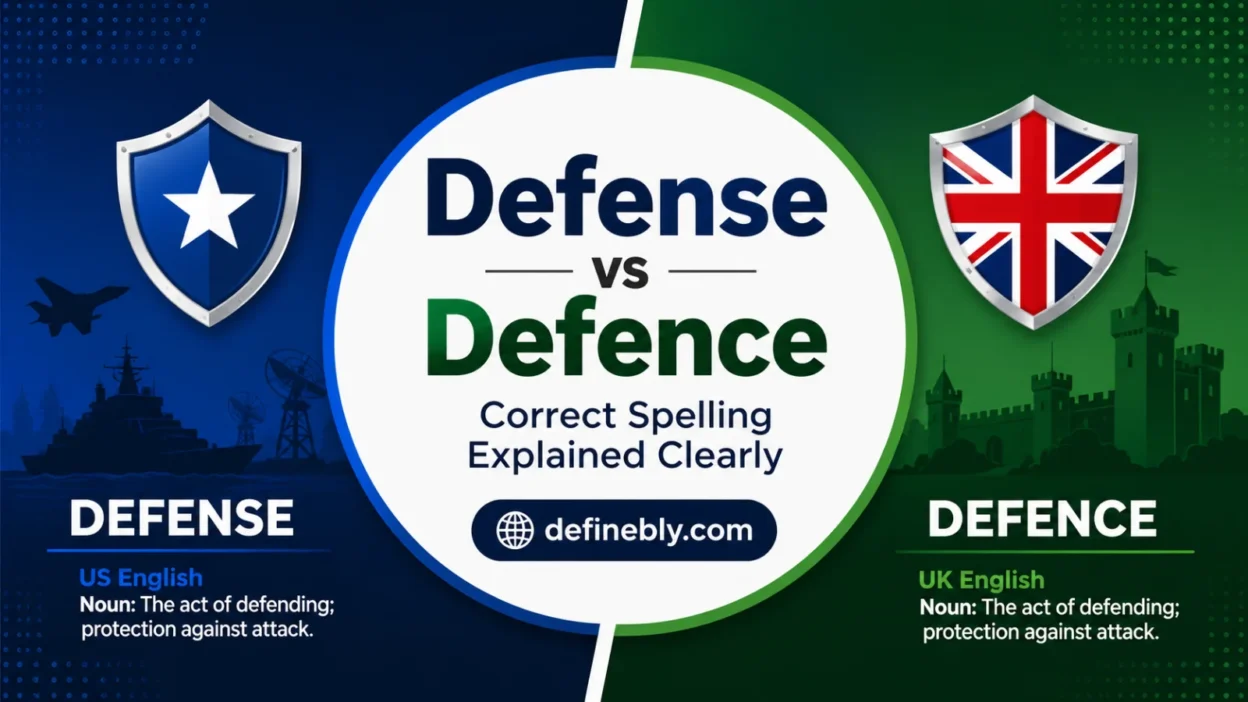
Defense vs. Defence: Which Spelling Is Correct?
Defense and defence are two correct spellings of the same English word. Both refer to protection, resistance, or the act of defending someone or something against an attack, threat, or criticism.
The difference is regional spelling preference. Defense is the standard spelling in American English, while defence is the preferred spelling in British English and many Commonwealth varieties of English.
Neither spelling is universally more correct than the other. The right choice depends on your audience and the spelling conventions you follow.
Quick Answer: Defense or Defence?
Both spellings are correct, but their usage depends on the variety of English.
| Spelling | Preferred Usage | Example |
|---|---|---|
| Defense | American English | The team played excellent defense. |
| Defence | British English | The team played excellent defence. |
The easy rule to remember:
- Use defense when writing in American English.
- Use defence when following British English conventions.
- Both spellings have the same meaning and pronunciation.
- Keep the spelling consistent throughout your writing.
What Does Defense or Defence Mean?
Defense (or defence) is a noun that means the act of protecting someone or something from danger, attack, harm, or criticism.
The word can also describe a person, group, argument, or system responsible for providing protection.
It has several common meanings:
1. Protection Against Attack
Defense refers to actions taken to protect a person, place, or country from danger or attack.
Example: The country strengthened its defense against external threats.
2. Legal Protection or Argument
In law, it refers to the arguments, evidence, or legal representation used to protect someone accused of an offense or involved in a legal dispute.
Example: The lawyer presented a strong defense in court.
3. Sports Protection
In sports, defense describes the players, tactics, or actions used to prevent an opposing team from scoring.
Example: The team’s defense stopped the opposition from scoring.
4. Justification or Explanation
Defense can also mean an explanation or argument intended to justify someone’s actions, decisions, or beliefs.
Example: She offered a reasonable defense of her decision.
All these meanings apply to both spellings.
Why Are There Two Spellings?
The difference between defense and defence comes from the historical development of English spelling.
The word traces back to Latin defensio, meaning protection or defense. It entered English through Old French defense.
Over time, spelling conventions developed differently in American and British English.
- American English standardized the spelling defense, using the ending -se.
- British English adopted and retained the spelling defence, using the ending -ce.
These regional conventions became established in dictionaries, educational materials, newspapers, and publishing standards.
The same pattern appears in other English spelling differences, such as:
- Offense vs. Offence
- License vs. Licence
- Practice vs. Practise
- Pretence vs. Pretense
However, spelling patterns are not identical across every word. It is best to learn the accepted spelling of each word rather than assume that one rule applies universally.
Defense vs. Defence in American and British English
The easiest way to choose the correct spelling is to consider your target audience.
American English: Defense
In the United States, defense is the standard spelling in everyday, academic, professional, legal, military, and sports writing.
Examples:
- The national defense budget increased this year.
- The lawyer prepared a strong defense for her client.
- Our team needs better defense to win the championship.
- The company introduced new defense measures against cyberattacks.
- He presented a convincing defense of his decision.
American dictionaries, including Merriam-Webster, use defense as the standard spelling.
British English: Defence
In British English, defence is the preferred spelling in general writing and many professional contexts.
Examples:
- The government announced a new defence policy.
- The lawyer prepared a strong defence for his client.
- The team’s defence performed well throughout the match.
- The country invested in modern defence equipment.
- She presented a reasonable defence of her actions.
British dictionaries, including Oxford and Cambridge, recognize defence as the standard British spelling.
Defense vs. Defence in Different Contexts
Both spellings can be used in several fields. The meaning stays the same, but the regional spelling convention changes.
1. Defense vs. Defence in Sports
In sports, defense refers to the players and strategies used to prevent the opposing team from scoring.
American sports coverage uses defense, while British sports coverage generally uses defence.
Examples:
- The team’s defense was strong throughout the game.
- The opposing team’s defence struggled in the second half.
- Good defense can determine the outcome of a championship.
- Their defence prevented the opponents from scoring.
2. Defense vs. Defence in Law
In legal writing, the word refers to the arguments, evidence, or legal representation used to defend a person or position.
American legal writing uses defense, while British legal writing generally uses defence.
Examples:
- The defense challenged the evidence presented by the prosecution.
- The defence questioned the reliability of the witness.
- The defendant hired an experienced defense attorney.
- The defence lawyer presented additional evidence.
3. Defense vs. Defence in Military Writing
In military contexts, the word describes measures, strategies, and systems used to protect a country or territory against attacks.
Examples:
- The United States increased its national defense spending.
- The government announced a new defence strategy.
- The military strengthened its coastal defenses.
- Advanced air defence systems were installed.
4. Defense vs. Defence in Cybersecurity
In cybersecurity, the word describes methods and technologies used to protect computer systems, networks, and information from digital threats.
Examples:
- The company improved its cybersecurity defenses.
- Strong cyber defence systems help protect sensitive information.
- The software includes several layers of defense.
- The organization introduced new cyber defence measures.
Related Words: Defense vs. Defence Word Family
Several related words come from the same root. Some follow the same American and British spelling distinction, while others use the same spelling in both varieties.
| American English | British English | Meaning |
|---|---|---|
| Defense | Defence | Protection against attack |
| Defenses | Defences | Protective measures |
| Defensive | Defensive | Intended to protect |
| Defend | Defend | To protect or support |
| Defender | Defender | A person who protects |
| Self-defense | Self-defence | Protection of oneself |
| Defenseless | Defenceless | Without protection |
| Defensiveness | Defensiveness | The tendency to react protectively |
Important: Not every related word changes its spelling. For example, defend, defender, and defensive are spelled the same in American and British English.
How To Choose the Correct Spelling
Choosing between defense and defence is straightforward when you know your audience.
1. Writing for an American Audience
Use defense in articles, essays, business documents, and other content written in American English.
Example: The team improved its defense before the final match.
2. Writing for a British Audience
Use defence when following British English spelling conventions.
Example: The team improved its defence before the final match.
3. Writing for Commonwealth Countries
Countries such as Australia and Canada generally follow British-style spelling for this word, using defence. However, always follow the relevant local publishing or institutional style guide.
4. Writing Legal or Official Documents
Follow the spelling used by the relevant jurisdiction, court, organization, or official style guide.
5. Writing SEO Content
Choose the spelling that matches the language and location of your intended readers.
For a US-focused website, defense is the natural choice. For UK-focused content, use defence.
There is no universal SEO advantage to choosing one spelling for every audience. Search performance depends on the target market, search intent, content quality, and other ranking factors.
Common Mistakes to Avoid
Although both spellings are correct, writers sometimes use them incorrectly.
1. Assuming Defence Is Incorrect
Defence is not a misspelling. It is the standard British English spelling.
2. Assuming Defense Is Only American
Although defense is preferred in American English, it is also understood and sometimes used in British contexts.
3. Mixing Both Spellings
Using defense in one section and defence in another can make an article inconsistent.
Choose one regional spelling convention and maintain it throughout your document.
4. Applying the Same Rule to Every Related Word
Not every word in the same family follows the same spelling pattern. For example, defensive does not change between American and British English.
5. Ignoring Your Target Audience
Using American spelling throughout an article intended for a British audience, or vice versa, can make the content less consistent with local writing conventions.
Frequently Asked Questions
Is Defense or Defence Correct?
Both are correct spellings. Defense is standard in American English, while defence is preferred in British English.
Is Defence Incorrect in American English?
It is understood but is not the standard American spelling. American writers should generally use defense.
Is Defense Used in British English?
Yes. British readers understand defense, but defence is the preferred spelling in standard British English.
Do Defense and Defence Have the Same Meaning?
Yes. Both words mean protection against attack, harm, or danger. They can also refer to legal arguments, sports strategies, and protective systems.
Why Does American English Use Defense Instead of Defence?
American English standardized the spelling with the -se ending, while British English retained the -ce form. Both developed from the same historical word.
Which Countries Use Defence?
The spelling defence is standard in British English and is commonly used in countries such as the United Kingdom, Australia, and Canada.
Is It Defense Attorney or Defence Attorney?
In American English, the correct term is defense attorney. In British English, defence lawyer is the more common expression.
Is It Self-Defense or Self-Defence?
Both are correct. Use self-defense in American English and self-defence in British English.
Is Defense or Defence Used in Sports?
American sports writing uses defense, while British sports writing generally uses defence. Both refer to strategies and players responsible for preventing the opposing team from scoring.
Which Spelling Is Better for SEO?
Use defense for US-focused SEO content and defence for UK-focused content. Choose the spelling that matches your target audience rather than assuming one version performs better worldwide.
What Is the Difference Between Defense and Defensive?
Defense is a noun that refers to protection or the act of defending. Defensive is an adjective describing something intended to protect or resist an attack.
Examples:
- The defense played exceptionally well.
- The team adopted a defensive strategy.
What Is the Plural of Defense or Defence?
The American plural is defenses, while the British plural is defences.
Examples:
- The building has several security defenses.
- The country strengthened its coastal defences.
Conclusion
Defense and defence are two correct regional spellings of the same English word. Both describe protection, resistance, or the act of defending someone or something against danger or attack.
The main difference is the spelling convention used in different varieties of English. Defense is the standard American English spelling, while defence is preferred in British English and many Commonwealth countries.
If you are writing for an American audience, choose defense. If your readers follow British English conventions, choose defence. In either case, use the same spelling consistently throughout your writing.
Easy rule to remember: American English = Defense; British English = Defence.