Which vs. That: Rules, Examples, and Comma Tips
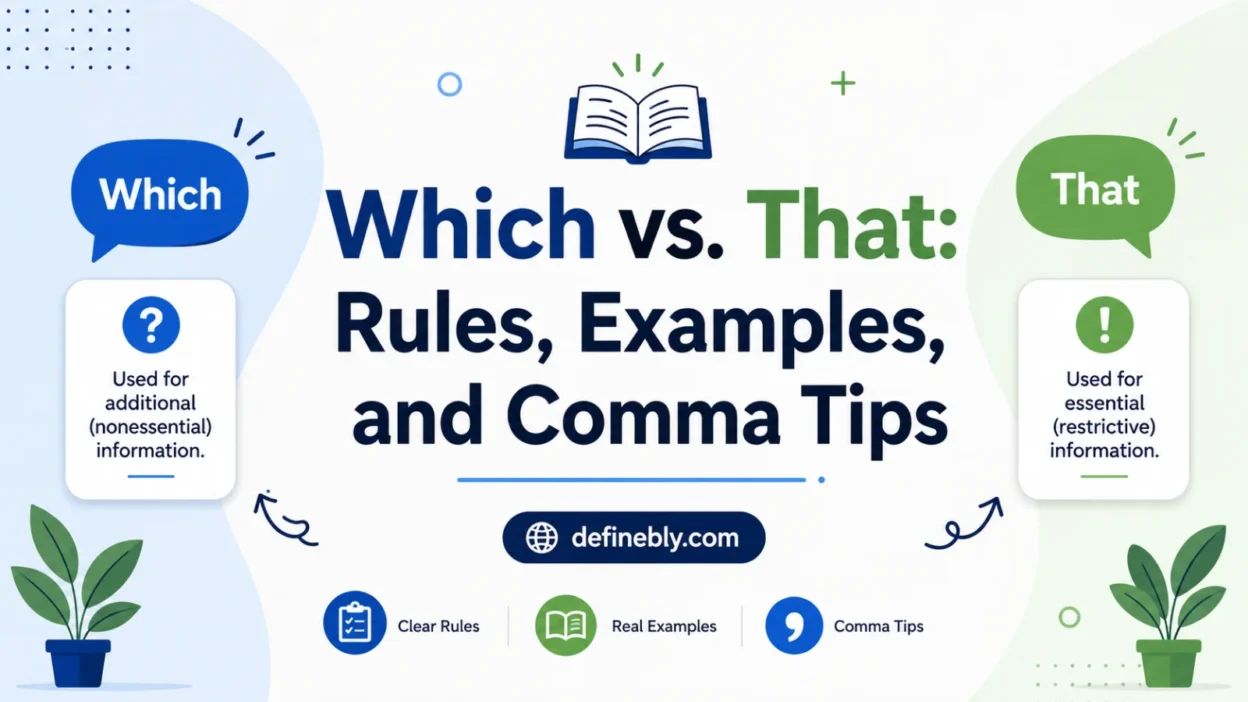
Use that for essential information and which for extra information, usually set off by commas, in edited American English. The difference depends on whether the clause identifies a noun or simply adds detail about it.
- That: The laptop that I bought last year still works well.
- Which: My laptop, which I bought last year, still works well.
In the first sentence, that I bought last year identifies which laptop you mean. In the second, which I bought last year adds information about a laptop that is already identified.
The easiest rule to remember is: that defines; which adds.
Quick Answer: Which vs. That
Use that when a clause is necessary to identify or limit the noun.
Example:
The file that contains the invoice is on my desktop.
The clause that contains the invoice tells readers which file you mean.
Use which when a clause adds extra information that is not necessary to identify the noun. Set off a nonessential clause with commas.
Example:
The file, which contains the invoice, is on my desktop.
The sentence still identifies the file without the extra clause: “The file is on my desktop.”
| Clause Type | Usual Word in Edited American English | Comma Rule | Example |
|---|---|---|---|
| Essential information | That | No commas around the clause | The phone that rang was mine. |
| Extra information | Which | Use commas | My phone, which rang twice, was on silent. |
| Essential information about a person | Who is often preferred | Usually no commas | The employee who called was helpful. |
| Extra information about a thing | Which | Use commas | The laptop, which is new, runs quickly. |
This distinction helps readers understand exactly what a sentence means. However, which can also introduce essential clauses in some styles, including British English. The that versus which distinction is a useful convention for clear, edited American writing, not an absolute rule followed by every English writer.
The Rule Explained
What Is an Essential Clause?
An essential clause, also called a restrictive clause, identifies or limits the noun it modifies. Without it, readers may not know exactly which person or thing you mean.
In edited American English, that is commonly used to introduce an essential clause referring to a thing.
Examples:
- The report that you sent yesterday needs one more chart.
- The shoes that are on sale are in the front row.
- The password that you sent me does not work.
- The restaurant that opened last month is already popular.
In each example, the clause helps identify the specific report, shoes, password, or restaurant.
For example:
The emails that arrived after midnight were marked urgent.
This sentence identifies the emails that arrived after midnight. It does not necessarily refer to every email.
What Is a Nonessential Clause?
A nonessential clause, also called a nonrestrictive clause, adds information about a noun that is already sufficiently identified. Removing the clause does not change which person or thing the sentence refers to.
Use which to introduce a nonessential clause referring to a thing, and set the clause off with commas.
Examples:
- My car, which needs new tires, is parked outside.
- Our office, which opened in 2021, is downtown.
- The report, which took three weeks to finish, was approved today.
- My phone, which rang twice, was on silent.
For example:
My car, which needs new tires, is parked outside.
The main point is that the car is parked outside. The information about its tires is additional detail.
How Commas Change the Meaning
The presence or absence of commas can change what a sentence communicates.
Compare these sentences:
Essential: The snacks that were gluten-free were placed on the side table.
This means the gluten-free snacks were placed on the side table. Other snacks may not have been placed there.
Nonessential: The snacks, which were gluten-free, were placed on the side table.
This presents the fact that the snacks were gluten-free as additional information about the snacks being discussed. It suggests that all those snacks were gluten-free.
Another example:
- Essential: The cars that had expired permits were towed.
- Nonessential: The cars, which had expired permits, were towed.
The first identifies the cars that were towed by their expired permits. The second presents the expired permits as extra information about the cars being discussed.
The distinction is not simply about where you pause when speaking. It is about whether the clause identifies the noun or adds a side detail.
When to Use That
Use That to Identify a Specific Thing
Use that when the clause tells readers which thing you mean.
Examples:
- The jacket that I left in the car is still damp.
- The movie that won the award is streaming now.
- The password that you sent me does not work.
- The form that requires a signature is on top.
- The laptop that has the blue sticker is mine.
Each clause narrows the reference to a particular item.
Use That to Limit a Group
Use that when you are referring to only some members of a larger group.
Examples:
- The students that submitted the form received a confirmation email.
- The books that are on the top shelf belong to my sister.
- The snacks that were gluten-free were placed on the side table.
- The emails that arrived after midnight were marked urgent.
These sentences do not necessarily refer to every student, book, snack, or email. The clause identifies the relevant subset.
For people, who is generally preferred in polished writing:
- The students who submitted the form received a confirmation email.
Using that for people is possible, but who is often the more natural choice in formal and professional American English.
Do Not Put Commas Around an Essential That Clause
An essential clause is part of the information needed to identify the noun, so it should not be separated from the noun with commas.
Incorrect: The app, that tracks expenses, is free.
Correct: The app that tracks expenses is free.
The clause identifies which app is being discussed.
Another example:
Incorrect: The students, that submitted the form, received a confirmation email.
Better: The students who submitted the form received a confirmation email.
If you are using that, the standard punctuation is:
The students that submitted the form received a confirmation email.
When to Use Which
Use Which to Add Extra Information
Use which when the noun is already clear and the clause provides additional detail.
Examples:
- My laptop, which I use for work, is almost five years old.
- The jacket, which I left in the car, is still damp.
- The app, which I downloaded yesterday, already needs an update.
- The presentation, which starts at 10 a.m., will be recorded.
- The report, which took three weeks to finish, was approved today.
In each sentence, the clause adds information rather than identifying which laptop, jacket, app, presentation, or report is meant.
Use Commas Around a Nonessential Which Clause
When a nonessential which clause appears in the middle of a sentence, place commas before and after it.
Correct:
The project, which started in January, is almost finished.
When the clause appears at the end of a sentence, use a comma before it.
Correct:
We updated the policy, which caused some confusion.
When it begins a sentence as a relative clause referring to the preceding idea, the usual construction is different. In standard writing, which can refer to a complete preceding clause or event.
Use Which to Refer to an Entire Previous Idea
Sometimes, which refers not to one noun but to the entire idea expressed in the preceding clause.
Examples:
- The deadline moved up, which surprised the team.
- She accepted the offer, which made her parents proud.
- The server went down, which delayed the launch.
- He forgot to save the file, which meant he had to start again.
In these examples, which refers to the event or situation described before the comma.
Do not replace which with that in this construction.
Incorrect: The deadline moved up, that surprised the team.
Correct: The deadline moved up, which surprised the team.
Can Which Introduce an Essential Clause?
Yes. You may encounter which in essential clauses, particularly in British English and in some American publications and style traditions.
Example:
The book which you recommended is on my desk.
This is understandable and accepted in some styles. However, in edited American English, many writers prefer:
The book that you recommended is on my desk.
If your goal is consistent, clear American usage, using that for essential clauses and which for nonessential clauses is a practical convention.
Common Mistakes With Which and That
Mistake 1: Using Which Without Commas for Extra Information
Incorrect: My laptop which I use for work is almost five years old.
If the information about using the laptop for work is an aside, add commas.
Correct: My laptop, which I use for work, is almost five years old.
Without commas, the clause may be read as identifying which laptop you mean, rather than adding extra information.
Mistake 2: Using Commas With an Essential Clause
Incorrect: The files, that were missing, have been restored.
Correct: The files that were missing have been restored.
The clause identifies which files have been restored. If you want to use a relative pronoun for people, prefer who where appropriate.
Mistake 3: Using That for Nonessential Information
Incorrect: My phone, that I bought yesterday, already needs charging.
Correct: My phone, which I bought yesterday, already needs charging.
In this sentence, the clause adds extra information about an already identified phone. Use which with commas.
Mistake 4: Ignoring How Commas Affect Meaning
Compare:
- The keys that are on the counter are mine.
- The keys, which are on the counter, are mine.
The first sentence identifies the keys that are on the counter. Other keys may belong to someone else.
The second presents the location as extra information about the keys being discussed.
Neither sentence is automatically better. The correct choice depends on what you intend to say.
Mistake 5: Using That or Which When Who Is Better for People
For people, who is often the most natural choice in polished American English.
Less natural in many contexts: The employee that helped me was kind.
Better: The employee who helped me was kind.
For things, that and which are commonly used according to the essential-versus-extra distinction. For people, prefer who unless there is a reason to use another construction.
Which vs. That: Correct Examples
| Sentence | Correct Choice | Why |
|---|---|---|
| The files that were missing have been restored. | That | Identifies which files. |
| The files, which were missing yesterday, have been restored. | Which | Adds extra detail. |
| The dog that barked all night lives next door. | That | Identifies which dog. |
| My dog, which rarely barks, woke me up. | Which | Adds extra information. |
| The movie that won the award is streaming now. | That | Identifies which movie. |
| The movie, which won the award, is streaming now. | Which | Presents the award detail as an aside. |
| The laptop that has the blue sticker is mine. | That | Identifies the laptop. |
| My laptop, which has a blue sticker, is mine. | Which | Adds a detail about the laptop. |
| The policy that changed last week affects new employees. | That | Identifies which policy. |
| The policy, which changed last week, affects new employees. | Which | Adds extra information about the policy. |
More examples:
- The restaurant that opened last month is already popular.
- The restaurant, which opened last month, is already popular.
- The password that you sent me does not work.
- My password, which you sent yesterday, does not work.
- The form that requires a signature is on top.
- The form, which requires a signature, is on top.
Notice that the choice depends on meaning, not just the noun itself. A restaurant, password, or form can be described with either that or which, depending on whether the clause is essential or nonessential.
An Easy Way to Remember Which vs. That
Try removing the clause from the sentence and reading the result.
If the clause is needed to identify the noun, use that in the standard edited-American-English pattern.
Example:
The car that needs gas is in the driveway.
The clause that needs gas identifies which car is meant.
If the clause adds a side detail, use which with commas.
Example:
My car, which needs gas, is in the driveway.
The noun my car is already identified. The information about needing gas is extra.
Remember this short rule:
That defines. Which adds.
Use it as a practical guide, not an absolute rule for every English variety or style guide.
Frequently Asked Questions
What Is the Difference Between Which and That?
In edited American English, that usually introduces essential information that identifies a noun. Which usually introduces extra information set off by commas.
- The shirt that has a stain is in the laundry.
- My shirt, which has a stain, is in the laundry.
The first identifies the shirt. The second adds detail about an already identified shirt.
When Should I Use That?
Use that when the clause identifies or limits the noun.
Example:
The house that has a red door is ours.
The clause tells readers which house you mean.
When Should I Use Which?
Use which when a clause adds nonessential information about a thing.
Example:
Our house, which has a red door, is on the corner.
The clause adds a detail about the house without identifying which house is meant.
Do I Need a Comma Before Which?
Use a comma before which when it introduces a nonessential clause.
Correct:
My bike, which has a flat tire, is in the garage.
Do not use a comma if the clause is essential and you are following the standard American distinction.
Example:
The bike that has a flat tire is in the garage.
Do I Need a Comma Before That?
Usually, no. When that introduces an essential clause, do not place a comma before it.
Correct:
The bike that has a flat tire is in the garage.
A comma may appear before that for an unrelated grammatical reason in a more complex sentence, but it should not be used to set off an essential that clause.
Can Which Be Used Instead of That?
Sometimes. Which can introduce essential clauses in some styles and varieties of English.
Example:
The book which you recommended is on my desk.
For consistent edited American English, the book that you recommended is often the preferred version.
Can That Be Used Instead of Which?
Not when which introduces a nonessential clause set off by commas.
Incorrect: My car, that is parked outside, needs gas.
Correct: My car, which is parked outside, needs gas.
Use which for the extra information in this sentence.
How Can I Tell Whether a Clause Is Essential?
Ask whether the clause helps identify which person or thing you mean.
- Essential: The file that contains the invoice is on my desktop.
- Nonessential: The file, which contains the invoice, is on my desktop.
Removing an essential clause may make the reference unclear or change the meaning. Removing a nonessential clause leaves the main statement intact.
Which Is Correct: “The One That” or “The One Which”?
In edited American English, the one that is usually the more natural choice when the clause identifies the item.
Correct:
Choose the one that fits best.
You may encounter the one which in some contexts, but the one that is the usual choice in this construction.
Should I Use Which or That for People?
Use who for people in most polished American writing.
Better:
The teacher who helped me was patient.
Use that mainly for things, animals, groups, and ideas. Use which for nonessential information about things and ideas.
Conclusion
Use that for essential information and which for extra information, usually set off by commas, in edited American English.
The key is to determine whether the clause identifies the noun or simply adds a detail. If it defines which thing you mean, that is usually the clearest choice. If it adds a side note about an already identified thing, use which with commas.
Remember: That defines. Which adds.