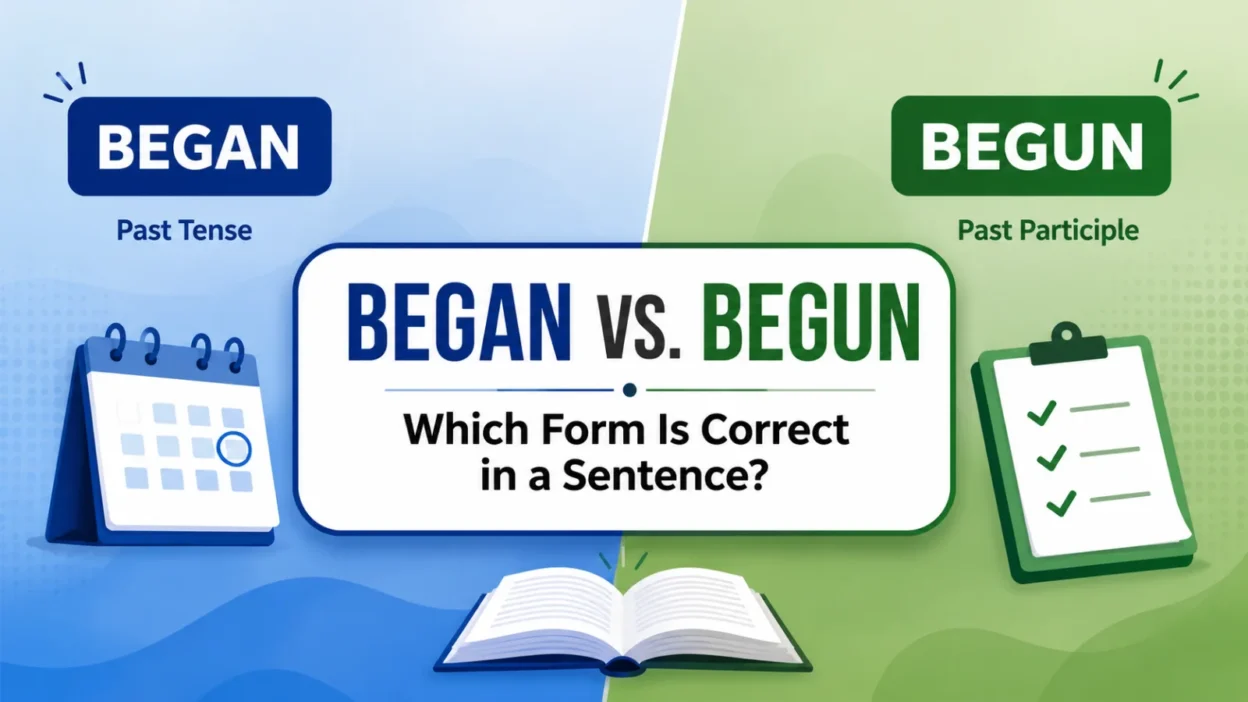
Began is the simple past tense of begin. Use it when no helping verb is present: The show began at eight.
Begun is the past participle. It requires a helping verb — have, has, had, was, were, is, been — or appears as an adjective before a noun: The show has begun. A newly begun tradition.
The single most common error: “has began” — always wrong. Whenever have, has, or had precedes begin, the form must be begun.
Where These Forms Come From
Begin traces to Old English beginnan, a strong class III verb. In Old English and the Germanic languages, strong verbs form their past tenses not by adding -ed but through ablaut — a systematic shift in the root vowel. The pattern for this verb class follows i/a/u:
Present stem: i (beginnan)
Past stem: a (begann)
Past participle stem: u (begunnen → begun)
This is not a quirk specific to begin. It is the same pattern running through an entire family of related verbs, all of which behave identically.
The Full Tense Chart
| Tense | Form | Example |
|---|---|---|
| Present | begin | The ceremony begins at noon. |
| Simple past | began | The ceremony began at noon. |
| Present perfect | has/have begun | The ceremony has begun. |
| Past perfect | had begun | The ceremony had already begun. |
| Present participle | beginning | The ceremony is beginning. |
| Passive voice | was/were begun | The tradition was begun by the founders. |
The test: if any helping verb precedes the verb form, use begun. Without a helping verb and without a following noun, use began.
The Sibling Verb Family
Begin belongs to a documented class of English irregular verbs, all following the same i/a/u vowel shift. Once you know the pattern, every verb in the family works identically.
| Verb | Simple Past | Past Participle |
|---|---|---|
| begin | began | begun |
| sing | sang | sung |
| ring | rang | rung |
| drink | drank | drunk |
| swim | swam | swum |
| sink | sank | sunk |
| spring | sprang | sprung |
| shrink | shrank | shrunk |
In every case: the middle form (began, sang, swam) is the simple past, used without a helping verb. The final form (begun, sung, swum) is the past participle, used with a helping verb. “I have drank” is wrong for exactly the same reason “I have began” is wrong.
Passive Voice — Where Writers Second-Guess Themselves
The original rule — begun requires a helping verb — applies equally to passive constructions. The auxiliary in a passive sentence (was, were, is, are, will be) serves the same function as have/has/had in an active perfect: it triggers the past participle form.
The tradition was begun by the founding members. ✔ (was = helping verb → begun)
The review process was begun immediately after the audit. ✔
The project is considered well begun at this stage. ✔
The tradition was began by the founding members. ✗
The review process was began immediately after the audit. ✗
The logic is identical across active and passive constructions. Any auxiliary verb — regardless of whether the sentence is active or passive — requires the past participle begun.
“It’s Begun” and the Contraction Trap
When a contraction obscures the auxiliary, writers sometimes second-guess which form is correct.
It’s begun to rain. ✔ — it’s = it has; the auxiliary has is present; past participle begun is correct.
It’s been begun before — and abandoned. ✔ — has been = auxiliary chain; begun is correct.
Expanding the contraction confirms the answer: it has begun. If expanding reveals an auxiliary, the past participle is always required.
“Begun” as an Adjective
In formal prose, begun occasionally appears as an attributive adjective before a noun, without any helping verb:
A well-begun initiative is more than half done. (proverb variation)
The newly begun construction disrupted the neighborhood for months.
Here begun is modifying a noun (initiative, construction), not forming a perfect or passive tense. This is a correct and documented use — a past participle functioning as an adjective — and it does not require a helping verb in this role.
Why “It Begun Raining” Persists in Speech
Like sung and rung, the form begun was used as a simple past tense in earlier varieties of English and survives in some American dialects: “It begun to rain about noon.” This has historical precedent — strong verbs in earlier English were less strictly sorted into simple-past vs. participle roles.
In standard edited American English today, begun as a simple past is nonstandard. All major authorities — Merriam-Webster, Garner’s, the Chicago Manual of Style — treat it as an error outside dialectal speech. For formal and professional writing, the distinction is non-negotiable: began for simple past, begun for past participle.
Common Mistakes and Quick Fixes
Mistake: She has began the project.
Fix: She has begun the project. — has requires the past participle.
Mistake: The game begun late last night.
Fix: The game began late last night. — no helping verb; simple past form.
Mistake: They had began planning months before the event.
Fix: They had begun planning months before the event. — had requires the past participle.
Mistake: The renovation was began last spring.
Fix: The renovation was begun last spring. — passive voice; was requires the past participle.
Mistake: It begun raining before we reached shelter.
Fix: It began raining before we reached shelter. — no helping verb; simple past.
Examples Side by Side
The concert began at eight and ran for two and a half hours. (simple past — no helping verb)
The concert has already begun; take your seats quietly. (present perfect — has)
By the time we arrived, the concert had already begun. (past perfect — had)
The tradition was begun in 1948 and continues today. (passive — was)
A well-begun project saves time later. (adjective — modifying project)
Quick Practice
Choose the correct form.
- The meeting [began / begun] ten minutes before I arrived.
- She has [began / begun] preparing for the presentation.
- By noon, it had already [began / begun] to rain.
- The program was [began / begun] by a local nonprofit in 2018.
- They [began / begun] construction on the new wing last month.
- It’s [began / begun] — there’s no turning back now.
Answers: 1. began (simple past, no helping verb) — 2. begun (has = auxiliary) — 3. begun (had = auxiliary) — 4. begun (was = passive auxiliary) — 5. began (simple past, no helping verb) — 6. begun (it’s = it has = auxiliary)
FAQs
Is it “has began” or “has begun”?
Has begun is always correct. The auxiliary has requires a past participle, and begun is the past participle of begin. Began is the simple past and never follows has, have, or had.
Can “begun” ever appear without a helping verb?
Yes — in one pattern: as an attributive adjective before a noun, as in “a well-begun initiative” or “the newly begun project.” In this use, begun modifies the noun directly and does not need an auxiliary. In all other cases, a helping verb is required.
Is “was begun” correct?
Yes. Passive voice uses begun with the auxiliaries was, were, is, are, or will be: “The tradition was begun by the founders.” The passive auxiliary triggers the past participle just as have/has/had does in active perfect constructions.
Why do people say “it begun” in casual speech?
The form has historical roots — in earlier English, begun appeared as a simple past in some contexts. This usage survives in certain American dialects. It is nonstandard in edited prose, but it is not a random error: it follows a historically attested pattern in the verb family.
What other verbs follow the same begin/began/begun pattern?
All verbs in the Germanic i/a/u ablaut class: sing/sang/sung, ring/rang/rung, drink/drank/drunk, swim/swam/swum, sink/sank/sunk, spring/sprang/sprung. Every one uses the middle form for simple past and the final form for past participle — no helping verb needed for the middle form, always required for the final form.
The Bottom Line
Began stands alone — simple past, no helping verb required. Begun never stands alone in a standard sentence — it always follows an auxiliary (have, has, had, was, were, is, been, will be) or modifies a noun as an adjective. The rule is the same as for every other verb in the i/a/u ablaut family: middle form for simple past, final form for past participle. Scan for a helping verb and the correct choice becomes automatic.
Conclusion
The began/begun choice comes down to one habit: scan for a helping verb. No helper, use “began.” A helper like have, has, had, was, or were, use “begun.” Once that check becomes automatic, the mix-up stops for good.