Less vs. Fewer: Rules, Examples, and Common Mistakes
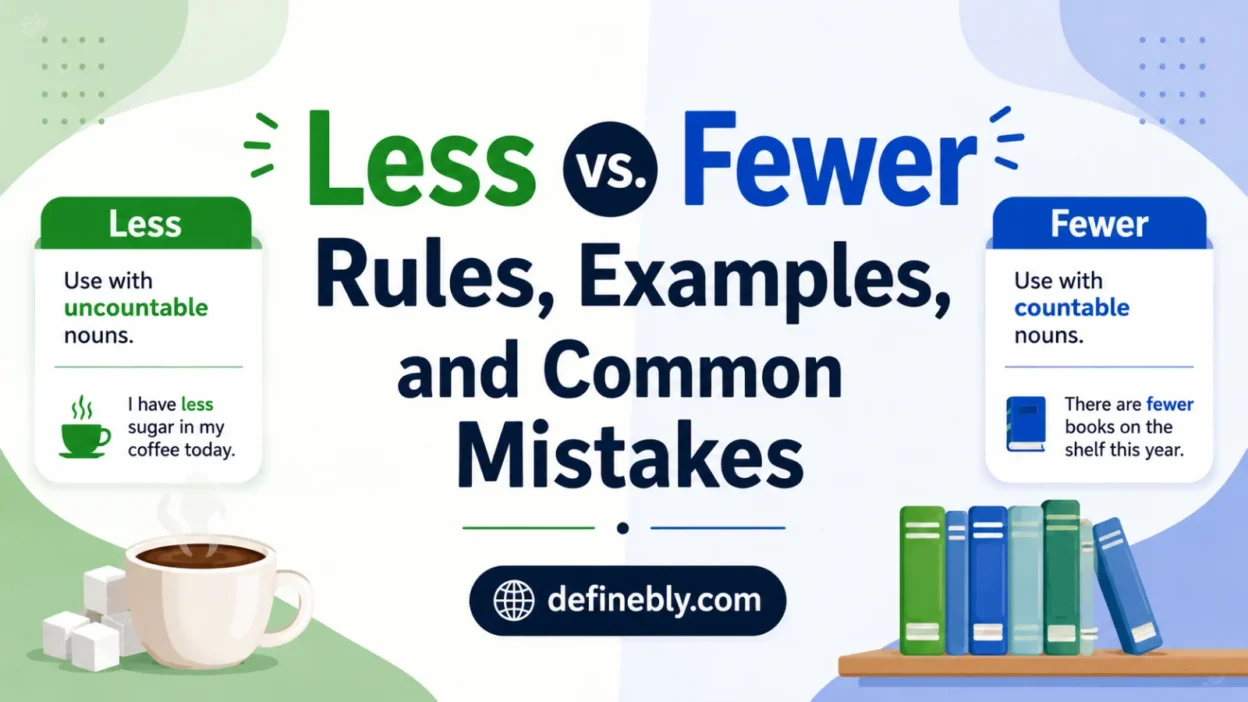
Less and fewer both describe a smaller quantity, but they are used in different situations. Use fewer with countable plural nouns and less with uncountable nouns, amounts, measurements, and degree.
- Fewer: We had fewer meetings this week.
- Less: We had less work this week.
The easiest rule to remember is this: use fewer for things you count individually and less for amounts you measure or treat as a whole.
Quick Answer: Less vs. Fewer
Use fewer when referring to a smaller number of separate, countable things.
Examples:
- Fewer books
- Fewer emails
- Fewer cars
- Fewer mistakes
- Fewer students
Use less when referring to an amount, an uncountable noun, a measurement, or a degree.
Examples:
- Less water
- Less money
- Less time
- Less traffic
- Less stress
| Situation | Correct Word | Example |
|---|---|---|
| Countable plural nouns | Fewer | Fewer problems |
| Uncountable nouns | Less | Less noise |
| Degree or intensity | Less | Less expensive |
| Individual items | Fewer | Fewer tickets |
| A measured total | Less | Less than two hours |
| Countable units | Fewer | Fewer workdays |
One important distinction: the presence of a number does not automatically mean you should use fewer. The choice depends on whether the sentence refers to individual countable items or a total amount or measurement.
The Grammar Rule Explained
What Does Fewer Mean?
Fewer means a smaller number of separate things or people. It is generally used with plural countable nouns.
Countable nouns name things you can count individually.
Examples:
- Fewer chairs
- Fewer calls
- Fewer applicants
- Fewer errors
- Fewer assignments
You can count these items as one chair, two chairs, three chairs, and so on.
Here are some examples in sentences:
- Fewer students signed up this year.
- The store sold fewer laptops in April.
- We made fewer mistakes this time.
- The team received fewer complaints.
- There are fewer cars in the parking lot.
Each noun refers to separate items or people, so fewer is the appropriate choice.
What Does Less Mean?
Less means a smaller amount, degree, or measured quantity. It is generally used with uncountable nouns and expressions of measurement.
Uncountable nouns are usually treated as a whole rather than counted individually.
Examples:
- Less coffee
- Less patience
- Less information
- Less traffic
- Less homework
Use less in sentences such as these:
- I need less sugar in my coffee.
- She has less patience today.
- We had less homework over the weekend.
- There was less noise in the room.
- The project created less stress than expected.
You can count packets of sugar, assignments, or noise complaints. However, when you refer to sugar, homework, or noise as a general amount, less is the natural choice.
Less vs. Fewer: Compare the Meaning
Sometimes, two sentences describe nearly the same situation but focus on different things.
- Fewer cars: There were fewer cars on the road.
- Less traffic: There was less traffic on the road.
Cars are individual vehicles that can be counted. Traffic refers to the overall amount of vehicle movement or congestion.
Another example:
- Fewer mistakes: We made fewer mistakes in the revised report.
- Less confusion: The revised report caused less confusion.
Mistakes can be counted individually, while confusion is treated as a general condition or degree.
When to Use Fewer
Use Fewer With Countable Plural Nouns
Use fewer when you mean a smaller number of people, places, objects, events, or other countable things.
Examples:
- Fewer employees attended the meeting.
- We received fewer applications this month.
- The revised test contains fewer questions.
- The company had fewer complaints this year.
- There are fewer seats available.
A useful test is to ask whether you can count the items separately.
For example:
- Five students → fewer students
- Ten laptops → fewer laptops
- Three mistakes → fewer mistakes
- Eight tickets → fewer tickets
If the noun refers to individual countable units, fewer is usually correct.
Use Fewer With Countable Units of Time or Measurement
Use fewer when you are counting separate units rather than describing a single measured total.
Examples:
- This month has fewer workdays than last month.
- I have fewer one-dollar bills in my wallet.
- The schedule includes fewer ten-minute breaks.
- We had fewer meetings this week.
- The revised recipe uses fewer cups of flour.
In these examples, workdays, bills, breaks, meetings, and cups are countable units.
Compare:
- The meeting lasted less than 30 minutes.
- We scheduled fewer 30-minute meetings this month.
The first sentence describes a duration. The second counts individual meetings.
When to Use Less
Use Less With Uncountable Nouns
Use less when referring to a smaller amount of something that is not normally counted as separate units in the sentence.
Examples:
- I need less sugar in my coffee.
- She has less free time this week.
- We used less water during the repair.
- The new plan requires less energy.
- He has less experience than the other candidate.
Other common expressions include less information, less equipment, less patience, and less work.
The key is the meaning of the noun in context. If you are talking about a general amount rather than individual units, less is usually appropriate.
Use Less to Compare Degree or Intensity
Use less when comparing how strong, difficult, expensive, stressful, or noticeable something is.
Examples:
- This route is less stressful.
- The second option is less expensive.
- The instructions are less confusing now.
- Today feels less busy than yesterday.
- The new process is less complicated.
Here, less modifies an adjective or describes a lower degree of a quality. There is no countable plural noun that requires fewer.
Use Less With Measured Totals
Use less when comparing an overall amount, duration, distance, weight, or cost.
Examples:
- The repair cost less than $100.
- The meeting lasted less than an hour.
- The trail is less than three miles long.
- The package weighs less than five pounds.
- The movie is less than two hours long.
Although dollars, hours, miles, and pounds can be counted as units, these sentences treat them as measurements of a total amount.
Compare:
- Less than two hours: The movie is less than two hours long.
- Fewer than two hours: This is generally not the standard choice when describing a single duration.
- Fewer hours: I worked fewer hours this week.
Use less than for a measured total and fewer when counting separate units such as work hours across a schedule.
Less Than vs. Fewer Than
The distinction between less than and fewer than follows the same basic rule.
Use Fewer Than With Countable Nouns
Examples:
- Fewer than ten students were absent.
- Fewer than five tickets remain.
- Fewer than three employees joined the call.
- Fewer than 20 applications were submitted.
- Fewer than 100 people attended the event.
The words after fewer than refer to countable people or items.
Use Less Than With Amounts and Measurements
Examples:
- The repair took less than an hour.
- The jacket costs less than $50.
- The package weighs less than two pounds.
- The project used less than a gallon of paint.
- The trip took less than a week.
These sentences describe a cost, duration, weight, or amount.
Is It “10 Items or Less” or “10 Items or Fewer”?
In careful, formal writing, “10 items or fewer” follows the traditional countable-noun rule because individual items can be counted.
However, “10 items or less” is common in everyday English, especially on store signs.
Both expressions are widely understood, but 10 items or fewer is the more precise choice when following the traditional distinction.
When Not to Use Less or Fewer
Do Not Use Less With Clearly Countable Plural Nouns in Formal Writing
In careful writing, use fewer with countable plural nouns.
Incorrect: There were less people at the meeting.
Correct: There were fewer people at the meeting.
More examples:
- Incorrect: We had less customers today.
- Correct: We had fewer customers today.
- Incorrect: The report had less errors.
- Correct: The report had fewer errors.
- Incorrect: There are less seats available.
- Correct: There are fewer seats available.
People, customers, errors, and seats can all be counted individually.
Do Not Use Fewer With Uncountable Nouns
Use less when a noun refers to an uncountable amount.
Incorrect: I have fewer patience today.
Correct: I have less patience today.
Other examples:
- Incorrect: She wants fewer homework.
- Correct: She wants less homework.
- Incorrect: The room has fewer light.
- Correct: The room has less light.
- Incorrect: We need fewer information.
- Correct: We need less information.
The nouns patience, homework, light, and information are treated as amounts in these sentences.
Do Not Choose Fewer Just Because a Number Appears
A number does not automatically require fewer. Look at what the sentence measures or counts.
Incorrect: The movie is fewer than two hours long.
Correct: The movie is less than two hours long.
Incorrect: The repair cost fewer than $50.
Correct: The repair cost less than $50.
Incorrect: The trail is fewer than four miles long.
Correct: The trail is less than four miles long.
These sentences describe a duration, cost, or distance as a total measurement, so less is the standard choice.
Common Mistakes With Less and Fewer
Mistake 1: Using Less With People or Countable Objects
Incorrect: We had less guests than expected.
Correct: We had fewer guests than expected.
Guests are individual people, so fewer is appropriate.
Incorrect: There are less seats available.
Correct: There are fewer seats available.
Seats are countable objects.
Mistake 2: Using Fewer With General Amounts
Incorrect: I need fewer coffee today.
Correct: I need less coffee today.
Coffee is treated as an amount in this sentence.
Incorrect: There was fewer traffic this morning.
Correct: There was less traffic this morning.
Traffic refers to the overall amount of vehicle movement or congestion.
Mistake 3: Confusing Less Than and Fewer Than
Incorrect: Fewer than an hour passed before the meeting began.
Better: Less than an hour passed before the meeting began.
Incorrect: Less than ten students were absent.
Better: Fewer than ten students were absent.
Use less than for a measured duration and fewer than for a count of students.
Mistake 4: Using Less Calories Instead of Fewer Calories
In edited writing, fewer calories is the standard choice because calories are countable units.
Preferred: This snack has fewer calories than the original version.
Similarly, use fewer grams, fewer servings, or fewer items when you mean a smaller number of countable units. Use less when referring to a general amount of an uncountable substance.
Mistake 5: Assuming Every Noun Is Always Countable or Uncountable
Some nouns can be countable or uncountable depending on their meaning.
| Noun | Use Less | Use Fewer |
|---|---|---|
| Coffee | I drank less coffee this week. | We ordered fewer coffees than usual. |
| Chicken | I ate less chicken this month. | The farm has fewer chickens now. |
| Experience | She has less experience than her colleague. | The trip gave us fewer memorable experiences than expected. |
| Work | I have less work this week. | We completed fewer assignments this week. |
| Time | We have less time than expected. | The schedule has fewer time slots available. |
In the countable examples, the noun refers to separate servings, animals, events, assignments, or slots. In the uncountable examples, it refers to an overall amount or concept.
Less vs. Fewer: Correct Examples
| Sentence | Correct Word | Reason |
|---|---|---|
| We need fewer chairs. | Fewer | Chairs are countable. |
| I need less coffee. | Less | Coffee is treated as an amount. |
| Fewer people attended this year. | Fewer | People can be counted. |
| She has less free time now. | Less | Time is treated as an amount. |
| The test had fewer questions. | Fewer | Questions are countable. |
| The room had less light. | Less | Light is treated as an amount. |
| The trip took less than a week. | Less | A week is a measured duration. |
| This month has fewer workdays. | Fewer | Workdays are countable units. |
| The new plan uses less energy. | Less | Energy is treated as an amount. |
| The team handled fewer support tickets. | Fewer | Tickets are countable. |
More examples:
- There are fewer cars in the parking lot.
- There is less space in the closet.
- We made fewer mistakes this time.
- I feel less pressure now.
- The project took less than a week.
- The store received fewer online orders.
- We had fewer delays after the update.
- She spent less money this month.
- The company needs fewer employees for this task.
- The new process requires less effort.
An Easy Way to Remember Less vs. Fewer
Use this simple test:
Can you count the individual items? Use fewer.
Examples:
- Fewer books
- Fewer calls
- Fewer students
- Fewer tasks
Are you describing an amount, measurement, or degree? Use less.
Examples:
- Less water
- Less money
- Less time
- Less work
The shortest memory trick is:
Fewer = number. Less = amount.
Remember these common comparisons:
- Fewer cars, less traffic
- Fewer tasks, less work
- Fewer mistakes, less confusion
- Fewer workdays, less time
- Fewer dollar bills, less money overall
Frequently Asked Questions
What Is the Difference Between Less and Fewer?
Fewer is generally used with countable plural nouns, while less is used with uncountable nouns, amounts, measurements, and degree.
- Fewer emails
- Less work
When Should I Use Fewer?
Use fewer when referring to a smaller number of separate, countable things or people.
Example: We had fewer guests than expected.
Guests can be counted individually.
When Should I Use Less?
Use less when referring to a smaller amount, a measured total, or a lower degree.
Example: I need less noise while I study.
Noise is treated as an amount in this sentence.
Is It Less People or Fewer People?
Fewer people is the standard choice in careful writing because people are countable.
Example: Fewer people came to the event this year.
Is It Less Money or Fewer Money?
Less money is correct when referring to money as an overall amount.
Example: I spent less money this month.
Use fewer when counting separate units of money, such as bills or coins.
Is It Less Time or Fewer Time?
Less time is correct when referring to the overall amount of time available.
Example: We have less time than we expected.
Use fewer when counting separate time units, such as workdays, appointments, or time slots.
Is It Less Calories or Fewer Calories?
Fewer calories is the preferred choice in standard edited writing because calories are countable units.
Example: This snack has fewer calories than the original version.
Is It Less Than or Fewer Than?
Use fewer than with countable plural nouns and less than with amounts, measurements, and degree.
- Fewer than ten students were absent.
- The repair took less than an hour.
Is “10 Items or Less” Wrong?
“10 items or fewer” is more precise under the traditional countable-noun rule. However, 10 items or less is common in everyday English, including on store signs.
For formal writing, 10 items or fewer is the safer choice.
Do I Use Less or Fewer With Percentages?
Choose the word based on what the percentage refers to.
- Less than 50% of the water was used. (Water is an amount.)
- Fewer than 50% of the students passed. (Students are countable people.)
The noun or quantity being described determines the choice.
Conclusion
Use fewer for separate things you can count and less for amounts, measurements, and degree.
The basic rule is straightforward:
- Fewer cars
- Less traffic
- Fewer tasks
- Less work
When you are unsure, ask whether the sentence counts individual items or describes an overall amount. That distinction will help you choose the correct word in most everyday and formal writing.