Comma Before Because: Rules, Examples, and Common Mistakes
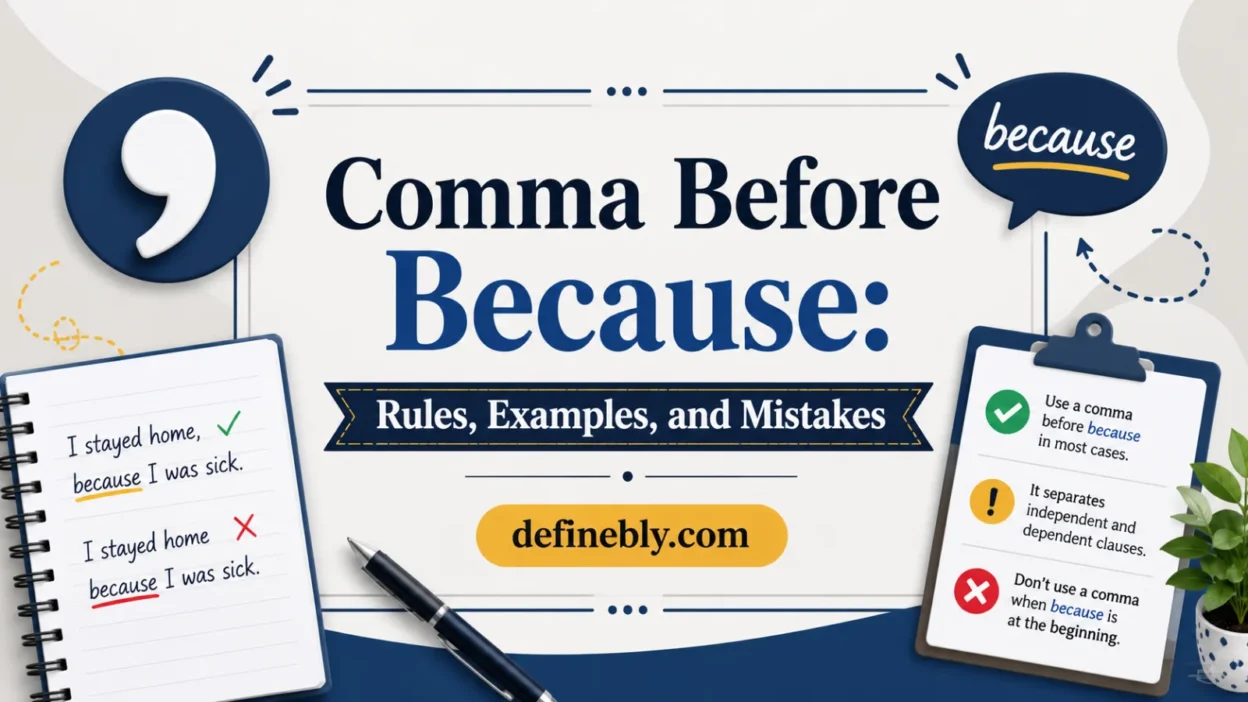
You usually do not need a comma before because. When because introduces an essential reason, it connects that reason directly to the main clause.
Correct: I stayed home because I felt sick.
The phrase because I felt sick explains why I stayed home, so no comma is necessary.
However, a comma before because can be appropriate when it prevents a misunderstanding or when the because clause adds a separate, nonessential explanation. The meaning of the sentence matters more than a pause in speech.
Quick Answer: Do You Put a Comma Before Because?
In most sentences, do not use a comma before because when it introduces the main reason for an action or situation.
Examples without a comma:
- We left early because traffic was getting worse.
- She bought a jacket because the weather was cold.
- I missed the call because my phone was on silent.
A comma before because may be appropriate when it clarifies an otherwise ambiguous sentence.
Example:
I did not leave, because I was afraid.
The comma helps communicate that fear was the reason I stayed. Without the comma, the sentence could mean that fear was not the reason for staying.
When a sentence begins with a because clause, place a comma after that introductory clause.
Example:
Because I was driving, I did not answer.
The basic rule is simple: usually no comma before because, but use one when the meaning or sentence structure calls for it.
The Rule Explained
The word because introduces a reason or cause. In most sentences, the reason is closely connected to the main statement, so the two parts do not need a comma.
Example:
The game was canceled because it rained.
The phrase because it rained explains why the game was canceled. It is an essential part of the sentence’s meaning.
Now compare these sentences:
- I did not leave because I was afraid.
- I did not leave, because I was afraid.
The first sentence can mean that fear was not the reason for staying. The second more clearly states that fear was the reason the person did not leave.
This distinction matters because a comma can affect how readers interpret a negative sentence. However, a comma is not a universal fix for every ambiguous construction. If the meaning is still unclear, rewrite the sentence.
Clearer alternatives:
- I stayed for another reason, not because I was afraid.
- I stayed because I was afraid.
These versions make the intended meaning explicit.
When to Use a Comma Before Because
1. Use a Comma When It Prevents Confusion
A comma before because can help readers understand which part of a sentence is being negated.
Potentially ambiguous: I did not call because I was angry.
Depending on the context, this can mean that anger was not the reason for calling, or that anger was the reason for not calling.
Clearer when anger caused the decision: I did not call, because I was angry.
If the sentence remains ambiguous, use a more direct version:
I stayed silent because I was angry.
Other examples in which a comma may clarify the intended meaning include:
- I did not respond, because I was driving.
- She did not attend, because she felt too ill to leave home.
- We did not wait, because the office was about to close.
These commas are most useful when the negative wording could otherwise confuse the reader. They are not automatically required in every negative sentence containing because.
2. Use a Comma When the Because Clause Adds Nonessential Information
Sometimes a because clause provides an additional explanation rather than identifying the reason that defines the main statement. In such cases, a comma may be appropriate.
Example:
The event was postponed, because the organizers had received several weather warnings.
The comma presents the reason as an added explanation. However, the sentence would normally be written without a comma if the weather warnings are the central reason for the postponement.
More examples:
- The office closed early, because the power outage affected the entire building.
- The package arrived late, because the storm disrupted deliveries.
- The meeting was canceled, because the speaker became ill.
These sentences can be grammatical with a comma in a context where the explanation is supplementary, but the comma is not automatically necessary. In straightforward cause-and-effect writing, leave it out when the because clause gives the main reason.
More direct versions:
- The office closed early because the power outage affected the entire building.
- The package arrived late because the storm disrupted deliveries.
- The meeting was canceled because the speaker became ill.
For clear, concise web writing, the versions without commas are usually preferable when the reason is essential.
3. Use a Comma in a Contrast With “Not Because … But Because”
When a sentence contrasts two possible reasons, the punctuation should make that contrast easy to follow.
Examples:
- He succeeded not because he was lucky, but because he practiced every day.
- She was promoted not because she was popular, but because she delivered strong results.
- We chose the plan not because it was cheap, but because it was reliable.
Notice that the comma comes before but, not automatically before the first occurrence of because.
The structure not because X, but because Y rejects one explanation and identifies another. The comma before but separates the contrasting parts.
When to Use a Comma After an Introductory Because Clause
When a sentence begins with a because clause, use a comma after that introductory clause when it precedes the main clause.
Examples:
- Because I was tired, I went to bed early.
- Because the store was closed, we went home.
- Because the file was missing, the report was delayed.
- Because it was raining, the children stayed inside.
In each example, the opening clause gives the reason, and the comma marks the boundary before the main clause.
Compare the word order:
Because I was tired, I went to bed early.
I went to bed early because I was tired.
The first sentence needs a comma after the introductory clause. The second usually does not need a comma before because because the reason follows the main clause directly.
When Not to Use a Comma Before Because
1. Do Not Use a Comma in Simple Cause-and-Effect Sentences
When because introduces the essential reason for an action, omit the comma.
Incorrect in ordinary cause-and-effect writing: I bought a jacket, because it was cold.
Correct: I bought a jacket because it was cold.
More examples:
- She smiled because the news was good.
- We ordered pizza because no one wanted to cook.
- He left early because he had an appointment.
- The baby cried because she was hungry.
- The team won because everyone stayed focused.
In each case, the because clause directly explains the action or situation.
2. Do Not Add a Comma Just Because You Hear a Pause
A pause in speech does not automatically require punctuation. The comma should reflect the sentence’s structure and intended meaning.
Usually unnecessary: I stayed late, because I had work to finish.
Better: I stayed late because I had work to finish.
The reason is essential to the sentence, so the version without a comma is more direct.
3. Do Not Put a Comma Immediately After Because
In a standard sentence, do not place a comma directly after because when the word introduces a reason.
Incorrect: I stayed home because, I was sick.
Correct: I stayed home because I was sick.
A comma can follow because when an interrupting expression appears after it.
Correct: I stayed home because, honestly, I was exhausted.
In this example, the commas surround the interrupting word honestly. They do not separate because from the clause it introduces.
4. Do Not Add a Comma When the Reason Is the Main Point
If the sentence’s purpose is to explain why something happened, the because clause generally belongs directly to the main clause.
Correct:
- The project failed because the team missed the deadline.
- She passed because she studied every night.
- The room smelled fresh because someone had opened a window.
- I chose the later flight because it was cheaper.
Adding a comma without a reason can interrupt the connection between the statement and its explanation.
Common Mistakes With Commas Before Because
| Common Mistake | Better Version | Why |
|---|---|---|
| He stayed late, because he had work to finish. | He stayed late because he had work to finish. | The reason is essential. |
| I left because, I was tired. | I left because I was tired. | No comma belongs directly after because. |
| Because I was sick I stayed home. | Because I was sick, I stayed home. | A comma follows the introductory clause. |
| He succeeded not because he was lucky, but because he practiced. | He succeeded not because he was lucky, but because he practiced. | The comma separates the contrasting clauses before but. |
| I did not leave because I was afraid. | I stayed because I was afraid. | A direct rewrite removes possible ambiguity when fear was the reason for staying. |
The most common error is adding a comma before every occurrence of because. In ordinary writing, the comma is usually unnecessary when because introduces an essential reason.
Correct Examples: Comma Before Because
Use these examples to compare the main punctuation patterns.
| Sentence | Comma Before Because? | Explanation |
|---|---|---|
| I went inside because it was raining. | No | The reason is essential. |
| She was late because her train stopped. | No | The clause explains why she was late. |
| I did not leave, because I was afraid. | Yes, if needed for clarity | The comma signals the intended reason in a potentially ambiguous sentence. |
| Because it was raining, we stayed inside. | No comma before because | The comma follows the introductory clause. |
| He succeeded not because he was lucky, but because he practiced. | No before the first because | The comma separates the contrast before but. |
| We ordered takeout because the fridge was empty. | No | The reason is essential. |
| Because the file was missing, the meeting was delayed. | No comma before because | The introductory clause ends at the comma. |
| The flight was delayed because of the storm. | No | The phrase because of the storm gives the reason. |
Additional examples:
- I missed the call because my phone was on silent.
- She brought an umbrella because rain was in the forecast.
- I chose the later flight because it was cheaper.
- The team won because everyone stayed focused.
- Because the store closed early, we went home.
- He apologized not because he was forced to, but because he meant it.
Remember that punctuation depends on the intended meaning and sentence structure, not simply on whether the sentence contains a negative word.
Quick Rule of Thumb
Use this simple test before placing a comma before because:
- Does the because clause give the main reason? Usually, do not use a comma.
- Could the sentence be misunderstood without the comma? Consider using one or rewriting the sentence.
- Does the because clause begin the sentence? Place a comma after the introductory clause.
- Does the sentence contrast two reasons using “not because … but because”? Usually, place the comma before but, not before the first because.
Examples:
- No comma: I left early because I felt sick.
- Comma after an introductory clause: Because I felt sick, I left early.
- Comma for clarity: I did not leave, because I felt sick.
The goal is not to add commas wherever a pause sounds natural. It is to make the sentence’s meaning clear.
FAQs
Do You Put a Comma Before Because?
Usually, no. When because introduces an essential reason, it normally does not need a comma.
Example: I stayed home because I was tired.
When Should You Use a Comma Before Because?
Use a comma when it helps prevent ambiguity or when the because clause provides a separate, nonessential explanation. Do not add one automatically; consider the sentence’s intended meaning.
Do You Always Need a Comma Before Because?
No. Most sentences containing because do not need a comma before it. The comma is used selectively when the structure or meaning calls for it.
What Is an Example Without a Comma Before Because?
Example: She brought an umbrella because it was raining.
The because clause gives the reason she brought an umbrella, so no comma is needed.
What Is an Example With a Comma Before Because?
Example: I did not leave, because I was afraid.
The comma helps communicate that fear was the reason for staying. Without it, the sentence could be interpreted differently.
Do You Put a Comma After Because?
Usually, no. Do not separate because from the reason it introduces.
Incorrect: I left because, I was tired.
Correct: I left because I was tired.
A comma may appear after because when an interrupting phrase follows, as in I left because, honestly, I was exhausted.
What If a Sentence Starts With Because?
Use a comma after the introductory because clause when it is followed by a main clause.
Correct: Because I was tired, I left early.
The opening clause explains the reason, and the main clause completes the sentence.
Can a Sentence Start With Because?
Yes. A sentence can begin with because as long as it includes a complete main clause.
Complete: Because it was raining, we stayed inside.
Fragment: Because it was raining.
The second example is a dependent clause without a main clause.
Can a Comma Before Because Change the Meaning?
Yes. In some negative sentences, a comma can help distinguish between rejecting a reason and giving that reason.
Compare:
- I did not leave because I was afraid.
- I did not leave, because I was afraid.
The first can mean fear was not the reason for staying. The second more clearly presents fear as the reason the person stayed. If the distinction matters, rewrite the sentence to make the meaning unmistakable.
Do You Use a Comma Before Because Of?
Usually, no. Because of introduces a reason, and no comma is normally needed when that reason is essential.
Example: The flight was delayed because of the storm.
A comma may be appropriate in a particular sentence if the phrase is supplementary or the punctuation is needed to clarify the meaning.
Is “Just Because” Different?
Not usually. The same general rule applies when just because introduces an essential reason.
Example: I stayed home just because I needed a quiet night.
No comma is needed because the phrase explains why the person stayed home.
Conclusion
You usually do not need a comma before because. Leave it out when the because clause gives the essential reason for an action or situation. Use a comma when it helps prevent confusion or when the reason is genuinely supplementary. When a because clause begins the sentence, place a comma after the introductory clause.
The most reliable rule is to consider meaning and sentence structure rather than pauses in speech. When punctuation alone cannot make your meaning clear, rewrite the sentence.