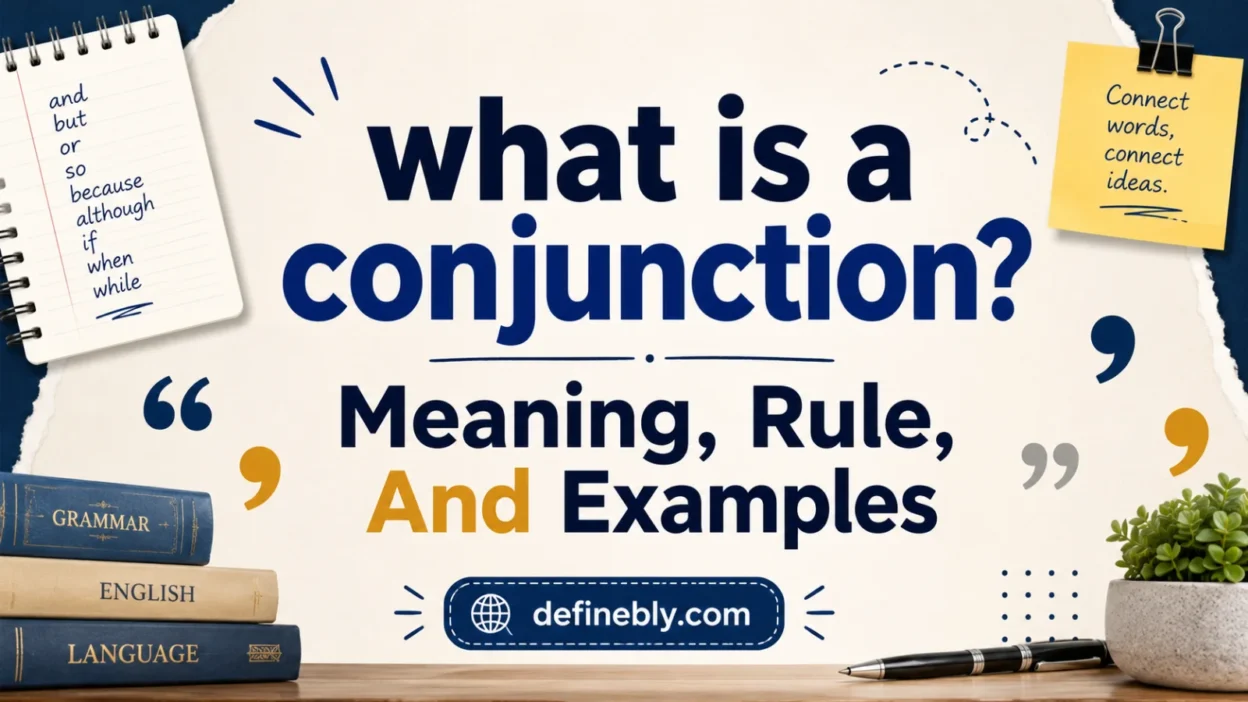
A conjunction is a word that connects words, phrases, clauses, or ideas in a sentence. Common conjunctions include and, but, or, because, although, if, when, and while.
Examples:
I bought apples and oranges.
She wanted to go, but she was tired.
You can call me or text me.
I stayed home because it rained.
Although the test was hard, I passed.
Conjunctions help writers show addition, contrast, choice, cause, time, condition, and other relationships between ideas.
Quick Answer: What Is A Conjunction?
A conjunction is a connecting word. It joins words, phrases, or clauses so a sentence can show how ideas relate.
Example:
I ordered tea and coffee.
The conjunction and joins two words: tea and coffee.
Example:
I called you, but you did not answer.
The conjunction but joins two complete ideas and shows contrast.
Example:
We left early because the roads were icy.
The conjunction because connects the reason to the main idea.
How Conjunctions Work
Conjunctions act like bridges. They connect sentence parts that belong together.
A conjunction can join two words:
peanut butter and jelly
coffee or tea
tired but happy
A conjunction can join two phrases:
in the kitchen or on the patio
after the meeting and before lunch
with confidence but without arrogance
A conjunction can join two clauses:
I wanted to leave, but the storm got worse.
She stayed home because she felt sick.
If you need help, call me.
A clause is a group of words with a subject and a verb.
Independent clause:
I wanted coffee.
This can stand alone as a sentence.
Dependent clause:
because I wanted coffee
This has a subject and verb, but it cannot stand alone as a complete sentence.
Types Of Conjunctions
The three main types of conjunctions are coordinating conjunctions, subordinating conjunctions, and correlative conjunctions. Conjunctive adverbs are also important because they connect ideas, but they follow different punctuation rules.
Type What It Does Examples
Coordinating Conjunction Joins equal words, phrases, or clauses and, but, or, nor, for, so, yet
Subordinating Conjunction Introduces a dependent clause because, although, if, when, while
Correlative Conjunction Works in pairs either…or, neither…nor, both…and
Conjunctive Adverb Connects ideas between clauses or sentences however, therefore, meanwhile, nevertheless
Coordinating Conjunctions
Coordinating conjunctions join equal parts of a sentence. They can connect two nouns, two verbs, two adjectives, two phrases, or two independent clauses.
The seven coordinating conjunctions are often remembered with the acronym FANBOYS.
Letter Conjunction Main Use Example
F for reason I stayed home, for I was sick.
A and addition We bought bread and milk.
N nor negative addition She did not call, nor did she text.
B but contrast The room was small, but it was clean.
O or choice You can stay or leave.
Y yet contrast It was late, yet we kept working.
S so result It rained, so we canceled the picnic.
How To Use Each Coordinating Conjunction
And adds information.
She packed socks and shoes.
He opened the door and stepped outside.
But shows contrast.
The test was hard, but I passed.
She is young but experienced.
Or gives a choice.
You can email me or call me.
Would you like soup or salad?
Nor adds a second negative idea.
He did not apologize, nor did he explain.
She does not drink coffee, nor does she like tea.
For gives a reason. It is more formal than because.
I brought a jacket, for the evening was cold.
So shows a result.
The roads were icy, so we drove slowly.
Yet shows contrast, similar to but, but often with a stronger sense of surprise.
The job was difficult, yet she enjoyed it.
Subordinating Conjunctions
A subordinating conjunction introduces a dependent clause and connects it to a main clause. It shows the relationship between the two ideas.
Examples:
I stayed home because I felt sick.
Although it was raining, we went for a walk.
Call me when you arrive.
If you study, you will improve.
In each sentence, the subordinating conjunction begins a clause that depends on another idea.
Common Subordinating Conjunctions By Meaning
Relationship Conjunctions Example
Cause Or Reason because, since, as I left early because I was tired.
Time when, while, before, after, until, once Call me when you arrive.
Condition if, unless, provided that We will go if the weather improves.
Contrast although, though, even though, whereas Although it was late, we stayed.
Purpose so that, in order that I wrote it down so that I would remember.
Comparison than, as She is taller than I expected.
Place where, wherever Sit where you can see the screen.
Dependent Clauses And Independent Clauses
A subordinating conjunction often turns a complete idea into a dependent clause.
Complete sentence:
I was tired.
Dependent clause:
Because I was tired
The second example is not a complete sentence because because makes the thought depend on another clause.
Fragment:
Because I was tired.
Complete:
I went to bed early because I was tired.
Also complete:
Because I was tired, I went to bed early.
The same idea can appear at the beginning or end of the sentence. The punctuation changes depending on placement.
Correlative Conjunctions
Correlative conjunctions work in pairs. They connect balanced words, phrases, or clauses.
Common correlative conjunctions include:
either…or
neither…nor
both…and
not only…but also
whether…or
rather…than
no sooner…than
Examples:
You can either call me or text me.
Neither the manager nor the assistant replied.
She is both careful and creative.
He is not only talented but also disciplined.
I do not know whether we should stay or leave.
Correlative Conjunctions Need Parallel Structure
Correlative conjunctions should connect grammatically equal elements. This is called parallel structure.
Weak:
She is both a strong writer and edits carefully.
Better:
She is both a strong writer and a careful editor.
Weak:
You can either submit the form online or by mail.
Better:
You can submit the form either online or by mail.
Better:
You can either submit the form online or send it by mail.
The parts after each half of the pair should match in structure.
Conjunctive Adverbs
Conjunctive adverbs connect ideas, but they are not standard conjunctions. They usually connect two independent clauses or two sentences.
Common conjunctive adverbs include:
however
therefore
nevertheless
meanwhile
moreover
furthermore
instead
consequently
otherwise
still
then
Examples:
I wanted to go; however, I was too tired.
The road was closed; therefore, we took another route.
She missed the first bus; nevertheless, she arrived on time.
Finish your homework; then, you can watch TV.
When a conjunctive adverb joins two independent clauses, use a semicolon before it and a comma after it.
Correct:
I called; however, no one answered.
Incorrect:
I called, however, no one answered.
But Vs. However
But is a coordinating conjunction. It can join two independent clauses with a comma.
Correct:
I called, but no one answered.
However is usually a conjunctive adverb. It needs stronger punctuation when joining two independent clauses.
Correct:
I called; however, no one answered.
Also correct:
I called. However, no one answered.
Incorrect:
I called, however, no one answered.
Use but for a simple, direct contrast. Use however when you want a more formal transition between complete ideas.
Conjunctions And Sentence Types
Conjunctions help create different sentence structures.
Compound Sentences
A compound sentence joins two independent clauses.
Example:
I wanted coffee, but the shop was closed.
Independent clause 1:
I wanted coffee.
Independent clause 2:
The shop was closed.
Conjunction:
but
Complex Sentences
A complex sentence contains one independent clause and one dependent clause.
Example:
I stayed home because it snowed.
Independent clause:
I stayed home.
Dependent clause:
because it snowed
Subordinating conjunction:
because
Compound-Complex Sentences
A compound-complex sentence contains at least two independent clauses and at least one dependent clause.
Example:
Because it snowed, I stayed home, and my sister worked remotely.
Dependent clause:
Because it snowed
Independent clause 1:
I stayed home
Independent clause 2:
my sister worked remotely
Conjunctions:
because
and
Comma Rules For Conjunctions
Conjunction punctuation depends on what the conjunction connects.
Use A Comma Before A Coordinating Conjunction That Joins Two Independent Clauses
Correct:
I wanted coffee, but the shop was closed.
She studied hard, so she passed.
We can leave now, or we can wait for Alex.
Each side can stand alone as a full sentence.
Do Not Use A Comma When A Conjunction Joins Only Two Words Or Phrases
Incorrect:
I bought apples, and oranges.
Correct:
I bought apples and oranges.
Incorrect:
She is smart, and kind.
Correct:
She is smart and kind.
The conjunction joins two words, not two complete clauses.
Use A Comma After An Introductory Dependent Clause
Correct:
Because I was tired, I went to bed early.
Although the movie was long, I enjoyed it.
When the meeting ended, everyone left.
When the dependent clause comes first, use a comma after it.
Usually Do Not Use A Comma Before A Dependent Clause At The End
Correct:
I went to bed early because I was tired.
We stayed inside because it was raining.
I will call you when I arrive.
A final dependent clause usually does not need a comma when the meaning is essential.
Use Commas Carefully With Correlative Conjunctions
Do not automatically add commas just because a correlative pair appears.
Correct:
She is both kind and honest.
You can either stay here or come with us.
A comma may be needed if the sentence structure requires it, but the correlative conjunction itself does not always require one.
Can You Start A Sentence With And, But, Or Because?
Yes. You can start a sentence with and, but, or because when the sentence is complete and the choice fits the tone.
Natural:
And that was the moment everything changed.
But the answer was still unclear.
Because the roads were icy, school was canceled.
Avoid sentence fragments.
Fragment:
Because the roads were icy.
Complete:
Because the roads were icy, school was canceled.
Starting with and or but can sound conversational. It is acceptable in modern writing, but it should not be overused in formal work.
Common Conjunctions List
Type Common Examples
Coordinating for, and, nor, but, or, yet, so
Subordinating: Time after, before, when, whenever, while, until, once
Subordinating: Cause because, since, as
Subordinating: Condition if, unless, provided that, even if
Subordinating: Contrast although, though, even though, whereas, while
Subordinating: Purpose so that, in order that
Correlative either…or, neither…nor, both…and, not only…but also
Conjunctive Adverbs however, therefore, nevertheless, meanwhile, consequently
Conjunction Examples In Sentences
Sentence Conjunction What It Connects
Ben and Mia arrived early. and two nouns
We can leave now or wait here. or two actions
The pizza was cold, but we ate it. but two clauses
I stayed inside because it snowed. because reason to main idea
Call me when you arrive. when time to main idea
Although I was nervous, I spoke first. although dependent clause to main clause
Either email me or call me. either…or two choices
She is both kind and honest. both…and two adjectives
I was tired; however, I finished the work. however two independent clauses
We left early so that we could avoid traffic. so that purpose
Conjunction Vs. Preposition
Some words can be conjunctions or prepositions depending on how they are used.
Before as a conjunction:
I washed the dishes before I went to bed.
Here, before connects two clauses.
Before as a preposition:
I washed the dishes before bed.
Here, before comes before the noun bed.
After as a conjunction:
We ate after the guests arrived.
After as a preposition:
We ate after the meeting.
A conjunction connects clauses or sentence parts. A preposition usually comes before a noun or pronoun and begins a prepositional phrase.
Conjunction Vs. Conjunctive Adverb
A conjunction directly joins words, phrases, or clauses.
Example:
I was tired, but I finished the report.
A conjunctive adverb connects ideas more like a transition.
Example:
I was tired; however, I finished the report.
The difference matters because punctuation changes.
Incorrect:
I was tired, however, I finished the report.
Correct:
I was tired; however, I finished the report.
When To Use Conjunctions
Use a conjunction when you need to connect related ideas.
Addition:
She bought bread and eggs.
Contrast:
The room was small, but comfortable.
Choice:
You can pay now or later.
Reason:
I stayed home because I was sick.
Time:
Call me when you arrive.
Condition:
We will go if the weather improves.
Conjunctions should make the relationship between ideas clearer. If they make the sentence long, crowded, or confusing, revise the sentence.
When Not To Use Conjunctions
Do not use too many conjunctions in one sentence.
Weak:
I opened the door and walked inside and turned on the light and sat down and checked my phone.
Better:
I opened the door, walked inside, turned on the light, and sat down. Then I checked my phone.
Do not use a conjunction when punctuation alone creates a stronger rhythm.
Weak:
The meeting ended, and everyone left, and the room was quiet.
Better:
The meeting ended. Everyone left. The room was quiet.
Do not use a subordinating conjunction without completing the thought.
Fragment:
Although I was tired.
Complete:
Although I was tired, I finished the assignment.
Common Conjunction Mistakes
Creating A Sentence Fragment
A dependent clause cannot stand alone as a complete sentence in formal writing.
Fragment:
Because I missed the bus.
Complete:
I was late because I missed the bus.
Fragment:
Although the movie was long.
Complete:
Although the movie was long, I enjoyed it.
Forgetting The Comma Between Two Independent Clauses
Incorrect:
I wanted coffee but the shop was closed.
Correct:
I wanted coffee, but the shop was closed.
Use a comma before a coordinating conjunction when both sides are complete sentences.
Adding A Comma When Joining Two Words
Incorrect:
I bought apples, and oranges.
Correct:
I bought apples and oranges.
No comma is needed because and joins only two nouns.
Creating A Comma Splice With However
Incorrect:
I wanted to go, however, I was too tired.
Correct:
I wanted to go; however, I was too tired.
Also correct:
I wanted to go. However, I was too tired.
Mixing Correlative Conjunction Pairs
Incorrect:
Either we can drive nor take the train.
Correct:
Either we can drive or take the train.
Incorrect:
Neither the manager or the assistant replied.
Correct:
Neither the manager nor the assistant replied.
Breaking Parallel Structure
Weak:
She is not only a skilled designer but also writes clearly.
Better:
She is not only a skilled designer but also a clear writer.
Also better:
She not only designs skillfully but also writes clearly.
Using So And Because Together Incorrectly
Incorrect:
Because it was raining, so we stayed home.
Correct:
Because it was raining, we stayed home.
Also correct:
It was raining, so we stayed home.
Use because or so to show the relationship. Do not use both to connect the same two clauses in standard English.
Overusing And
Weak:
The room was dark and cold and quiet and empty.
Better:
The room was dark, cold, quiet, and empty.
Also better:
The room was dark and empty.
Use a list, a stronger sentence structure, or fewer details.
How To Identify A Conjunction
Use this test:
Does the word connect words, phrases, clauses, or ideas?
Examples:
peanut butter and jelly
small but useful
stay home or go out
I left because I was tired
Call me when you arrive
If the word links two sentence parts and shows a relationship between them, it is probably a conjunction.
A simple memory rule:
And adds.
But contrasts.
Or gives a choice.
Because gives a reason.
If gives a condition.
When gives a time.
Quick Editing Checklist For Conjunctions
Before publishing a sentence with a conjunction, check these points:
Does the conjunction show the right relationship?
Does it connect equal elements or create a dependent clause?
If it joins two independent clauses, is the comma correct?
If the dependent clause comes first, did you add a comma after it?
If you used a correlative pair, do both sides match grammatically?
Did you avoid comma splices with however?
Would two shorter sentences be clearer?
Weak:
I wanted to leave, however, I stayed.
Correct:
I wanted to leave; however, I stayed.
Better for simple writing:
I wanted to leave, but I stayed.
FAQ
What is a conjunction in simple words?
A conjunction is a word that connects words, phrases, or clauses.
Examples:
and
but
or
because
although
if
when
Example:
I wanted tea, but she wanted coffee.
The conjunction but connects two contrasting ideas.
What are five examples of conjunctions?
Five common conjunctions are:
and
but
or
because
although
Example:
I stayed home because I felt sick.
What are the three main types of conjunctions?
The three main types of conjunctions are coordinating, subordinating, and correlative conjunctions.
Examples:
Coordinating: and, but, or
Subordinating: because, although, if
Correlative: either…or, neither…nor, both…and
What are coordinating conjunctions?
Coordinating conjunctions connect equal words, phrases, or independent clauses.
The seven coordinating conjunctions are:
for
and
nor
but
or
yet
so
A common memory word is FANBOYS.
Example:
I wanted coffee, but the shop was closed.
What are subordinating conjunctions?
Subordinating conjunctions introduce dependent clauses and connect them to main clauses.
Examples:
because
although
if
when
while
before
after
unless
Example:
I stayed home because I was tired.
What are correlative conjunctions?
Correlative conjunctions are paired conjunctions.
Examples:
either…or
neither…nor
both…and
not only…but also
whether…or
Example:
Either call me or text me.
Do you need a comma before a conjunction?
Use a comma before a coordinating conjunction when it joins two independent clauses.
Correct:
I called, but no one answered.
Do not use a comma when the conjunction joins only two words or short phrases.
Correct:
I bought apples and oranges.
Can you start a sentence with a conjunction?
Yes. You can start a sentence with and, but, or because when the sentence is complete and the style fits the context.
Correct:
But the answer was still unclear.
Because it was raining, we stayed inside.
Avoid fragments.
Incorrect:
Because it was raining.
Is because a conjunction?
Yes. Because is a subordinating conjunction. It introduces a reason.
Example:
I wore a coat because it was cold.
Is however a conjunction?
However is usually a conjunctive adverb, not a regular conjunction.
Correct:
I wanted to go; however, I was too tired.
Simpler:
I wanted to go, but I was too tired.
What is the difference between but and however?
But is a coordinating conjunction. However is a conjunctive adverb.
Correct:
I called, but no one answered.
I called; however, no one answered.
Do not join two complete sentences with only a comma and however.
Does every sentence need a conjunction?
No. A sentence can be complete without a conjunction.
Example:
The baby slept.
Use a conjunction only when you need to connect words, phrases, clauses, or ideas.
Conclusion
A conjunction is a word that connects words, phrases, clauses, or ideas. It helps show relationships such as addition, contrast, choice, reason, time, condition, and result.
The most useful rule is simple: choose the conjunction that shows the exact relationship between your ideas, then punctuate the sentence based on what the conjunction connects.