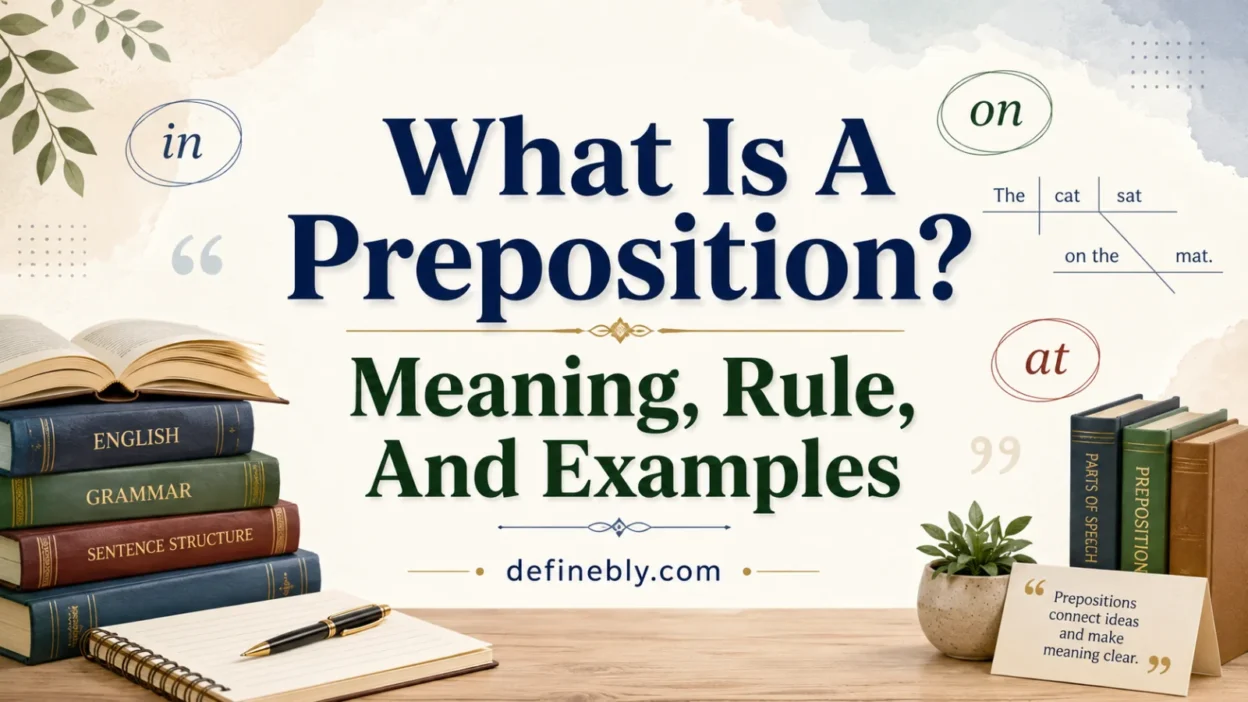
A preposition is a word that shows the relationship between a noun, pronoun, or noun phrase and another word in a sentence. Prepositions often show place, time, direction, cause, purpose, possession, topic, or connection.
Examples:
- The keys are on the table.
- We met after lunch.
- She walked toward the exit.
- This book is about history.
- The gift is for you.
In “The keys are on the table,” the preposition on connects keys to table and shows where the keys are.
Quick Answer: What Is A Preposition?
A preposition is a word that connects a noun or pronoun to another part of a sentence.
Common prepositions include:
- in
- on
- at
- under
- over
- before
- after
- to
- from
- with
- by
- for
- about
- between
- among
Example:
- The dog slept under the bed.
The preposition is under. The object of the preposition is the bed. Together, under the bed is a prepositional phrase that tells where the dog slept.
How Prepositions Work
A preposition usually comes before a noun, pronoun, or noun phrase. That noun or pronoun is called the object of the preposition.
Example:
- She sat beside me.
Preposition: beside
Object of the preposition: me
Prepositional phrase: beside me
Another example:
- The charger is in my backpack.
Preposition: in
Object of the preposition: my backpack
Prepositional phrase: in my backpack
A preposition usually does not work alone. It needs an object to complete the relationship.
Incomplete:
- The keys are on.
Complete:
- The keys are on the counter.
What Is A Prepositional Phrase?
A prepositional phrase is a group of words that begins with a preposition and includes the object of the preposition.
Examples:
- on the table
- under the bed
- after the meeting
- with my sister
- about the schedule
- because of the rain
A prepositional phrase usually adds information about place, time, direction, reason, possession, or relationship.
Examples:
- The phone is on the desk.
- We left after dinner.
- She walked toward the door.
- The delay happened because of traffic.
Parts Of A Prepositional Phrase
A prepositional phrase has two main parts: the preposition and its object. It may also include modifiers.
Example:
- The cat slept under the old wooden chair.
Preposition: under
Modifiers: the old wooden
Object: chair
Prepositional phrase: under the old wooden chair
The object is the main noun or pronoun after the preposition.
More examples:
| Prepositional Phrase | Preposition | Object |
|---|---|---|
| in the kitchen | in | kitchen |
| before sunrise | before | sunrise |
| with her | with | her |
| about the problem | about | problem |
| near the front door | near | door |
| because of the storm | because of | storm |
What Prepositions Show
Prepositions show relationships between words. The relationship can be physical, logical, emotional, or abstract.
| Relationship | Common Prepositions | Example |
|---|---|---|
| Place | in, on, at, under, beside, near | The keys are on the table. |
| Time | before, after, during, until, at, by | We left after lunch. |
| Direction | to, toward, into, through, across | She walked to the store. |
| Source | from, out of | This letter is from Maria. |
| Cause | because of, due to, from | The game was canceled because of rain. |
| Purpose | for | This tool is for cutting wire. |
| Possession | of | The cover of the book is torn. |
| Agent | by | The song was written by Adele. |
| Instrument | with, by | He opened the box with a knife. |
| Topic | about, regarding, concerning | We talked about the movie. |
| Comparison | like, unlike, than | She sings like a professional. |
Types Of Prepositions
Prepositions can be grouped by the kind of relationship they show. These categories are helpful, but many prepositions can belong to more than one category depending on the sentence.
Prepositions Of Place
Prepositions of place show where something is.
Examples:
- The cup is on the shelf.
- The keys are in my bag.
- The dog is sleeping under the table.
- She stood beside me.
- The painting hangs above the fireplace.
Common prepositions of place include:
- in
- on
- at
- under
- over
- above
- below
- beside
- between
- behind
- near
- inside
- outside
Prepositions Of Time
Prepositions of time show when something happens.
Examples:
- The meeting starts at 10 a.m.
- We moved here in July.
- I will call you on Friday.
- She arrived before dinner.
- The store is open until midnight.
Common prepositions of time include:
- at
- in
- on
- before
- after
- during
- until
- by
- since
- for
Prepositions Of Direction Or Movement
Prepositions of direction show movement from one place to another.
Examples:
- He walked to the station.
- The bird flew over the fence.
- She ran into the kitchen.
- They drove through the tunnel.
- We walked across the bridge.
Common prepositions of direction include:
- to
- toward
- into
- onto
- through
- across
- over
- past
- from
- around
Prepositions Of Cause Or Reason
Prepositions of cause explain why something happened.
Examples:
- The picnic was canceled because of the storm.
- She was tired from working late.
- The delay happened due to heavy traffic.
- He missed class because of illness.
Common cause prepositions and prepositional expressions include:
- because of
- due to
- from
- out of
- on account of
Prepositions Of Purpose
Prepositions of purpose show the intended use of something.
Examples:
- This brush is for painting.
- I bought a notebook for class.
- She saved money for a new laptop.
- The room is used for meetings.
The preposition for is especially common when showing purpose.
Prepositions Of Possession Or Relationship
Prepositions can show ownership, belonging, or a relationship between things.
Examples:
- The pages of the book are torn.
- A friend of mine called.
- The roof of the house needs repair.
- She is the leader of the team.
The preposition of is one of the most common prepositions in English.
Prepositions Of Agent Or Instrument
A preposition can show who did an action or what tool was used.
Agent:
- The novel was written by Toni Morrison.
- The window was broken by the storm.
Instrument:
- He opened the package with scissors.
- She paid by credit card.
Use by for the doer of an action, especially in passive sentences. Use with for tools or instruments.
Prepositions Of Topic
Prepositions of topic show what something is about.
Examples:
- We talked about the movie.
- The article is about climate policy.
- I have a question about the assignment.
- The memo is regarding the new schedule.
Common topic prepositions include:
- about
- regarding
- concerning
- on
Compound Prepositions
A compound preposition is a preposition made of more than one word.
Examples:
- according to
- because of
- due to
- instead of
- in front of
- in spite of
- out of
- next to
- ahead of
- apart from
Examples in sentences:
- We stayed home because of the snow.
- The bank is next to the pharmacy.
- She answered according to the instructions.
- He chose tea instead of coffee.
- The car stopped in front of the house.
Compound prepositions work like single prepositions because they connect an object to the rest of the sentence.
Common Prepositions List
Here are common English prepositions:
| Common Prepositions |
|---|
| about, above, across, after, against |
| along, among, around, at, before |
| behind, below, beneath, beside, between |
| beyond, by, concerning, despite, during |
| except, for, from, in, inside |
| into, like, near, of, off |
| on, onto, opposite, out, outside |
| over, past, regarding, since, through |
| throughout, to, toward, under, underneath |
| until, up, upon, with, within, without |
Do not memorize prepositions only as isolated words. Learn them in phrases, such as interested in, good at, responsible for, and on Monday.
Preposition Collocations
A collocation is a natural word pairing. Many verbs, adjectives, and nouns are commonly followed by specific prepositions.
Examples:
| Word Or Phrase | Correct Preposition | Example |
|---|---|---|
| interested | in | She is interested in design. |
| good | at | He is good at math. |
| afraid | of | They are afraid of spiders. |
| responsible | for | I am responsible for the report. |
| depend | on | We depend on reliable data. |
| listen | to | Please listen to the instructions. |
| apologize | for | She apologized for the delay. |
| similar | to | This version is similar to the old one. |
| different | from | The result is different from expected. |
| proud | of | He is proud of his team. |
These patterns often must be learned through reading, listening, and practice. Meaning alone does not always predict the correct preposition.
Prepositions And Phrasal Verbs
Some verbs combine with prepositions or particles to create new meanings. These are often called phrasal verbs.
Examples:
- look up a word = search for it
- look after a child = take care of the child
- give up = quit
- run into someone = meet unexpectedly
- put off a meeting = delay it
The small word after the verb can change the meaning completely.
Compare:
- I looked up the address.
- I looked after my younger brother.
- I looked into the complaint.
Each phrase has a different meaning.
Adjective And Adverb Prepositional Phrases
A prepositional phrase can act like an adjective or an adverb.
Adjective Prepositional Phrases
An adjective prepositional phrase describes a noun or pronoun.
Examples:
- The book on the shelf is mine.
- The woman with the red scarf waved.
- The house near the lake is for sale.
In “The book on the shelf is mine,” the phrase on the shelf describes book.
Adverb Prepositional Phrases
An adverb prepositional phrase describes a verb, adjective, or adverb. It often tells where, when, how, or why.
Examples:
- We ate dinner after the game.
- She waited in the lobby.
- He spoke with confidence.
- The event was canceled because of rain.
In “She waited in the lobby,” the phrase in the lobby tells where she waited.
How To Use In, On, And At
In, on, and at are among the most common and confusing prepositions in English. They can show both place and time.
In
Use in for enclosed spaces, larger areas, and longer time periods.
Place:
- in the box
- in the room
- in New York
- in the United States
Time:
- in July
- in 2026
- in the morning
- in the summer
Examples:
- The files are in the folder.
- She lives in Chicago.
- We met in 2024.
On
Use on for surfaces, streets, days, and dates.
Place:
- on the table
- on the wall
- on Main Street
- on the bus
Time:
- on Monday
- on July 4
- on my birthday
- on the weekend
Examples:
- The cup is on the counter.
- The office is on King Street.
- The event is on Friday.
At
Use at for specific points, exact places, and exact times.
Place:
- at the door
- at the station
- at the front desk
- at school
Time:
- at 8 a.m.
- at noon
- at midnight
- at the moment
Examples:
- Meet me at the entrance.
- The train leaves at 6:30.
- She is at work.
These patterns are useful, but English has exceptions. For example, Americans usually say on the weekend, while British English often uses at the weekend.
Common Confusing Prepositions
To Vs. For
Use to for direction, transfer, or receiver.
Examples:
- She walked to the office.
- I sent the file to Alex.
- He gave the keys to his brother.
Use for for purpose, benefit, reason, or duration.
Examples:
- This gift is for you.
- I studied for the exam.
- We waited for two hours.
Incorrect:
- I explained the rule for her.
Correct:
- I explained the rule to her.
In Vs. Into
Use in for location.
Example:
- The keys are in the drawer.
Use into for movement from outside to inside.
Example:
- She put the keys into the drawer.
In casual speech, in is sometimes used for movement, but into is clearer when movement matters.
On Vs. Onto
Use on for position.
Example:
- The book is on the table.
Use onto for movement to a surface.
Example:
- The cat jumped onto the table.
By Vs. With
Use by to show the doer of an action or the method of travel or payment.
Examples:
- The song was written by Alicia Keys.
- We traveled by train.
- She paid by card.
Use with for tools, instruments, or accompaniment.
Examples:
- He cut the paper with scissors.
- I went with my cousin.
Between Vs. Among
Use between when talking about separate people, things, or choices.
Examples:
- The secret stayed between the two friends.
- Choose between tea, coffee, and water.
Use among when talking about something within a group.
Examples:
- The teacher walked among the students.
- There was disagreement among the committee members.
The old rule that between is only for two things is too simple. Between can be used for more than two when the items are separate and distinct.
For Vs. Since
Use for with a length of time.
Examples:
- for two hours
- for three years
- for a long time
Use since with a starting point.
Examples:
- since Monday
- since 2020
- since breakfast
Correct:
- I have lived here for five years.
- I have lived here since 2021.
Above Vs. Over
Use above when something is higher than something else.
Example:
- The lamp hangs above the table.
Use over when something covers, crosses, or moves from one side to another.
Examples:
- She put a blanket over the baby.
- The plane flew over the city.
Sometimes both are possible:
- The picture hangs above the fireplace.
- The picture hangs over the fireplace.
When Not To Use A Preposition
Do not add a preposition when the verb already takes a direct object.
Incorrect:
- We discussed about the plan.
Correct:
- We discussed the plan.
Incorrect:
- Please enter into the room.
Correct:
- Please enter the room.
Incorrect:
- She married with him.
Correct:
- She married him.
Incorrect:
- I reached to the office late.
Correct:
- I reached the office late.
- I arrived at the office late.
Some verbs need prepositions; others do not. Learn the verb and its pattern together.
Common Preposition Mistakes
Using The Wrong Preposition
Incorrect:
- I arrived to the airport at 8.
Correct:
- I arrived at the airport at 8.
For a specific place, arrive at is common. For a city or country, use arrive in.
Examples:
- We arrived at the hotel.
- We arrived in Boston.
Adding An Extra Preposition
Incorrect:
- Please enter into the room.
Correct:
- Please enter the room.
Incorrect:
- We discussed about the budget.
Correct:
- We discussed the budget.
Leaving Out A Needed Preposition
Incorrect:
- I’m waiting the bus.
Correct:
- I’m waiting for the bus.
Incorrect:
- She listened the song.
Correct:
- She listened to the song.
Confusing In, On, And At
Incorrect:
- The meeting is in Monday.
Correct:
- The meeting is on Monday.
Incorrect:
- She lives at Canada.
Correct:
- She lives in Canada.
Incorrect:
- The class starts on 9 a.m.
Correct:
- The class starts at 9 a.m.
Using To With Home
Incorrect:
- I went to home.
Correct:
- I went home.
In this sentence, home works like an adverb of place, so it does not need to.
Confusing Good At, Good In, And Good With
Use good at for skills.
Examples:
- She is good at math.
- He is good at solving problems.
Use good with for handling people, animals, or tools well.
Examples:
- She is good with children.
- He is good with computers.
Using Different Than, Different From, Or Different To
In standard American English, different from is usually the safest choice.
Example:
- This result is different from the last one.
Different than is common in American English before a clause.
Example:
- The result was different than we expected.
Different to is more common in British English than American English.
Can You End A Sentence With A Preposition?
Yes. A sentence can end with a preposition when the result sounds natural and clear.
Natural:
- What are you looking at?
- Who are you talking to?
- That is the issue I was worried about.
- She has nothing to be ashamed of.
More formal:
- At what are you looking?
- To whom are you talking?
The formal versions are grammatically possible, but they can sound stiff. In modern American English, ending a sentence with a preposition is often normal, especially in questions and natural conversation.
Avoid ending with a preposition only when it creates awkwardness, confusion, or an unnecessarily informal tone for the context.
Preposition Vs. Adverb
Some words can be prepositions or adverbs depending on how they are used.
A preposition has an object.
Preposition:
- She went inside the house.
The object is the house.
An adverb does not have an object.
Adverb:
- She went inside.
Here, inside tells where she went, but it does not have an object.
More examples:
| Word | Preposition | Adverb |
|---|---|---|
| outside | Wait outside the door. | Wait outside. |
| down | He walked down the stairs. | He sat down. |
| around | We walked around the lake. | We looked around. |
| near | She stood near the window. | The deadline is near. |
To identify the word, ask whether it has an object. If it has an object, it is probably a preposition.
How To Identify A Preposition
Use this test:
Does the word show a relationship between a noun or pronoun and another part of the sentence?
Example:
- The cat is under the chair.
Ask:
- Where is the cat?
- Under what?
Answer:
- Under the chair.
The word under connects cat and chair, so under is a preposition.
Another example:
- We talked about the movie.
Ask:
- Talked about what?
Answer:
- About the movie.
The word about connects the action talked to the topic movie.
Preposition Examples In Sentences
| Sentence | Preposition | What It Shows |
|---|---|---|
| The phone is on the desk. | on | Place |
| We arrived after dinner. | after | Time |
| She walked toward the exit. | toward | Direction |
| The gift is for you. | for | Relationship or benefit |
| He sat beside me. | beside | Place |
| The store closes at 9. | at | Time |
| I sent a message to Alex. | to | Receiver |
| They talked about the movie. | about | Topic |
| The delay happened because of traffic. | because of | Cause |
| The poem was written by Maya. | by | Agent |
| He opened the jar with a towel. | with | Instrument |
| The pages of the notebook are torn. | of | Possession or relationship |
Quick Editing Checklist For Prepositions
Before publishing a sentence, check these points:
- Is the preposition necessary?
- Does the verb require a specific preposition?
- Does the adjective naturally pair with that preposition?
- Is the object of the preposition clear?
- Would another preposition change the meaning?
- Is the sentence natural in American English?
Weak:
- We discussed about the project.
Correct:
- We discussed the project.
Weak:
- She is interested about design.
Correct:
- She is interested in design.
Weak:
- The meeting is in Monday.
Correct:
- The meeting is on Monday.
FAQ
What is a preposition in simple words?
A preposition is a word that shows how a noun or pronoun connects to another word in a sentence.
Example:
- The cup is on the shelf.
The preposition on shows the relationship between cup and shelf.
What are five examples of prepositions?
Five common prepositions are:
- in
- on
- at
- under
- before
Examples:
- in the room
- on the table
- at noon
- under the bed
- before dinner
What are 10 examples of prepositions?
Ten examples of prepositions are:
- in
- on
- at
- by
- with
- for
- from
- to
- under
- about
Example:
- We talked about the trip.
What does a preposition do?
A preposition shows a relationship between words. It can show place, time, direction, cause, purpose, possession, topic, or connection.
Example:
- She walked to the store.
The preposition to shows direction.
What is a prepositional phrase?
A prepositional phrase is a group of words that starts with a preposition and includes its object.
Example:
- under the table
Under is the preposition. The table is the object.
What is the object of a preposition?
The object of a preposition is the noun, pronoun, or noun phrase that follows the preposition.
Example:
- She sat beside me.
The preposition is beside. The object is me.
What are the types of prepositions?
Common types include prepositions of place, time, direction, cause, purpose, possession, agent, instrument, topic, and comparison.
Examples:
- Place: on the desk
- Time: after dinner
- Direction: toward the door
- Cause: because of rain
- Topic: about the book
Is to a preposition?
Yes. To is often a preposition.
Example:
- We walked to the park.
It can show direction, transfer, receiver, or relationship.
Is because a preposition?
Because is usually a conjunction.
Example:
- I stayed home because it rained.
The phrase because of works as a compound preposition.
Example:
- I stayed home because of the rain.
Can a sentence end with a preposition?
Yes. A sentence can end with a preposition when the sentence sounds natural and clear.
Example:
- What are you looking at?
This is normal in modern English. “At what are you looking?” is also grammatical, but it sounds much more formal.
What is the difference between a preposition and an adverb?
A preposition usually has an object. An adverb does not.
Preposition:
- She went inside the house.
Adverb:
- She went inside.
In the first sentence, inside has an object: the house. In the second, it stands alone.
Does every sentence need a preposition?
No. A sentence can be complete without a preposition.
Example:
- The baby slept.
Add a preposition only when you need to show a relationship, such as place, time, direction, cause, purpose, or connection.
Conclusion
A preposition is a word that connects a noun, pronoun, or noun phrase to another part of a sentence. It shows relationships such as place, time, direction, cause, purpose, possession, topic, and connection.
The easiest way to identify a preposition is to look for the noun or pronoun that follows it. If the word begins a phrase such as on the desk, after lunch, with her, or about the plan, it is probably a preposition.