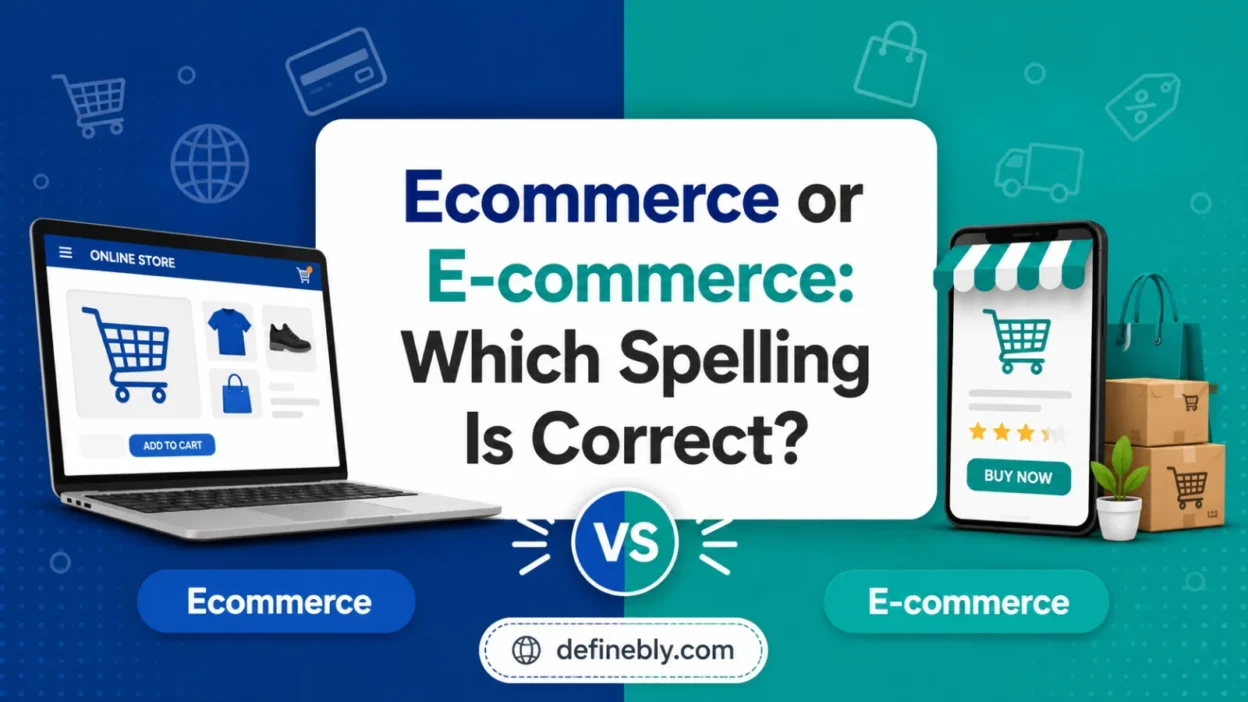
Ecommerce vs. E-commerce: Which Spelling Is Correct?
E-commerce is the traditional dictionary spelling in American English, while ecommerce without a hyphen is widely used in online business, marketing, and technology content. Both forms are recognizable, but the best choice depends on your publication’s style guide, audience, and purpose.
If you are writing an article, academic paper, or formal business document, e-commerce is a reliable choice. If you are creating content for an online store or digital marketing website, ecommerce is also widely accepted.
The form eCommerce, with a capital C, is commonly associated with branding and product names rather than standard edited English. E commerce, written as two separate words without a hyphen, is generally not the preferred spelling.
Quick Answer: Ecommerce or E-commerce?
| Spelling | Usage | Recommendation |
|---|---|---|
| E-commerce | Traditional dictionary and editorial spelling | Best for formal writing |
| Ecommerce | Digital marketing, online business, and general web content | Acceptable when used consistently |
| eCommerce | Branding, software, and some company materials | Follow the brand’s official spelling |
| E commerce | Nonstandard form in ordinary English | Avoid in edited writing |
Example: The company launched a new e-commerce website to sell clothing online.
The hyphenated form is a dependable choice when you are unsure which spelling to use. However, the closed form, ecommerce, is common enough that it should not automatically be treated as a spelling mistake.
What Does E-commerce Mean?
E-commerce stands for electronic commerce. It refers to buying and selling products or services through electronic networks, particularly the internet.
E-commerce activities include purchasing clothing from an online store, ordering food through a website, selling digital products, and subscribing to an online service.
For example:
- She started an e-commerce business selling handmade jewelry.
- The company uses an ecommerce platform to manage its online store.
- Many retailers combine physical shops with e-commerce sales.
In these sentences, e-commerce and ecommerce communicate the same meaning. The difference is spelling and editorial preference, not definition.
Why Are There Two Spellings?
The difference comes from how English handles words formed with the prefix e-, which represents electronic.
When internet-related terms became common, writers frequently used a hyphen to connect the prefix to the following word. Examples included e-mail, e-business, and e-commerce. The hyphen helped readers recognize the relationship between the prefix and the original word.
Over time, some of these terms developed closed spellings. Email, for example, became the standard form in many modern style guides. Other terms, including e-commerce, have continued to appear in both hyphenated and unhyphenated forms.
As a result, writers encounter both e-commerce and ecommerce in dictionaries, business publications, online stores, and marketing materials.
The important distinction is that a spelling can be widely used without being the preferred form in every style guide.
What Do Dictionaries and Style Guides Say?
When choosing between e-commerce and ecommerce, dictionaries and editorial style guides provide a useful starting point.
Merriam-Webster
Merriam-Webster lists e-commerce as a dictionary entry. This makes the hyphenated form a strong choice for American English writing when you want to follow established dictionary usage.
For articles about spelling, grammar, and word usage, using e-commerce also makes the editorial choice straightforward.
The AP Stylebook
The Associated Press Stylebook uses the hyphen in generic terms such as e-commerce. Its guidance treats email as an exception rather than a rule that automatically applies to every word beginning with e-.
For writers producing news articles, press releases, and other content that follows AP style, e-commerce is the appropriate choice.
The Chicago Manual of Style
The Chicago Manual of Style generally directs writers to established dictionary guidance when resolving spelling questions. For e-commerce, Merriam-Webster provides a useful reference.
Writers following Chicago style should check the applicable edition and their organization’s editorial rules rather than assuming that every e- term follows the same pattern.
British and International English
The spelling e-commerce is also established in British and international English. However, individual publishers and businesses may prefer ecommerce in their own content.
If you are writing for an international audience, choose a form that matches your publication’s style and apply it consistently.
Ecommerce vs. E-commerce in SEO
The choice between ecommerce and e-commerce can matter when planning website content, but it should not be treated as a simple ranking trick.
People use both spellings when searching for information about online stores, selling products, payment systems, and digital retail. Search engines can often understand closely related spelling variations, so using the hyphenated form does not automatically prevent a page from appearing for searches containing the closed form.
For SEO, focus on the following practices:
- Match the search intent. Give readers the information they expect when they search for ecommerce platforms, ecommerce websites, or e-commerce business advice.
- Use a consistent primary spelling. Choose either e-commerce or ecommerce for your main editorial style.
- Write natural titles and headings. Do not repeat both spellings unnecessarily to target minor variations.
- Use descriptive metadata. Make page titles and meta descriptions clear, relevant, and accurate.
- Cover the topic thoroughly. Explain the subject, answer related questions, and provide useful examples instead of relying on keyword repetition.
For example, a grammar website could use the title “Ecommerce vs. E-commerce: Which Spelling Is Correct?” and explain both forms in the article. A business website could use ecommerce throughout its navigation and product descriptions if that matches its house style.
There is no need to force both spellings into every paragraph. A clear, helpful page is more valuable than awkwardly repeating keywords.
Should You Use Ecommerce or E-commerce in Your Writing?
The best spelling depends on where the content will appear.
Formal and Academic Writing
Use e-commerce in academic assignments, formal reports, editorial articles, and other documents that require conventional spelling.
Example: The study examines the effects of e-commerce on consumer purchasing behavior.
Business Websites and Digital Marketing
Either spelling can work for business websites, marketing articles, and online store resources. Some companies prefer ecommerce because it looks simpler in navigation labels and digital content.
Example: Our ecommerce platform helps small businesses manage their online stores.
If your company already uses one spelling consistently, there is usually little reason to change it solely because another version is available.
News Articles and Press Releases
Use e-commerce when following AP style or a publication that specifies the hyphenated form.
Example: The retailer expanded its e-commerce operations across the United States.
Always follow the publication’s own style sheet if it gives a specific instruction.
Brand Names and Product Names
Use the official spelling of a company, product, or platform when referring to its proper name.
For example, WooCommerce and BigCommerce retain their established brand spellings. These names should not be altered to fit a general spelling preference.
Capitalization Rules for E-commerce
Capitalization depends on the position of the word and the style of the surrounding text.
In the middle of a sentence: Use lowercase e-commerce or ecommerce unless the word begins a proper name.
Example: The retailer improved its e-commerce checkout process.
At the beginning of a sentence: Capitalize the first letter.
Example: E-commerce has changed how many businesses reach customers.
In headings and titles: Follow your publication’s capitalization rules. Depending on the title case convention, you may see E-commerce Trends or E-Commerce Trends.
In brand names: Preserve the official capitalization, as in WooCommerce.
Avoid changing capitalization randomly within the same article. Consistent formatting makes content easier to read and maintain.
Common Mistakes to Avoid
Writers sometimes treat the two main spellings as if they have different meanings. They do not.
Watch out for these common errors:
- Treating ecommerce as universally incorrect. The closed form is widely used in business and digital content.
- Assuming email determines every e- word’s spelling. Different terms can follow different editorial conventions.
- Switching spellings without a reason. Using e-commerce in one heading and ecommerce in another can make an article look inconsistent.
- Writing e commerce without the hyphen. This is generally not the preferred form in standard edited English.
- Changing official brand names. Company and product names should retain their established spelling.
- Overusing spelling variations for SEO. Repeating both forms unnaturally can make content less readable without guaranteeing better rankings.
Choose a spelling based on a clear editorial decision, then apply it throughout the page.
Frequently Asked Questions
Is ecommerce or e-commerce correct?
Both forms are widely used. E-commerce is the established dictionary and editorial spelling, while ecommerce is common in online business and digital marketing. Follow your publication’s style guide when one applies.
Is ecommerce one word or two?
Ecommerce is written as one word without a hyphen. E-commerce is written with a hyphen. The form e commerce, with a space and no hyphen, is generally not preferred in standard edited English.
Does AP style use ecommerce or e-commerce?
AP style uses e-commerce for the generic term. It treats email as an exception to the general hyphenation convention for e- words.
Is eCommerce with a capital C correct?
eCommerce is used in some branding, product names, and marketing materials. In ordinary edited prose, e-commerce or ecommerce is generally preferable. Preserve eCommerce when it is part of an official name that uses that spelling.
Which spelling is better for SEO?
Neither spelling guarantees higher rankings. Both appear in online searches, and search engines can often understand their relationship. Choose a natural primary spelling, satisfy the search intent, and avoid unnecessary keyword repetition.
Should I use ecommerce or e-commerce in American English?
For formal American English, e-commerce is the safer choice because it is listed by Merriam-Webster and used in AP style. Ecommerce is also common in commercial and digital content.
Should ecommerce be capitalized?
No, not in the middle of an ordinary sentence. Use ecommerce or e-commerce in lowercase unless it begins a sentence or appears in a proper name. Capitalization in headings depends on the title style being followed.
Final Verdict: Ecommerce or E-commerce?
E-commerce is the recommended choice for formal American English, dictionary-based spelling guidance, and publications that follow AP style. Ecommerce is a widely used alternative in digital business, online retail, and marketing content.
Neither spelling changes the meaning of the word. The difference is primarily editorial convention and usage.
For a grammar or spelling article, use e-commerce as the main form and explain that ecommerce is also common. For a business website, choose the form that best fits your existing style and audience.
Above all, keep the spelling consistent, follow any applicable style guide, and prioritize clear, useful content over unnecessary keyword variations.