
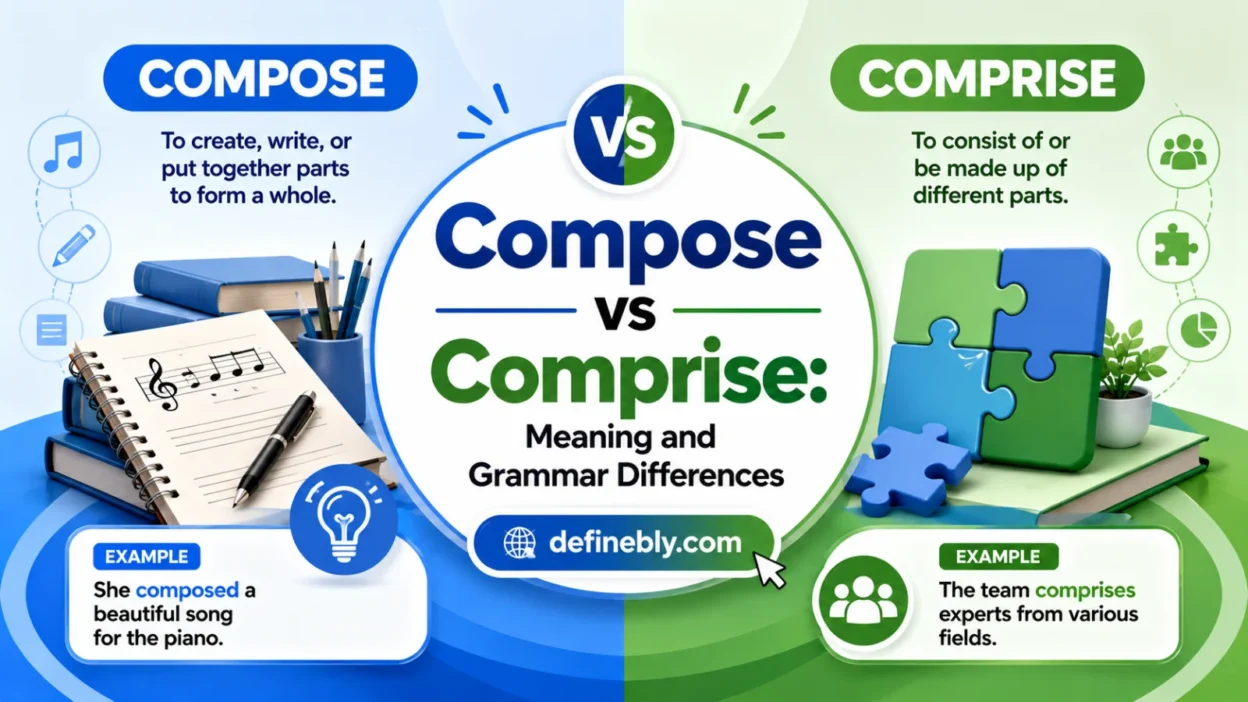
“Compose” and “comprise” are commonly confused because they describe the relationship between parts and a whole. The real difference is not just meaning—it is sentence direction.
Once you understand who is the “whole” and who is the “parts,” the correct usage becomes much easier.
In simple terms:
- Compose = parts make up a whole
- Comprise = a whole includes parts
Quick Answer
Use compose when the parts are doing the forming.
Use comprise when the whole is doing the including.
Examples
- Five players compose the team.
- The team comprises five players.
Same meaning, different direction.
The Core Idea: Sentence Direction
This is where most confusion comes from.
Compose (Parts → Whole)
- The smaller elements come first
- They create or form something larger
Structure:
Parts + compose + whole
Example:
- Ten chapters compose the book.
Comprise (Whole → Parts)
- The complete thing comes first
- It contains or includes its elements
Structure:
Whole + comprise + parts
Example:
- The book comprises ten chapters.
Why People Confuse Compose And Comprise
They are confusing because:
- both describe parts and wholes
- both are used in formal writing
- meanings feel reversible
- sentence structure changes depending on direction
But grammatically, they are not interchangeable.
Compose Vs Comprise At A Glance
| Context | Correct Word | Sentence Direction |
|---|---|---|
| Parts forming a group | compose | parts → whole |
| Whole including parts | comprise | whole → parts |
| Ingredients forming something | compose | ingredients first |
| Describing what something contains | comprise | whole first |
What Does Compose Mean?
Compose means:
- to form
- to make up
- to create something larger from parts
Common Uses
- compose a team
- compose a sentence
- compose music
- compose a mixture
Examples
- Twelve students compose the class.
- Water and minerals compose the solution.
- Multiple scenes compose the film.
What Does Comprise Mean?
Comprise means:
- to include
- to contain
- to consist of parts
Common Uses
- comprise members
- comprise sections
- comprise elements
- comprise components
Examples
- The class comprises twelve students.
- The report comprises five chapters.
- The committee comprises experts from different fields.
Important Grammar Rule: The Direction Test
Ask this simple question:
Who is the “whole”?
- If the sentence starts with parts → use compose
- If the sentence starts with whole → use comprise
This is the most reliable rule in modern English usage.
Comprise Vs Consist Of
This is a key related distinction used in professional writing.
Comprise
- Whole → parts
- More direct and formal
Example:
- The panel comprises five members.
Consist Of
- Whole → parts (like comprise)
- More neutral and widely accepted in formal writing
Example:
- The panel consists of five members.
Key Difference
- Comprise = more concise, formal tone
- Consist of = more flexible and widely used in style guides
Common Mistakes And Fixes
Reversing Sentence Direction
Incorrect:
- The team composes ten players.
Correct:
- The team comprises ten players.
Using “Comprised Of” In Formal Writing
Common but debated:
- The team is comprised of ten players.
Preferred in strict style guides:
- The team comprises ten players.
- The team consists of ten players.
However, “comprised of” is widely accepted in modern American usage.
Sentence Transformation Practice
Transforming helps fix the concept.
- Ten members compose the committee.
→ The committee comprises ten members. - Ingredients compose the recipe.
→ The recipe comprises the ingredients. - Engineers compose the team.
→ The team comprises engineers.
Real-World Usage Examples
Business Writing
- Senior managers compose the leadership group.
- The leadership group comprises senior managers from five departments.
Education
- Multiple subjects compose the curriculum.
- The curriculum comprises science, math, and literature.
Science
- Hydrogen and oxygen compose water.
- Water comprises hydrogen and oxygen.
Memory Trick
- Compose = parts come together
- Comprise = complete thing includes parts
Simple shortcut:
- compose → build
- comprise → contain
Word History
Both words come from Latin roots meaning “to put together.”
Over time, English separated them based on sentence direction:
- compose → focus on formation
- comprise → focus on inclusion
Modern usage now strongly depends on grammatical structure rather than literal meaning.
FAQ
What is the difference between compose and comprise?
Compose means parts form a whole, while comprise means a whole contains its parts.
Is it correct to say “comprised of”?
It is common in modern English, but some style guides prefer “comprises” or “consists of.”
Can compose and comprise be used interchangeably?
No. Their meaning depends on sentence direction and structure.
What is the difference between comprise and consist of?
Both mean “to include parts,” but “consist of” is more neutral and widely accepted in formal writing.
How do I remember compose vs comprise easily?
Think:
- compose = parts build the whole
- comprise = whole contains the parts
Conclusion
“Compose” and “comprise” are not just vocabulary differences—they are sentence structure differences.
- Use compose when parts create a whole
- Use comprise when a whole includes parts
Once you understand the direction rule, you can use both words confidently in academic, professional, and everyday writing.