
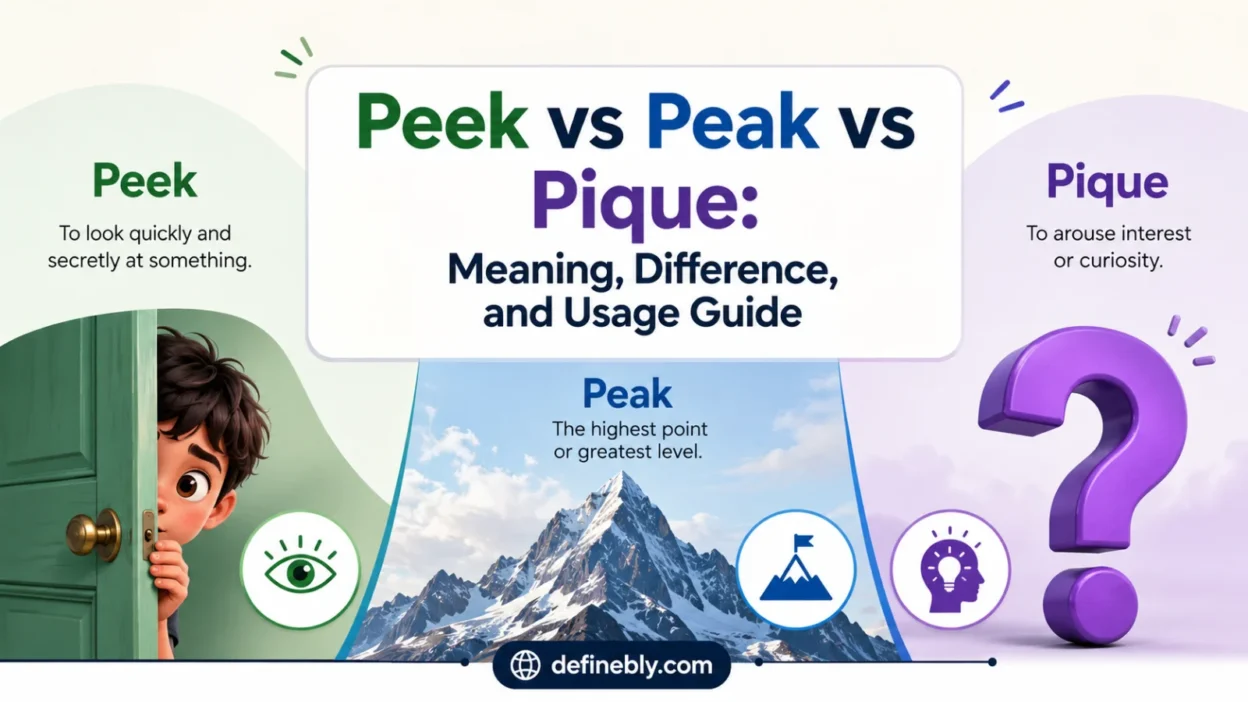
“Peek,” “peak,” and “pique” are three English words that sound the same but mean completely different things. They are homophones, which is why they are often confused in writing.
The simplest way to understand them is:
- “Peek” is about looking briefly
- “Peak” is about the highest point
- “Pique” is about interest or irritation being triggered
Quick Answer
Peek = a quick or secret look
Peak = the highest point or maximum level
Pique = to stimulate interest or cause mild irritation
Why These Words Are Confusing
These words are confusing because they sound identical in spoken English. However, their spelling and meanings come from completely different origins.
Since pronunciation does not help distinguish them, writers must rely on meaning and context instead.
Peek: Meaning, Usage, and Examples
“Peek” refers to a quick or secret look at something. It is often used when someone is curious or trying not to be noticed.
It can function as both:
- Verb: to look quickly
- Noun: a quick glance
Examples:
- She took a quick peek inside the box.
- Don’t peek at your birthday gift.
- He gave a peek through the curtain.
Common expression:
- take a peek → to look briefly
Peak: Meaning, Usage, and Examples
“Peak” refers to the highest point of something, either physically or figuratively.
It can function as:
- Noun: the top point
- Verb: to reach highest level
- Adjective: maximum level (peak performance)
Examples:
- The mountain’s peak was covered in snow.
- Traffic peaked at 6 p.m.
- She is at her peak performance level.
Common expressions:
- at its peak → at the highest level
- peak season → busiest time period
Pique: Meaning, Usage, and Examples
“Pique” has two main meanings: to stimulate interest or to trigger mild irritation.
It is most commonly used as a verb.
Examples:
- The headline piqued my curiosity.
- The comment piqued his interest in the topic.
- She was piqued by the rude remark.
Key note:
Unlike “peek” and “peak,” “pique” is abstract and emotional rather than physical.
Common expression:
- pique interest / pique curiosity → spark interest
Key Differences at a Glance
| Word | Meaning | Type of Idea | Example Concept |
|---|---|---|---|
| Peek | Quick look | Visual action | Looking briefly |
| Peak | Highest point | Physical or abstract level | Top of mountain or performance |
| Pique | Trigger emotion | Psychological response | Interest or irritation |
Common Mistakes and Fixes
Incorrect: The movie peaked my interest
Correct: The movie piqued my interest
Incorrect: Don’t peak yet
Correct: Don’t peek yet
Incorrect: The peek of the mountain is high
Correct: The peak of the mountain is high
Quick rule:
- If it’s about looking → peek
- If it’s about height or maximum → peak
- If it’s about interest or emotion → pique
Real-World Usage Contexts
Marketing:
- Ads are designed to pique curiosity.
Travel:
- You can peek through temple doors respectfully in some places.
Sports:
- Athletes perform at their peak during major tournaments.
Writing:
- A good title should pique reader interest immediately.
Memory Trick
- Peek → think “eye” (looking quickly)
- Peak → think “mountain top”
- Pique → think “spark” (emotion or curiosity)
This visual grouping helps lock in the difference quickly.
FAQ
What is the difference between peek, peak, and pique?
Peek means a quick look, peak means the highest point, and pique means to trigger interest or irritation.
Why is pique interest and not peak interest?
Because “pique” means to stimulate curiosity or emotion, while “peak” refers only to a highest level or point.
Can peak be used as a verb?
Yes, “peak” can be a verb meaning to reach its highest level, such as sales peaking in December.
Is peek always related to seeing something?
Yes, “peek” always involves a brief or secret look.
Conclusion
“Peek,” “peak,” and “pique” sound alike but serve completely different roles in English. One is visual, one is structural, and one is emotional. Once you link each word to its core idea—look, top, and spark—you can use them correctly in any context without confusion.