
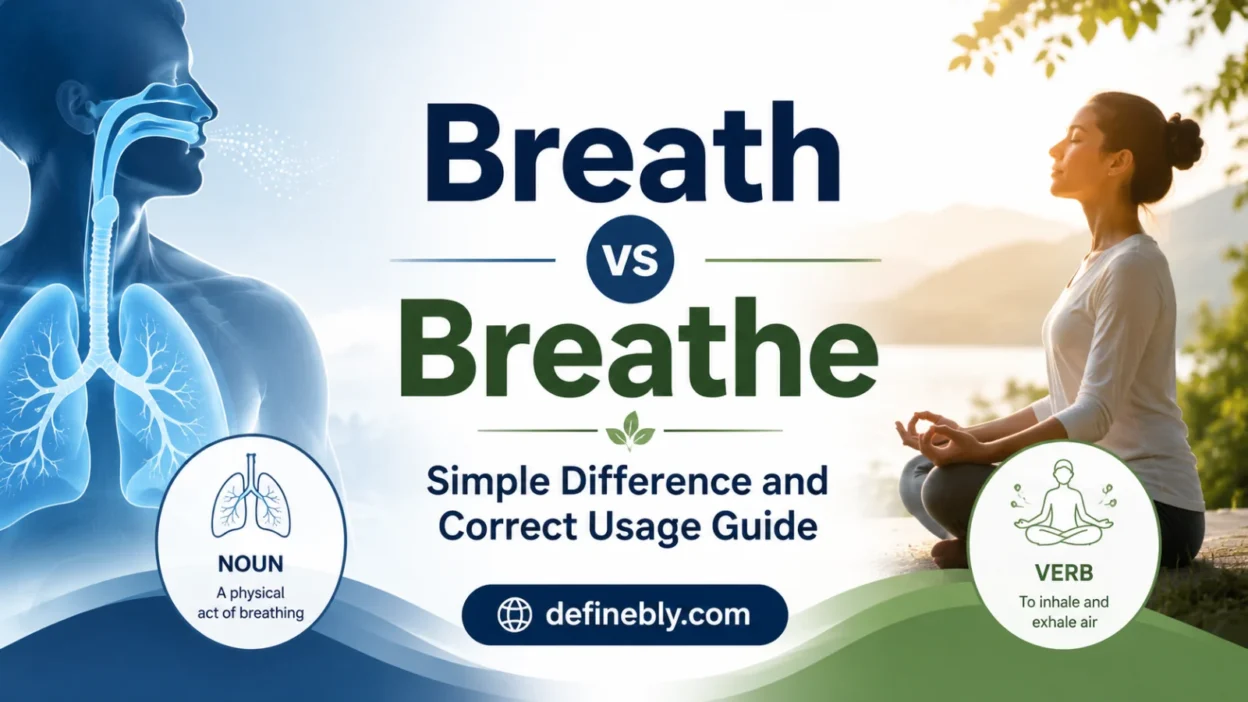
“Breath” and “breathe” are closely related words, but they are not interchangeable. The difference is simple: “breath” is a noun (the air), while “breathe” is a verb (the action of using air). Mixing them up is one of the most common English writing mistakes, especially for learners.
Quick Answer
“Breath” = the air you inhale or exhale (noun)
“Breathe” = the action of inhaling and exhaling (verb)
What Does Breath Mean?
“Breath” is a noun that refers to a single amount of air taken into or released from the lungs.
It describes the result of breathing, not the action itself.
Examples:
- Take a deep breath before you speak.
- I could see my breath in the cold air.
- She held her breath underwater.
What Does Breathe Mean?
“Breathe” is a verb that describes the ongoing action of inhaling and exhaling air.
It changes form depending on tense:
- breathe (base form)
- breathed (past tense)
- breathing (continuous form)
Examples:
- I can’t breathe properly after running.
- He breathed slowly to calm down.
- She is breathing heavily.
Pronunciation Difference
- Breath → /breθ/ (short “e” sound, ends like “death”)
- Breathe → /briːð/ (long “ee” sound, ends with soft “th”)
This pronunciation difference often helps learners remember the spelling distinction.
Key Usage Difference
| Situation | Correct Word | Why |
|---|---|---|
| Referring to air itself | breath | It is a noun (thing) |
| Referring to the action | breathe | It is a verb (doing) |
Common Expressions and Idioms
“Breath” and “breathe” appear in many everyday English phrases:
- take a breath → pause and inhale
- out of breath → unable to breathe properly after effort
- hold your breath → stop breathing temporarily
- breathe easy → relax because a problem is gone or resolved
Examples:
- After climbing the stairs, I was out of breath.
- You can breathe easy now—the test is over.
Common Mistakes and Fixes
Incorrect: I need to breath.
Correct: I need to breathe.
Incorrect: Take a deep breathe.
Correct: Take a deep breath.
Incorrect: She was out of breathe.
Correct: She was out of breath.
Quick rule:
- If you can replace the word with “air,” use breath
- If you can replace it with “inhale/exhale,” use breathe
When To Use Each Word
Use breath when referring to:
- A single unit of air
- A physical result of breathing
- Descriptions of cold air, exhaustion, or pause
Use breathe when referring to:
- Physical action of breathing
- Emotional regulation (calm down, relax)
- Physical effort or movement
Memory Trick
Think of it this way:
- “Breath” is a thing you can take.
- “Breathe” is something you do.
The extra “e” in “breathe” reminds you it is an action word.
Everyday Usage Examples
- Take a deep breath and try again.
- She struggled to breathe in the smoky room.
- I paused to breathe before answering.
- His breath smelled like coffee.
FAQ
What is the main difference between breath and breathe?
“Breath” is a noun meaning air, while “breathe” is a verb meaning the action of taking air in and out.
Why do people confuse breath and breathe?
They look similar in spelling and both relate to air and lungs, but their grammatical roles are different.
Is it correct to say “take a deep breathe”?
No. The correct phrase is “take a deep breath.”
How do you remember breath vs breathe easily?
Remember that “breathe” has an extra “e,” which signals action (verb). “Breath” is the thing itself (noun).
Conclusion
“Breath” refers to the air you take in or release, while “breathe” describes the action of doing it. Once you connect “breath = thing” and “breathe = action,” the confusion disappears and correct usage becomes automatic.