Between vs. Among: Meaning, Difference, and Usage Explained
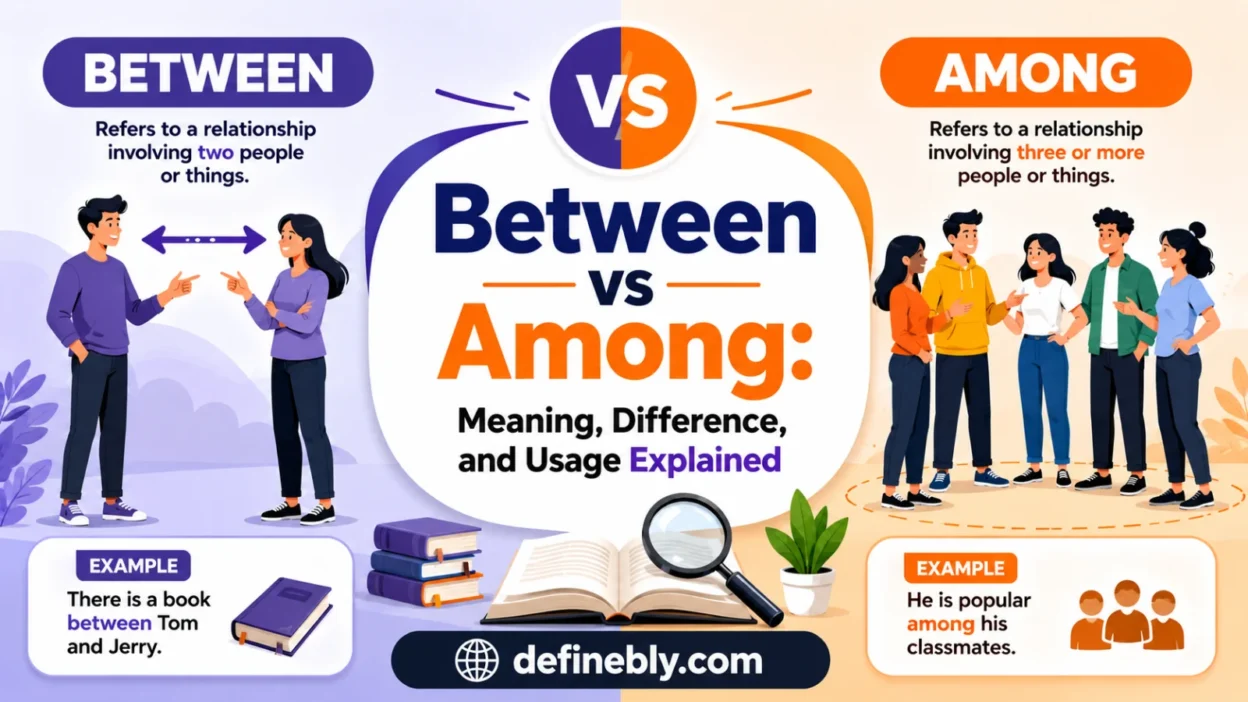
Between and among both describe relationships involving people, places, or things, but they are not always interchangeable. The main difference is how the items are viewed.
Use between when referring to distinct, separate people or things and the relationships connecting them. Use among when referring to someone or something within a group or surrounded by a collection.
The traditional rule says between is for two items and among is for more than two. However, this rule is incomplete: between can also be correct with more than two items when they are considered individually.
Examples:
- The agreement was made between the two companies.
- She felt comfortable among her friends.
- Negotiations between the three countries continued.
- The news spread among the students.
Quick Answer: Between vs. Among
| Word | Meaning and use | Example |
|---|---|---|
| Between | Relationships involving distinct, separate items | The choice between three options was difficult. |
| Among | Something within or surrounded by a group | He was popular among his classmates. |
Remember:
- Between focuses on individual relationships or distinctions.
- Among focuses on a group or collective setting.
What Is the Difference Between Between and Among?
The difference is not simply the number of people or things involved. It depends on whether you are thinking about separate relationships or a collective group.
Between: Separate and Distinct Relationships
Use between when people or things are treated as separate individuals, even if there are more than two.
Examples:
- The negotiations between the three companies lasted several weeks.
- The responsibility was divided between the four managers.
- The agreement between the countries established new trade rules.
- She had to choose between several job offers.
In each sentence, the people, organizations, or options are considered separately.
Among: Within a Group
Use among when someone or something is considered part of a group, surrounded by others, or distributed within a collective.
Examples:
- She felt relaxed among her friends.
- The teacher distributed the worksheets among the students.
- There was confusion among the employees.
- The rumor spread quickly among the villagers.
Here, the focus is on the group rather than on separate relationships between its members.
Why Do People Confuse Between and Among?
Many people learn a simple grammar rule:
- Between = two
- Among = three or more
This rule is easy to remember, but it does not explain how the words are actually used in modern English.
Consider these examples:
Between three companies:
The agreement was negotiated between three companies.
This is correct because the three companies are separate parties involved in a specific agreement.
Among three companies:
The new technology became popular among three companies.
This can also be correct because the companies are being viewed as a group in which the technology is popular.
The number alone does not determine which preposition to use. The relationship and intended meaning matter.
Key Grammar Differences
| Feature | Between | Among |
|---|---|---|
| Main focus | Distinct relationships | Group or collective setting |
| Number | Two or more | Usually three or more |
| Common use | Comparisons, choices, agreements | Inclusion, distribution, group situations |
| Example | An agreement between five countries | A discussion among colleagues |
What Does Between Mean?
Between is a preposition used to describe a relationship, position, choice, or distinction involving separate people or things.
It commonly appears when the items involved can be identified individually.
Common Uses of Between
1. Comparing or Choosing
Use between when considering separate alternatives.
Examples:
- I cannot decide between the two designs.
- The choice between three job offers was difficult.
- She had to choose between studying and working.
2. Agreements and Negotiations
Use between when describing an agreement or discussion involving distinct parties.
Examples:
- The agreement between the two businesses was finalized.
- Negotiations between the three governments continued.
- A dispute developed between the two departments.
3. Relationships and Connections
Use between to describe connections involving separate people or things.
Examples:
- The relationship between the two sisters is strong.
- There is a clear connection between exercise and physical fitness.
- Communication between the departments needs improvement.
4. Physical Position
Use between when something is located in the space separating distinct objects or places.
Examples:
- The library is between the bank and the post office.
- She sat between her two brothers.
- The village lies between three mountains.
Common Expressions With Between
- Between you and me: Something shared privately.
- Choose between: Select one option from separate alternatives.
- Between the lines: Understand an implied meaning.
- Go-between: A person who helps two sides communicate.
- Between meetings: During the time separating scheduled meetings.
What Does Among Mean?
Among is a preposition used when someone or something is included in, surrounded by, or distributed within a group.
It generally emphasizes the collective rather than the individual relationships between group members.
Common Uses of Among
1. Group Inclusion
Use among to describe someone or something as part of a group.
Examples:
- She is popular among her classmates.
- He felt comfortable among close friends.
- The new employee quickly became accepted among the team.
2. Distribution Within a Group
Use among when something is shared or distributed across members of a group.
Examples:
- The prize money was divided among the winners.
- The teacher distributed the books among the students.
- The responsibilities were shared among the team members.
3. Opinions and Feelings Within a Group
Use among when describing attitudes or reactions within a collective.
Examples:
- There was excitement among the fans.
- Concern grew among the employees.
- The proposal received strong support among voters.
4. Something Surrounded by a Group
Use among when a person or object is surrounded by several people or things.
Examples:
- The cottage stood among tall trees.
- She walked among the crowd.
- A small flower grew among the rocks.
Common Expressions With Among
- Among friends: Within a group of friends.
- Among others: Along with additional people or things.
- Among the best: Included in a group of the highest-quality options.
- Among themselves: Within a particular group.
- Among the crowd: Surrounded by a large number of people.
Between vs. Among: Examples That Show the Difference
Comparing similar sentences is one of the easiest ways to understand the distinction.
| Between | Among |
|---|---|
| The secret stayed between the three friends. | She felt comfortable among her friends. |
| The agreement was made between five companies. | The new policy became popular among employees. |
| The money was divided between the two partners. | The money was distributed among the workers. |
| The discussion between the managers continued. | Confusion spread among the managers. |
In the between examples, the focus is on distinct relationships or parties. In the among examples, the focus is on the group as a whole.
Can You Use Between for More Than Two Things?
Yes. Between can be used with more than two people, places, or things when they are treated as separate and identifiable.
Correct examples:
- The agreement between the four companies was signed yesterday.
- The differences between the three proposals were significant.
- The road runs between the three villages.
- The competition between five teams attracted a large audience.
The important point is that each item has an individual relationship to the others or to the situation being described.
Do not avoid between simply because more than two items are involved.
Can You Use Among for Two People?
Yes, among can sometimes refer to two people or things, particularly when they are considered part of a larger group or collection.
However, when referring directly to a relationship between two specific people, between is normally the natural choice.
Compare:
- The agreement between the two partners was finalized.
- She felt at ease among the people in the room.
The first sentence describes a relationship between two distinct individuals. The second describes someone’s experience within a group.
Common Mistakes and How to Fix Them
1. Using Among for a Choice Between Two Options
Incorrect: Choose among tea and coffee.
Correct: Choose between tea and coffee.
When selecting one of two distinct options, use between.
2. Assuming Between Is Only for Two Items
Incorrect: The discussion between the three companies was productive.
Correct: The discussion between the three companies was productive.
The original sentence is already correct. Between works because the companies are separate participants in the discussion.
3. Using Between When Referring to a Group
Less natural: She felt comfortable between friends.
Better: She felt comfortable among friends.
Use among when describing someone’s experience within a group rather than a specific relationship with individual people.
4. Confusing Group Distribution With Individual Relationships
Compare:
- The money was divided between the two partners.
- The money was distributed among the employees.
Both sentences are correct. The choice depends on the number and arrangement of the recipients and how the distribution is being described.
Between vs. Among in Different Contexts
Business Writing
Use between for specific business relationships, negotiations, and agreements.
Examples:
- The contract between the two companies was renewed.
- Negotiations between the three business partners are ongoing.
Use among when discussing group-wide situations.
Examples:
- Communication among departments needs improvement.
- The new policy received support among employees.
Legal Writing
Use between when identifying distinct parties to an agreement or dispute.
Example:
The agreement between the three parties was signed on Monday.
Use among when referring to issues or disagreements within a group.
Example:
There was disagreement among the stakeholders.
Academic Writing
Use between when comparing distinct subjects, concepts, or disciplines.
Example:
The study examines the relationship between language and culture.
Use among when describing patterns or opinions within a group.
Example:
The survey measured differences in reading habits among students.
Between vs. Among vs. Amongst
Amongst has the same basic meaning as among. It is an alternative form, not a word with a different grammatical function.
Examples:
- She walked among the trees.
- She walked amongst the trees.
Both sentences are correct.
The main difference is stylistic and regional:
- Among is the standard, widely preferred form in American English.
- Amongst is more common in British English and can sound more formal or literary.
For most modern American writing, choose among.
A Simple Rule to Remember
Use this quick test before choosing between the two words:
- Are you describing a relationship between separate, identifiable people or things? Use between.
- Are you describing something within or surrounded by a group? Use among.
Examples:
- The agreement between the five companies was finalized.
- She was sitting among her classmates.
- The differences between the three plans were obvious.
- Excitement spread among the audience.
Remember that the number of items is not the deciding factor. The way you view the relationship is what matters.
Practice: Between or Among?
Choose the correct preposition in each sentence.
- The agreement was signed (between/among) the three companies.
- She felt comfortable (between/among) her classmates.
- The differences (between/among) the four proposals were clear.
- Excitement spread (between/among) the fans.
- The secret remained (between/among) the two friends.
Answers:
- Between
- Among
- Between
- Among
- Between
Frequently Asked Questions
What Is the Main Difference Between Between and Among?
Between describes relationships involving distinct, separate people or things. Among describes something within or surrounded by a group. The difference is about how the items are viewed, not simply how many there are.
Can We Use Between for More Than Two Things?
Yes. You can use between for three or more items when they are considered separate and identifiable. For example, “The agreement between the five countries was signed yesterday” is correct.
Is It Correct to Say Between Friends?
Yes, in the right context. Use between friends when referring to a specific relationship or something shared privately by friends. Use among friends when describing someone or something within a group of friends.
What Is the Difference Between Among and Amongst?
Both words have the same basic meaning. Among is more common in American English, while amongst is more frequently used in British English and can sound more formal or literary.
Can Among Be Used for Two People?
Yes, when the two people are being considered as part of a larger group or collective setting. However, between is usually preferred when describing a direct relationship involving two specific people.
Is Between Only Used for Two People?
No. This is a common misconception. Between can refer to more than two people or things when each is considered separately.
Should I Use Between or Among in Formal Writing?
Both are appropriate in formal writing. Use between for distinct relationships and among for group settings. The context determines which one is correct.
Is Among More Formal Than Between?
No. Neither word is inherently more formal than the other. They have different grammatical uses, and both are suitable for professional and academic writing.
Conclusion
The difference between between and among is about the relationship you want to describe, not simply the number of people or things involved.
Use between when referring to distinct, identifiable people or things and their individual relationships. Use among when describing something within, surrounded by, or shared across a group.
The easiest rule to remember is this: between focuses on separate relationships, while among focuses on the group.