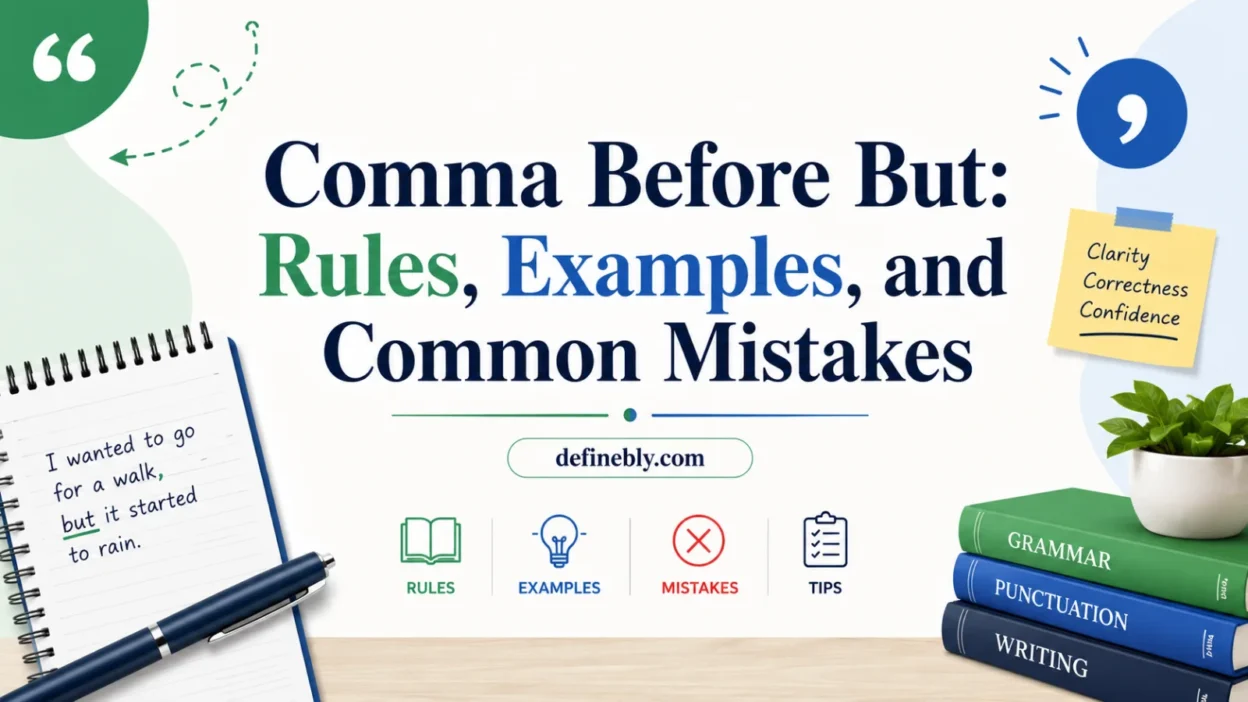
Use a comma before but when but joins two complete thoughts.
Example:
- I wanted to go for a walk, but it started raining.
Do not use a comma before but when it joins only two words, two phrases, or two actions with the same subject.
Example:
- The test was hard but fair.
The key is not the pause you hear. The key is the sentence structure.
Quick Answer
Use a comma before but when both sides can stand alone as complete sentences.
Correct:
- I wanted to help, but I was too late.
Both parts are complete thoughts:
- I wanted to help.
- I was too late.
Skip the comma when the words after but are not a complete thought.
Correct:
- The movie was long but interesting.
The word interesting cannot stand alone as a sentence, so no comma is needed.
The Rule Explained
But is a coordinating conjunction. It connects contrasting words, phrases, or complete thoughts.
The main rule is simple:
Complete thought + but + complete thought = comma before but.
Correct:
- She studied all night, but she still felt nervous.
The first part is complete:
- She studied all night.
The second part is complete:
- She still felt nervous.
That is why the comma belongs before but.
If the second part is not a complete thought, do not use a comma.
Correct:
- She was tired but happy.
The word happy is not a complete sentence. It is only a description.
When To Use It
Use A Comma Before But Between Two Complete Thoughts
Use a comma before but when each side has its own subject and verb.
Correct:
- The restaurant was busy, but we found a table.
- The store was closing, but we made it in time.
- The lecture was long, but the examples were useful.
- I called twice, but no one answered.
Each sentence joins two complete ideas.
You can test the sentence by splitting it into two sentences.
Example:
- The restaurant was busy.
- We found a table.
Because both parts work alone, the comma before but is correct.
Use A Comma Before But When The Subject Changes
A comma is especially helpful when the subject changes after but.
Correct:
- I wanted the blue jacket, but it was sold out.
- Maya sent the file, but Jordan never received it.
- The team worked quickly, but the client needed more changes.
The subject changes in the second part, so the comma helps readers follow the contrast.
Use A Comma Before But In Longer Contrasts
Use a comma before but when the second complete thought turns the sentence in a new direction.
Correct:
- The plan sounded simple, but it took all afternoon.
- The team had practiced for weeks, but the final round was harder than expected.
- The first draft looked strong, but the final version needed more detail.
The comma marks the contrast clearly.
Use A Comma Before But In Short Complete Sentences When Clarity Helps
Some short independent clauses can be clear without a comma.
Acceptable in some styles:
- I came but I left.
Clearer for most writing:
- I came, but I left.
For school, business, and general writing, the comma is usually the safer choice when both sides are complete sentences.
When Not To Use It
Do Not Use A Comma Before But Between Two Adjectives
Do not use a comma before but when it joins two descriptions.
Incorrect:
- The room was small, but cozy.
Correct:
- The room was small but cozy.
More correct examples:
- The answer was short but helpful.
- The job was difficult but rewarding.
- The soup was spicy but delicious.
The second word is not a complete thought.
Do Not Use A Comma Before But When One Subject Does Two Actions
Do not use a comma before but when the same subject performs both actions.
Incorrect:
- Maya opened the email, but forgot to reply.
Correct:
- Maya opened the email but forgot to reply.
The subject Maya applies to both actions.
More correct examples:
- He opened the app but forgot his password.
- She tried to explain but stopped halfway through.
- We planned to leave early but stayed for dessert.
Do Not Use A Comma Before But With Short Phrases
Do not add a comma before but when only a phrase follows.
Incorrect:
- The answer was surprising, but true.
Correct:
- The answer was surprising but true.
Incorrect:
- The trip was tiring, but worth it.
Correct:
- The trip was tiring but worth it.
The phrase after but cannot stand alone as a sentence.
Do Not Add A Comma Just Because You Pause
A pause in speech does not always need a comma.
Incorrect:
- I liked the idea, but not the price.
Correct:
- I liked the idea but not the price.
The phrase not the price is not a complete sentence.
Common Mistakes
Missing The Comma Between Two Complete Thoughts
Incorrect:
- I wanted to stay home but my friends convinced me to go.
Correct:
- I wanted to stay home, but my friends convinced me to go.
Both sides can stand alone as sentences.
Adding A Comma Before But When Only A Word Follows
Incorrect:
- The movie was long, but interesting.
Correct:
- The movie was long but interesting.
The word interesting is only an adjective.
Putting A Comma After But For No Reason
Incorrect:
- I wanted to help but, I was too late.
Correct:
- I wanted to help, but I was too late.
Usually, the comma goes before but, not after it.
Using A Comma After But With An Interrupter
A comma can come after but when an interrupter follows.
Correct:
- I wanted to help, but, honestly, I was too late.
- The plan worked, but, to be fair, it took longer than expected.
- She agreed, but, in fact, she still had concerns.
The interrupting phrase needs commas around it.
Without the interrupter, do not use a comma after but.
Correct:
- I wanted to help, but I was too late.
Misplacing The Comma In Not Only…But Also
Do not automatically place a comma before but also.
No comma needed:
- She is not only smart but also patient.
Use a comma when the construction joins two complete thoughts.
Correct:
- Not only did she finish the report, but she also reviewed the charts.
The comma works because the sentence joins larger complete ideas.
Correct Examples
| Sentence | Comma? | Why |
|---|---|---|
| I was tired, but I finished the report. | Yes | Two complete thoughts |
| The soup was hot but delicious. | No | Two adjectives |
| She called me, but I missed the call. | Yes | Two complete thoughts |
| He opened the app but forgot his password. | No | One subject, two actions |
| The job was difficult but rewarding. | No | Two descriptions |
| The store was closing, but we made it in time. | Yes | Two complete thoughts |
| The answer was short but helpful. | No | Two adjectives |
| I wanted to help, but, honestly, I was too late. | Yes | Interrupter after but |
More examples:
- The weather was cold, but the kids still played outside.
- I liked the design but not the color.
- The report was short, but it answered every question.
- She wanted to speak but stayed quiet.
- The laptop was expensive but reliable.
- I sent the invoice, but the client did not receive it.
- The class was hard but useful.
- We arrived late, but the meeting had not started.
Quick Memory Fix Or Rule Of Thumb
Use this simple test:
Can both sides of but stand alone as sentences?
If yes, use a comma before but.
Correct:
- I was hungry, but the fridge was empty.
Both parts are complete sentences.
If no, skip the comma.
Correct:
- I was hungry but patient.
The word patient is not a complete sentence.
FAQs
Do you put a comma before but?
Yes, use a comma before but when it joins two complete thoughts.
Example:
- I wanted to call, but my phone was dead.
Do not use a comma when but joins only two words or phrases.
Do you always need a comma before but?
No. A comma before but is not always needed.
Use it between two complete thoughts. Skip it when but joins two adjectives, two verbs with the same subject, or short phrases.
What is an example of a comma before but?
Here is a simple example:
- The road was icy, but we drove carefully.
Both parts can stand alone as sentences.
When should you not use a comma before but?
Do not use a comma before but when the second part is not a complete sentence.
Correct:
- The lesson was hard but useful.
The word useful is only a description.
Do you put a comma after but?
Usually, no. A comma normally goes before but, not after it.
A comma can come after but when an interrupter follows.
Correct:
- The trip was fun, but, to be honest, exhausting.
Can you start a sentence with but?
Yes. You can start a sentence with but when it clearly contrasts with the previous sentence.
Example:
- I wanted to go. But I was too tired.
This works best when the contrast is clear. In formal writing, use it sparingly.
Is but a conjunction?
Yes. But is a coordinating conjunction.
It connects words, phrases, or complete thoughts that contrast with each other.
Is “small but powerful” correct?
Yes. Small but powerful is correct without a comma.
The word but joins two adjectives, not two complete thoughts.
Do you use a comma before but also?
Not always.
No comma is needed in a simple not only…but also phrase.
Correct:
- She is not only talented but also hardworking.
Use a comma when the sentence joins two larger complete ideas.
Correct:
- Not only did she lead the project, but she also trained the new team.
What is the easiest way to check comma before but?
Split the sentence at but.
If both parts can stand alone, use a comma.
Example:
- I wanted to leave, but the meeting was not over.
If the second part cannot stand alone, skip the comma.
Example:
- I wanted to leave but stayed.
Conclusion
Use a comma before but when but joins two complete thoughts.
Skip the comma when but joins two words, two phrases, or two actions with the same subject.
The easiest test is simple: if both sides of but can stand alone as sentences, put a comma before but.