
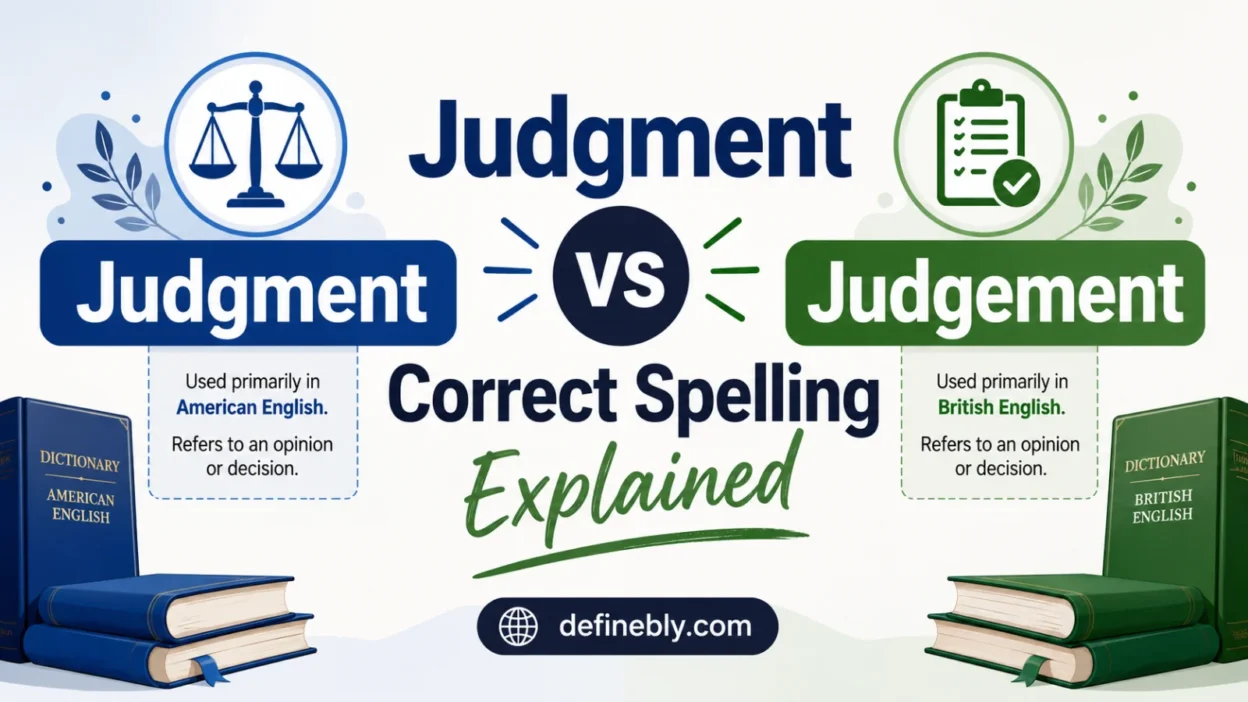
“Judgment” and “judgement” are two spellings of the same word, and both are correct depending on regional English conventions. The key difference is not meaning but spelling preference: American English primarily uses “judgment,” while British English often uses “judgement.”
Which Spelling Is Correct?
Both forms are correct in English, but their usage depends on region and writing standards.
- American English: judgment
- British English: judgement (though “judgment” is also increasingly accepted in modern UK usage, especially in legal contexts)
The most important rule is consistency within your writing.
Why Are There Two Spellings?
The difference comes from historical English spelling variation. Over time:
- American English simplified many words by dropping extra vowels in unstressed syllables.
- British English retained more traditional spellings in certain cases.
Both “judgment” and “judgement” evolved from the same root word in Middle English, but diverged as spelling standards became regionally fixed.
Judgment vs Judgement In Style Guides
Different authoritative sources treat the spellings as follows:
- AP Style (United States): judgment
- Chicago Manual of Style: judgment
- Merriam-Webster Dictionary: judgment (primary entry)
- Oxford Dictionary (UK English): judgement (preferred variant, though both appear)
- Cambridge Dictionary: judgement (UK usage preference)
This shows that American English strongly favors “judgment,” while British English allows both but leans toward “judgement.”
Legal And Formal Usage Differences
In legal writing, “judgment” is especially important:
- In United States law, “judgment” is the official legal spelling used in court documents, rulings, and case law.
- In British legal contexts, both spellings appear, but “judgment” is increasingly common in formal legal writing.
This makes “judgment” the more globally dominant form in legal and technical contexts.
How To Choose The Correct Spelling
Use this decision framework:
- If writing for a US audience → use judgment
- If writing for UK audiences → use judgement
- If writing for global or SEO content → choose judgment for broader consistency in modern digital usage
- In all cases → do not mix both forms in the same document
Consistency is a key marker of professional writing quality.
Example Sentences In Real Context
American English (judgment):
- The court issued its final judgment in the case.
- I trust your judgment on this decision.
- Her judgment was questioned during the review process.
British English (judgement):
- The committee questioned his judgement.
- She showed excellent judgement under pressure.
- His judgement of the situation was accurate.
Neutral / Legal Context:
- The judgment was filed with the court records.
- The judgment can be appealed within 30 days.
Related Words And Variations
The same root appears in several related terms:
- judgmental (both US and UK)
- pass judgment / pass judgement
- court judgment
- value judgment
These related forms reinforce the same spelling distinction pattern.
Common Mistakes
- Mixing “judgment” and “judgement” in the same article or document
- Assuming “judgement” is incorrect in all contexts (it is valid in British English)
- Overusing regional variants without considering audience consistency
- Ignoring legal and formal writing conventions where “judgment” dominates
Quick Decision Rule
- US English → judgment
- UK English → judgement
- Professional writing → choose one system and stay consistent
- Legal/technical writing → prefer judgment in most modern contexts
FAQs
Is “judgement” incorrect in American English?
No, it is understood, but “judgment” is the standard and preferred spelling in American writing.
Is “judgment” used in British English?
Yes, it is increasingly common, especially in legal and formal writing, though “judgement” is still widely used.
Why did American English drop the “e” in judgment?
American English spelling reforms often simplified words by removing silent or unstressed letters for consistency.
Which spelling is used in courts?
In the United States, “judgment” is the official legal spelling used in all court documents.
Can I use both spellings in writing?
No, mixing them in the same document is considered inconsistent and unprofessional.
Which spelling is more common globally?
“Judgment” is more common in global legal, academic, and digital writing due to American English influence.
Is there a pronunciation difference?
No, both spellings are pronounced the same way.
What do dictionaries say about judgment vs judgement?
Most major dictionaries list “judgment” as the primary American spelling and “judgement” as a British variant.
Should I use judgment or judgement for SEO content?
Use the version that matches your target audience; for broad US/global SEO, “judgment” is generally preferred.
Are there other words with similar differences?
Yes, similar pairs include “color/colour” and “organize/organise,” following the same US vs UK pattern.
Conclusion
“Judgment” and “judgement” are regional spelling variants of the same word with identical meaning. American English standardizes “judgment,” while British English commonly uses “judgement.” The most important rule in any writing context is not which spelling you choose, but maintaining consistency and aligning with your intended audience and style guide.