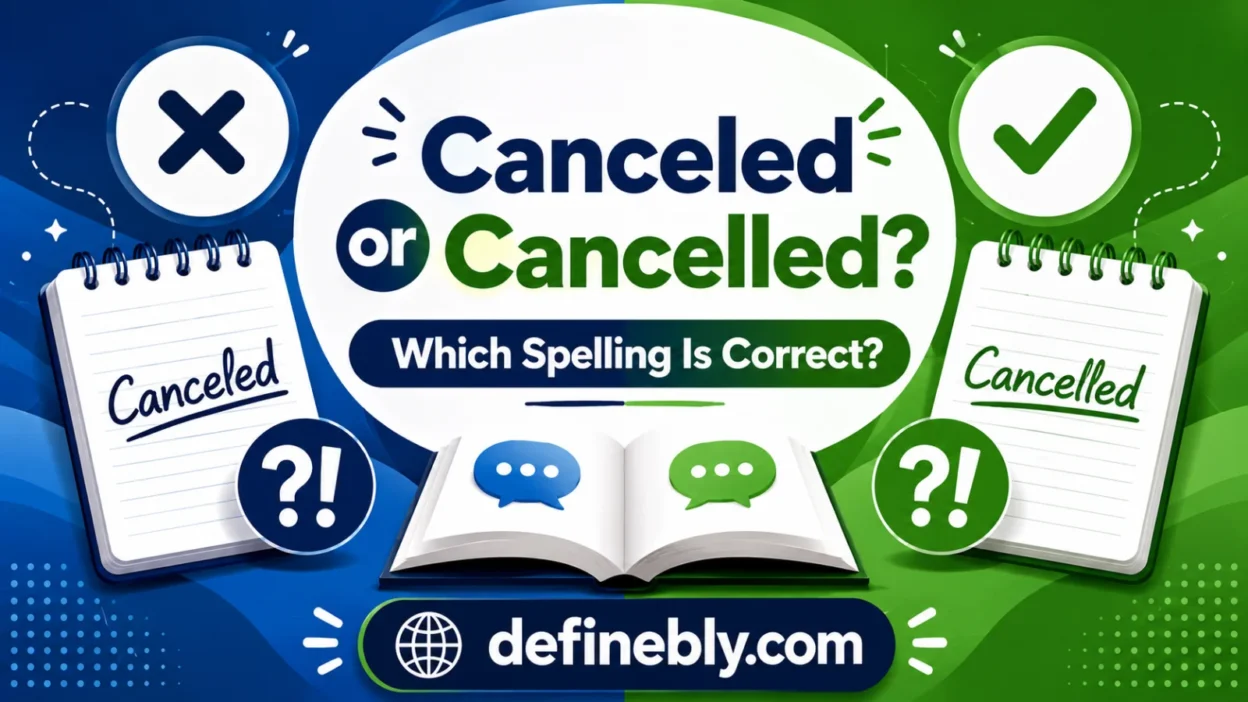
“Canceled” and “cancelled” are both correct spellings of the past tense of cancel, but they follow different regional conventions. The difference is not grammatical—it is a spelling standard shaped by American and British English usage.
Understanding when to use each form is important for professional writing, academic work, and SEO content targeting specific audiences.
Quick Answer
- Canceled → Preferred in American English
- Cancelled → Preferred in British English, Canadian English, and other Commonwealth regions
- Both spellings are correct; the choice depends on audience and style guide.
Why There Are Two Spellings
The difference comes from a general spelling pattern in English verbs ending in -l.
In British English, consonants are often doubled before adding suffixes:
- cancel → cancelled → cancelling
In American English, the final consonant is usually not doubled:
- cancel → canceled → canceling
This pattern is consistent across many verbs (travelled/traveled, labelled/labeled).
What Style Guides Say
- AP Stylebook (U.S.): prefers canceled
- Merriam-Webster (U.S.): lists canceled as primary
- Oxford English Dictionary (U.K.): prefers cancelled
- British Standard Usage: commonly uses double “l”
These conventions matter in publishing, journalism, academic writing, and SEO content consistency.
Canceled vs Cancelled in Real Usage
American English Usage
- The flight was canceled due to weather.
- The subscription was canceled after payment failure.
- The event was canceled at the last minute.
British English Usage
- The flight was cancelled due to weather.
- The concert was cancelled because of rain.
- The booking was cancelled without notice.
Both versions communicate the same meaning: something planned has been stopped.
Related Word Forms You Should Know
Understanding spelling consistency requires looking at the full verb family:
- Cancel (base form)
- Canceled / Cancelled (past tense)
- Canceling / Cancelling (present participle)
- Cancellation (noun – always double “l”)
Even in American English, cancellation keeps the double “l,” which is a common exception learners miss.
Where Each Form Is Commonly Used
- Airlines & travel → “flight canceled/cancelled” depending on region
- Subscriptions & billing → “subscription canceled” (US default)
- Legal documents → follows jurisdiction style guide
- News media → follows publication region (AP vs UK standards)
Consistency within one document or brand is more important than mixing forms.
Which One Should You Use?
Choose based on your audience:
- Write canceled if your readers are primarily in the United States
- Write cancelled if your audience is in the United Kingdom, Canada, Australia, or other Commonwealth regions
For global content (especially SEO articles), pick one variant and stay consistent throughout the entire page.
Common Mistakes
Mixing both spellings in one document
This is the most common writing error and reduces professionalism.
Thinking one spelling is incorrect
Both are correct; only regional usage differs.
Applying US spelling rules inconsistently
Example: writing canceled but cancelling in the same US-focused article creates inconsistency.
Memory Trick
- Canceled (one L) → American English
- Cancelled (two Ls) → British/Commonwealth English
FAQ
Is canceled or cancelled correct in the United States?
Canceled with one “l” is the standard American English spelling.
Is cancelled wrong?
No. It is correct in British English and many other English varieties.
Why does British English use two l’s?
British spelling commonly doubles consonants before suffixes like -ed and -ing.
Which spelling should I use for SEO content?
Use the version that matches your target audience. For U.S. traffic, use “canceled.”
Do cancellation and canceled follow the same rule?
No. “Cancellation” uses a double “l” in all major English variants.
Conclusion
“Canceled” and “cancelled” are not competing correct and incorrect forms—they are regional spelling variations of the same word. The deciding factor is your audience and the style guide you follow.
For American English, use canceled. For British and Commonwealth English, use cancelled. Consistency is the real rule that determines professional writing quality.