
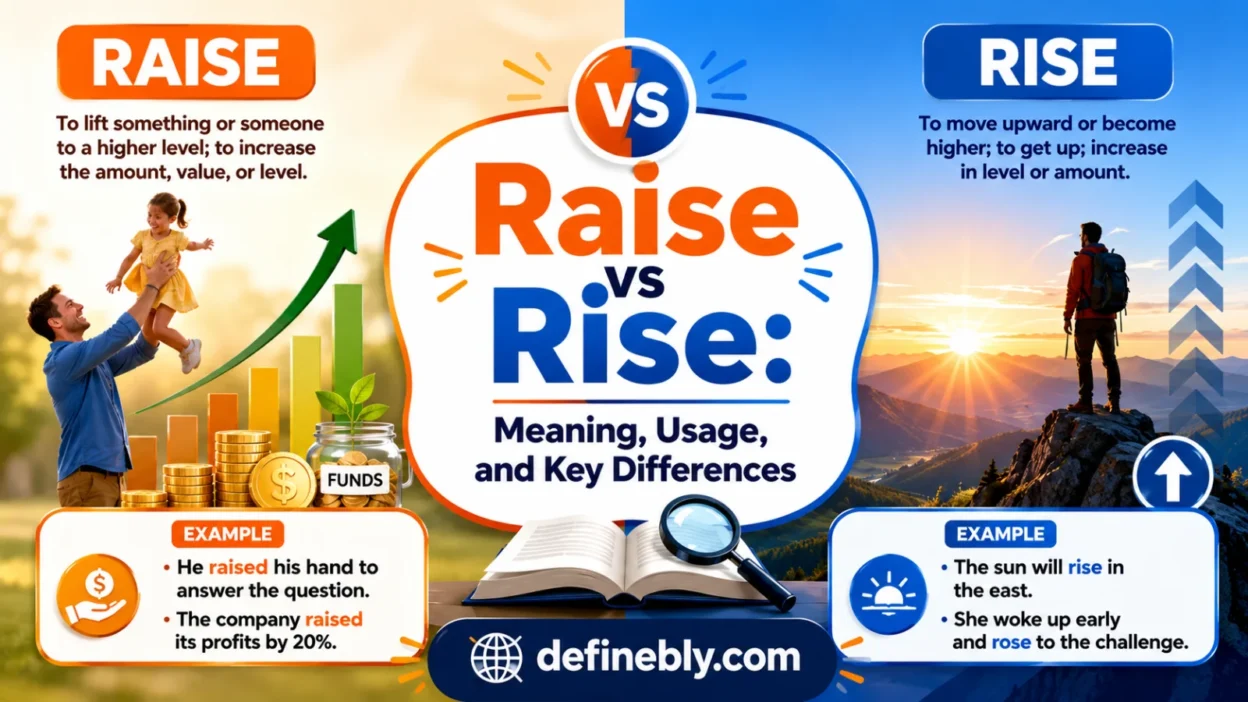
“Raise” and “rise” are commonly confused because both involve movement upward. However, they do not work the same way in a sentence.
Understanding the difference becomes much easier once you know who or what causes the upward movement.
Quick Answer
The difference between raise and rise is about control:
- Raise means someone or something causes something else to go up.
- Rise means something goes up on its own.
Examples
- The government raised taxes.
- Prices rose last year.
If there is a “doer,” use raise. If something moves by itself, use rise.
Why People Confuse Raise And Rise
Both words describe upward movement such as:
- prices
- temperature
- hands
- salaries
- emotions
- physical movement
The confusion happens because the result (something going up) looks the same, even though the grammar structure is different.
Key Grammar Difference (Most Important Rule)
| Feature | Raise | Rise |
|---|---|---|
| Verb type | Transitive | Intransitive |
| Object required | Yes | No |
| Meaning | To cause something to go up | To go up on its own |
| Example | Raise your hand | The sun rises |
Simple Logic
- Raise = you lift something
- Rise = something lifts itself
What Does Raise Mean?
Raise is a verb that means to:
- lift something
- increase something
- elevate something
- bring something up
It always needs an object.
Common Collocations
- raise your hand
- raise prices
- raise concerns
- raise awareness
- raise funds
- raise standards
Examples
- The teacher asked students to raise their hands.
- The company raised employee salaries.
- She raised an important question in the meeting.
- They raised money for disaster relief.
What Does Rise Mean?
Rise is a verb that means to:
- move upward
- increase naturally
- stand up
- grow over time
It does not take an object.
Common Collocations
- rise in prices
- rise sharply
- rise from bed
- rise to power
- rise and fall
- rise over time
Examples
- The sun rises in the east.
- Prices rose during the inflation period.
- She rose from her chair.
- Smoke rose into the sky.
Raise Vs Rise Vs Past Tense Confusion (Common Mistake Area)
A major source of confusion is past tense forms:
| Base Verb | Past Tense |
|---|---|
| raise | raised |
| rise | rose |
Examples
- Prices rose last year.
- The company raised prices last year.
Wrong mix-ups:
- ❌ Prices raised last year
- ❌ The sun raised this morning
Real-World Usage Contexts
Finance And Business
- The company raised investment capital.
- Stock prices rose sharply this week.
Weather And Nature
- Temperatures rise in summer.
- The sun rises every morning.
Workplace Communication
- She raised a concern about deadlines.
- Tension rose during the meeting.
Physical Movement
- He raised his hand.
- The balloon rose into the air.
Sentence Transformation Practice
Convert correctly:
- The sun rise/raise → The sun rises
- She raised/rose her hand → She raised her hand
- Prices were raised/rose → Prices rose
- The manager raised/rose concerns → The manager raised concerns
Common Mistakes And Fixes
Mistake 1: Using Raise Without An Object
❌ Prices raised
✔ Prices rose
Mistake 2: Using Rise With An Object
❌ She rose her hand
✔ She raised her hand
Mistake 3: Mixing Past Tense Forms
❌ The sun raised
✔ The sun rises
Memory Trick
- Raise = Reach Out And Lift Something
- Rise = Rises By Itself
Or simply:
- If you can ask “what is being lifted?” → raise
- If nothing is being acted on → rise
Word History
Both words come from old Germanic language roots connected to movement upward. Over time, English separated them into two grammatical roles:
- Raise → caused action
- Rise → natural action
FAQ
What is the difference between raise and rise?
Raise means to lift or increase something. Rise means to move upward on its own.
Is it rise or raise the sun?
The correct form is the sun rises, because the sun moves naturally.
What is the past tense of rise and raise?
- rise → rose
- raise → raised
Can we say prices raised?
No. The correct form is prices rose unless someone actively increased them.
Is raise always transitive?
Yes. Raise always needs an object (something being lifted or increased).
Conclusion
The difference between raise and rise comes down to control:
- Use raise when someone causes something to go up.
- Use rise when something goes up naturally.
A simple rule:
Raise = you do it. Rise = it happens on its own.