
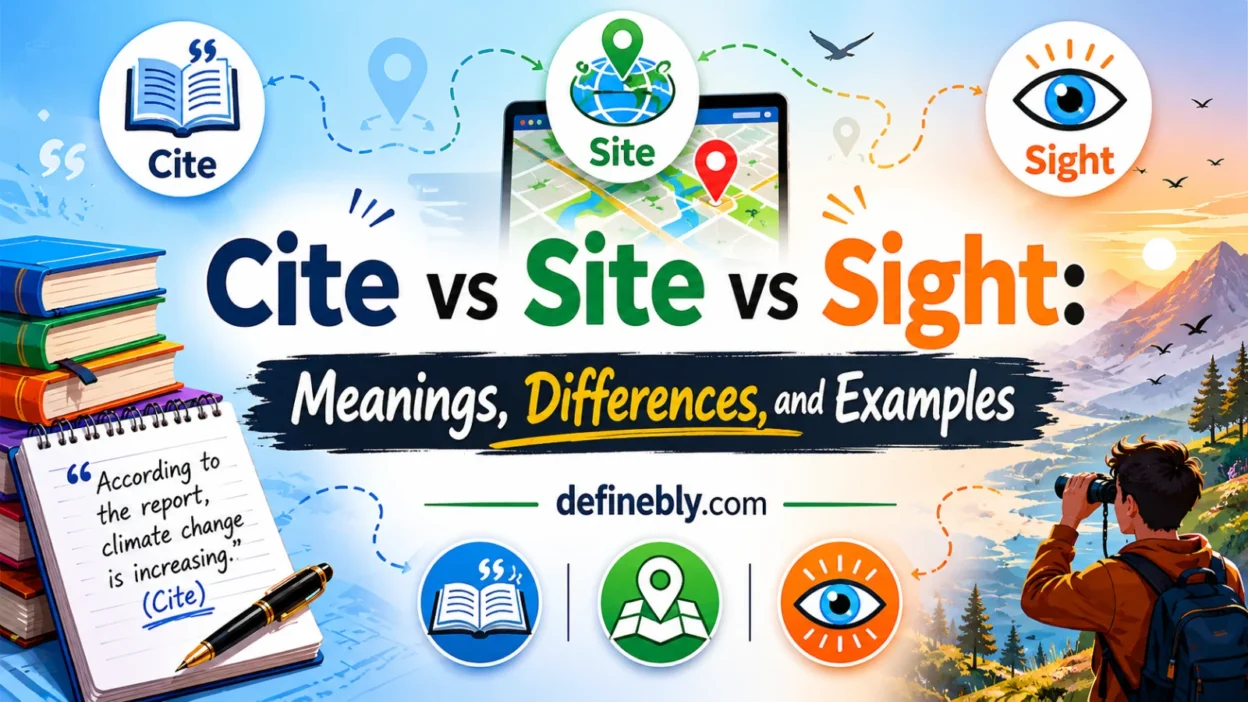
“Cite,” “site,” and “sight” sound exactly the same in spoken English, but their meanings are completely different.
These words are classic homophones—words that share pronunciation but differ in spelling and meaning.
- Cite relates to references, sources, or quotations.
- Site refers to a place, location, or website.
- Sight relates to vision, seeing, or something visible.
Because the words sound identical, writers often confuse them in emails, essays, online posts, and everyday communication.
Quick Answer
Use:
- cite for quoting or referencing sources
- site for locations or places
- sight for vision or things you see
Examples:
- Please cite your sources.
- The company opened a new construction site.
- The mountains were a beautiful sight.
Why People Confuse Cite, Site, And Sight
These words are confusing because:
- they are pronounced the same
- they differ by only one or two letters
- they appear in many everyday contexts
- spellcheck may not catch the wrong choice
For example:
- “website sight” is incorrect
- “website site” is correct
Because all three are valid English words, writers often overlook mistakes during proofreading.
Pronunciation And Homophone Confusion
All three words are pronounced:
/saɪt/
English contains many homophones, and these are among the most commonly confused because their meanings are completely unrelated.
Cite Vs Site Vs Sight At A Glance
| Word | Main Meaning | Common Context |
|---|---|---|
| cite | reference or quote | essays, journalism, research |
| site | place or location | construction, websites, geography |
| sight | vision or something seen | travel, eyesight, visual experience |
What Does Cite Mean?
Cite means to quote, mention, or reference a source, example, or authority.
It is commonly used in:
- academic writing
- journalism
- legal documents
- research papers
Examples Of Cite
- Students must cite reliable sources.
- The article cites several scientific studies.
- Lawyers often cite previous court decisions.
Common Grammar Patterns
- cite a source
- cite evidence
- cite research
- cite an example
Cite Vs Citation
- Cite = verb
- Citation = noun
Example:
- You must cite the article correctly.
- The citation was incomplete.
What Does Site Mean?
Site refers to a place, location, or physical area.
It can describe both real-world locations and digital spaces.
Physical Site Examples
- construction site
- campsite
- archaeological site
- historical site
Digital Site Examples
- website
- online shopping site
- social media site
Example Sentences
- Workers arrived early at the construction site.
- We visited a famous historical site.
- The company launched a new website site design.
What Does Sight Mean?
Sight relates to vision, seeing, or something visible.
It can describe:
- physical eyesight
- visual experiences
- impressive scenes
- figurative expressions
Examples Of Sight
- The waterfall was an incredible sight.
- She lost sight of her friend in the crowd.
- His eyesight improved after surgery.
Sight As A Verb
Sight can also function as a verb meaning “to see.”
Example:
- Sailors sighted land after several days at sea.
Common Idioms And Phrases With Sight
Popular Expressions
- out of sight
- at first sight
- line of sight
- catch sight of
- lose sight of
- hidden from sight
Examples
- They fell in love at first sight.
- The mountain remained hidden from sight.
- We caught sight of dolphins near the shore.
These phrases are extremely common in spoken and written English.
Real-World Usage Differences
Academic Writing
Use cite:
- cite sources
- cite evidence
- cite references
Travel And Geography
Use site:
- tourist site
- historical site
- camping site
Vision And Observation
Use sight:
- beautiful sight
- eyesight test
- visual sighting
Common Mistakes And Quick Fixes
Using Sight Instead Of Site
Incorrect:
- We visited the construction sight.
Correct:
- We visited the construction site.
Using Site Instead Of Cite
Incorrect:
- Please site your references.
Correct:
- Please cite your references.
Using Cite Instead Of Sight
Incorrect:
- The sunset was a beautiful cite.
Correct:
- The sunset was a beautiful sight.
Sentence Correction Practice
- ❌ Students must site their sources.
✔ Students must cite their sources. - ❌ The beach was a beautiful site.
✔ The beach was a beautiful sight. - ❌ The workers arrived at the construction sight.
✔ The workers arrived at the construction site.
Memory Tricks To Remember The Difference
Cite
Think:
- citation
- referencing information
Site
Think:
- website
- physical location
Sight
Think:
- eyesight
- seeing something visually
Simple shortcut:
- cite = quote
- site = place
- sight = vision
Synonyms And Related Words
Cite
- reference
- quote
- mention
- credit
Site
- location
- area
- place
- position
Sight
- vision
- scene
- view
- spectacle
Word Origins And Language History
Although these words sound identical today, they developed from different historical roots.
- Cite comes from Latin roots related to calling or summoning.
- Site developed from roots connected to position or location.
- Sight evolved from Old English words related to vision and seeing.
Over time, pronunciation changes caused them to become homophones in modern English.
Why This Distinction Matters
Using the wrong word can:
- confuse readers
- weaken academic credibility
- create professional writing mistakes
- change sentence meaning completely
For example:
- “cite your sources” is correct in academic writing
- “site your sources” is a common but incorrect spelling mistake
FAQ
What is the difference between cite, site, and sight?
Cite means reference, site means location, and sight relates to vision or seeing.
What does cite mean in writing?
Cite means to quote or reference information from a source.
Is a website a site or sight?
The correct word is “site.”
What is an example of sight?
“The Grand Canyon was an amazing sight” uses sight correctly.
Why are cite, site, and sight confusing?
They are homophones, meaning they sound the same but have different meanings and spellings.
How can I remember cite vs site vs sight?
Think:
- cite = citation
- site = place
- sight = eyesight
Conclusion
“Cite,” “site,” and “sight” may sound identical, but they belong to completely different parts of English.
- Use cite for references and sources.
- Use site for locations and places.
- Use sight for vision and things you see.
Once you connect each word to its core meaning—reference, place, or vision—the confusion becomes much easier to avoid in both casual and professional writing.