“Allusion” and “illusion” are two words that look and sound almost identical, but they describe completely different ideas.
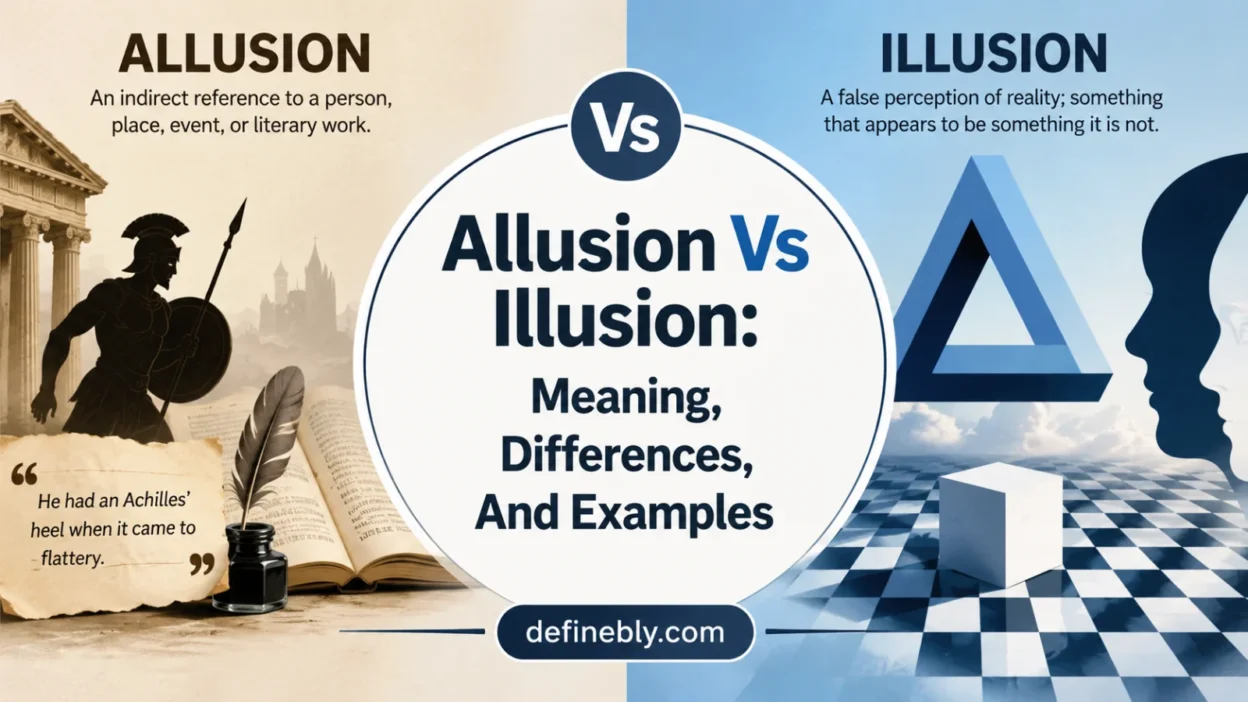
- Allusion refers to an indirect reference to something, often in writing or speech.
- Illusion refers to something that tricks your senses or makes something appear real when it is not.
The confusion is common because the words sound the same and both suggest something “not directly obvious.” However, their meanings belong to entirely different fields—language and perception.
Quick Answer
An allusion is an indirect reference to something well-known, such as a person, event, or text.
An illusion is a false perception or misleading appearance that tricks the mind or senses.
Example:
- The author made an allusion to Shakespeare.
- The magician created an illusion on stage.
Why People Confuse Allusion And Illusion
These words are frequently mixed up because:
- They sound almost identical when spoken
- They share the same “-usion” ending
- Both involve something indirect or not immediately obvious
- They often appear in formal writing or storytelling contexts
Despite these similarities, they operate in completely different domains.
Pronunciation Note
Both words are pronounced nearly the same: /əˈluːʒən/ and /ɪˈluːʒən/.
Because of this similarity in sound, spelling becomes the only reliable way to distinguish them in writing.
Allusion Vs Illusion At A Glance
| Context | Correct Word | Meaning |
|---|---|---|
| Indirect reference in writing | allusion | hints at something without naming it |
| Literary device | allusion | reference to texts, people, events |
| Visual trick or deception | illusion | false appearance or perception |
| Magic, psychology, perception | illusion | something that seems real but isn’t |
What Does Allusion Mean?
An allusion is an indirect reference to something the reader is expected to recognize.
It is commonly used in:
- literature
- speeches
- essays
- film scripts
- pop culture writing
Examples Of Allusion
- The novel makes an allusion to Greek mythology.
- His speech contained an allusion to the Civil Rights Movement.
- The movie includes an allusion to classic superhero stories.
Key Idea
Allusion = indirect reference that depends on shared knowledge.
What Does Illusion Mean?
An illusion is something that deceives the senses or mind.
It makes something appear real, even though it is not.
Types Of Illusion
- Optical illusion (visual tricks)
- Cognitive illusion (thinking errors)
- Psychological illusion (perception bias)
- Magical illusion (stage tricks)
Examples Of Illusion
- The desert heat created an illusion of water.
- The magician’s trick was a visual illusion.
- Social media often creates an illusion of perfect lives.
Key Idea
Illusion = false perception of reality.
Allusion In Literature And Communication
Allusions are powerful literary tools because they:
- add depth without explanation
- create emotional or cultural connections
- rely on shared knowledge between writer and reader
Example
A writer saying “He met his Waterloo” is an allusion to Napoleon’s defeat, meaning a final or decisive failure.
Illusion In Real Life And Media
Illusions are everywhere in daily life:
- Movies use CGI illusions
- Magicians create stage illusions
- Advertising creates lifestyle illusions
- Social media can create identity illusions
These examples show how perception can be shaped or distorted.
Illusion Vs Delusion (Common Confusion)
This is a frequent related search.
- Illusion = external false perception (what you see or experience)
- Delusion = internal false belief (what you believe despite evidence)
Example:
- A mirage in the desert is an illusion.
- Believing something false despite facts is a delusion.
Common Mistakes And Fixes
Using Illusion Instead Of Allusion
Incorrect:
- The poem makes an illusion to mythology.
Correct:
- The poem makes an allusion to mythology.
Using Allusion Instead Of Illusion
Incorrect:
- The magician created an allusion.
Correct:
- The magician created an illusion.
Treating Them As Synonyms
Incorrect:
- The story contains an illusion to history.
Correct:
- The story contains an allusion to history.
Sentence Correction Practice
- ❌ The book uses illusion to Shakespeare.
✔ The book uses allusion to Shakespeare. - ❌ The heat created an allusion of water.
✔ The heat created an illusion of water. - ❌ The film contains an illusion to mythology.
✔ The film contains an allusion to mythology.
Memory Tricks To Remember The Difference
- Allusion = allude (to hint or refer)
- Illusion = illusory (fake appearance)
Simple shortcut:
- Allusion = language (literary hint)
- Illusion = senses (fake reality)
Synonyms And Related Words
Allusion
- reference
- hint
- implication
- suggestion
- nod to something
Illusion
- mirage
- trick
- deception
- false image
- appearance
Modern Usage Examples
- Movies often include allusions to older franchises.
- Deepfake videos can create powerful illusions.
- Political speeches may use historical allusions.
- Filters on social media create visual illusions.
Why This Distinction Matters
Using the wrong word can:
- confuse readers
- change meaning entirely
- weaken writing credibility
- create misunderstanding in academic or professional contexts
In literature, “allusion” signals meaning. In perception, “illusion” signals deception.
FAQ
What is the difference between allusion and illusion?
Allusion is an indirect reference in language, while illusion is a false perception that tricks the senses.
Why are allusion and illusion so confusing?
They sound almost identical and share similar spelling patterns, making them easy to mix up in writing.
What is an example of an allusion?
A sentence that references Shakespeare without naming him directly is an allusion.
What is an example of an illusion?
A mirage in the desert that looks like water is an illusion.
What is the difference between illusion and delusion?
Illusion is a false perception, while delusion is a false belief.
How can I remember allusion vs illusion?
Allusion = allude (hinting), illusion = illusory (fake appearance).
Conclusion
The difference between “allusion” and “illusion” is simple once you connect them to their domains.
- Allusion belongs to language and indirect meaning.
- Illusion belongs to perception and false appearance.
Remember:
- Allusion = hint in writing
- Illusion = trick of the senses
Once this distinction is clear, you can use both words confidently in academic, creative, and everyday writing.