Then and than look similar, and they often sound alike in everyday speech.
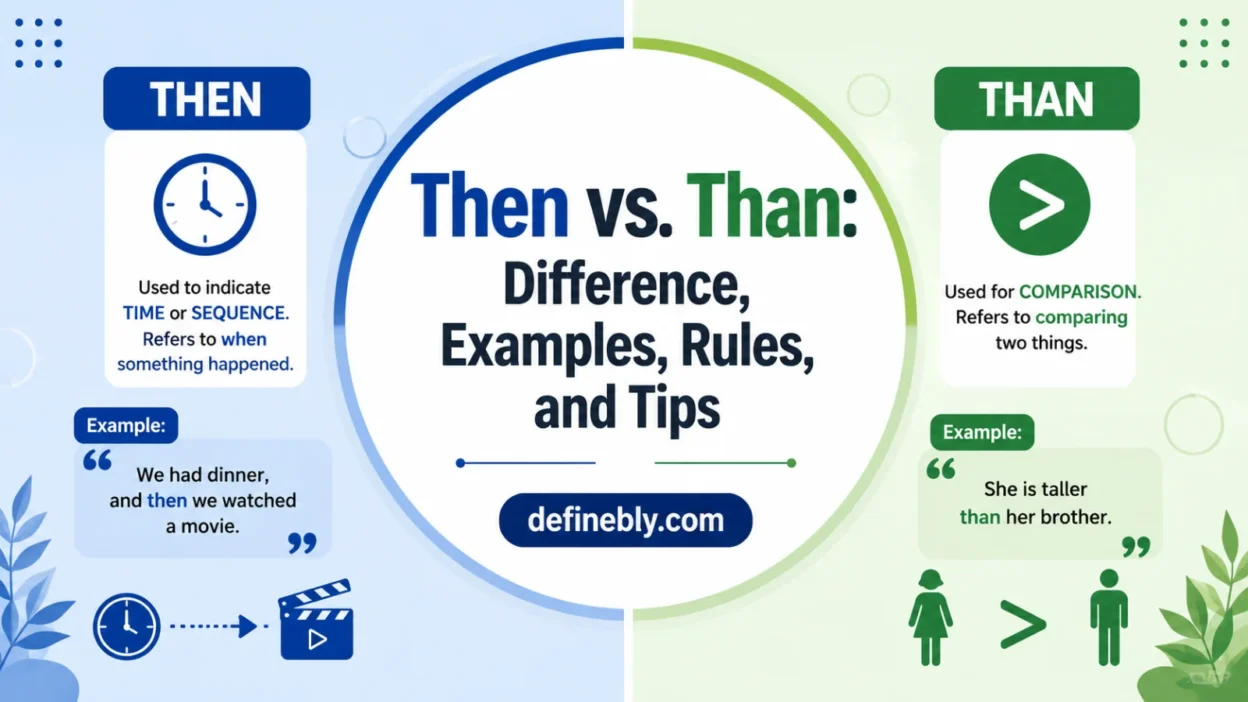
Use then for time, sequence, or consequence. Use than for comparison.
Correct:
- We ate dinner, then watched a movie.
- This movie is better than the last one.
The easiest rule is this: then is for time; than is for comparison.
Quick Answer
Use then when you mean at that time, next, or in that case.
Correct:
- I was living in Chicago back then.
- Save the file, then close the app.
- If you are ready, then we can start.
Use than when you compare two people, things, amounts, actions, or ideas.
Correct:
- This route is faster than the highway.
- She is taller than her brother.
- I would rather walk than wait.
Quick test:
- If the sentence is about time or order, use then.
- If the sentence compares something, use than.
Why People Confuse Them
People confuse then and than because the words differ by only one letter.
They can also sound very similar in fast speech. In careful pronunciation, then has the vowel sound in hen, while than has the vowel sound in can. In everyday speech, that difference can be hard to hear.
The spelling matters in writing because the meanings are different.
Compare:
- I finished work, then went home.
- I finished work faster than usual.
The first sentence shows what happened next. The second sentence makes a comparison.
Key Differences At A Glance
| Context | Best Choice | Why |
|---|---|---|
| You mean next | then | It shows sequence. |
| You mean at that time | then | It points to a time. |
| You mean in that case | then | It shows consequence. |
| You are comparing two things | than | It introduces a comparison. |
| The sentence uses better, more, or less | than | These words usually compare. |
| You can replace it with after that | then | The sentence is about order. |
Meaning And Usage Difference
Then usually relates to time.
Correct:
- I lived in Denver back then.
- We did not have smartphones then.
- The office was smaller then.
In these sentences, then means at that time.
Then can also show sequence.
Correct:
- First, check your email. Then, reply to the client.
- We packed our bags, then left for the airport.
- She finished the draft, then sent it to her teacher.
In these sentences, then means next or after that.
Then can also mean in that case.
Correct:
- If the store is closed, then we’ll order online.
- If you need help, then call me.
- If the price drops, then we should buy it.
Than is used for comparison.
Correct:
- My phone is newer than yours.
- The second test was harder than the first.
- This plan costs less than the old one.
In each sentence, than introduces the second part of the comparison.
Tone, Context, And Grammar
Then often works as an adverb. It tells when something happened, what happened next, or what follows from a condition.
Common patterns:
- back then
- since then
- until then
- and then
- first…then
- if…then
Examples:
- I was younger then.
- We paid the bill, then left.
- If the meeting ends early, then I’ll call you.
Than often appears after comparison words.
Common patterns:
- better than
- worse than
- more than
- less than
- fewer than
- older than
- younger than
- rather than
- other than
Examples:
- The repair cost more than expected.
- This option is better than the first one.
- I would rather email than call.
In careful writing, choose the word by meaning, not by sound.
Which One Should You Use?
Use then if the sentence is about time, order, or what happens next.
Test it with after that.
Correct:
- We finished lunch, then went outside.
- We finished lunch. After that, we went outside.
The time idea works, so then is correct.
Use then if the sentence means in that case.
Correct:
- If the door is locked, then use the side entrance.
The word then shows what should happen if the condition is true.
Use than if the sentence compares one thing with another.
Correct:
- This plan is better than the old one.
- Her explanation was clearer than mine.
- The package arrived later than expected.
Look for comparison words. If you see better, worse, more, less, fewer, rather, or a word ending in -er, than is often the right choice.
When One Choice Sounds Wrong
Use than, not then, after comparison words.
Incorrect:
- This coffee is stronger then mine.
Correct:
- This coffee is stronger than mine.
The sentence compares two cups of coffee.
Use then, not than, for sequence.
Incorrect:
- I brushed my teeth, than went to bed.
Correct:
- I brushed my teeth, then went to bed.
The sentence shows what happened next.
Use than, not then, in more than and less than.
Incorrect:
- The meeting lasted more then an hour.
Correct:
- The meeting lasted more than an hour.
Use then, not than, in back then.
Incorrect:
- I lived near the beach back than.
Correct:
- I lived near the beach back then.
Use than, not then, in rather than.
Incorrect:
- I would rather drive then fly.
Correct:
- I would rather drive than fly.
Common Mistakes And Quick Fixes
Using Then After A Comparison Word
Incorrect:
- This version is better then the first one.
- The hotel was cheaper then we expected.
- She arrived later then usual.
Correct:
- This version is better than the first one.
- The hotel was cheaper than we expected.
- She arrived later than usual.
Quick fix:
If the sentence compares two things, use than.
Using Than For Sequence
Incorrect:
- Finish the form, than send it to me.
- We ate dinner, than watched TV.
- First save the file, than close the app.
Correct:
- Finish the form, then send it to me.
- We ate dinner, then watched TV.
- First save the file, then close the app.
Quick fix:
If the sentence means next, use then.
Writing More Then Instead Of More Than
Incorrect:
- We waited more then 20 minutes.
Correct:
- We waited more than 20 minutes.
The sentence compares the wait time with 20 minutes.
Writing Rather Then Instead Of Rather Than
Incorrect:
- I would rather stay home then go out.
Correct:
- I would rather stay home than go out.
The phrase rather than compares two choices.
Forgetting That Then Can Mean In That Case
Correct:
- If you are finished, then turn in the assignment.
- If the package arrives today, then I’ll bring it over.
- If we miss the bus, then we’ll call a ride.
The word then shows what follows from the condition.
Everyday Examples
Then In Sentences
- I woke up early, then made coffee.
- Back then, we lived near the beach.
- First save the file, then close the app.
- If the package arrives today, then I’ll bring it to you.
- We finished the meeting, then went back to work.
- She checked the address, then mailed the card.
- The store was smaller then.
- If you are not sure, then ask for help.
Than In Sentences
- This coffee tastes better than yesterday’s.
- The hotel was cheaper than we expected.
- I would rather call than text.
- The new model is lighter than the old one.
- She works faster than I do.
- The repair cost less than $100.
- The movie was longer than I expected.
- He is more patient than his brother.
Then And Than In The Same Sentence
- We ate lunch, then picked a route faster than the highway.
- She studied first, then scored higher than last time.
- I checked the price, then found a cheaper option than the first one.
- We waited until then, but the delay was longer than expected.
- Finish the draft, then make it clearer than the old version.
Common Phrases With Then And Than
Use then in time and sequence phrases:
- back then
- since then
- until then
- just then
- and then
- now and then
- first…then
- if…then
Examples:
- See you then.
- I have not heard from her since then.
- We’ll review the form first, then submit it.
Use than in comparison phrases:
- better than
- worse than
- more than
- less than
- fewer than
- other than
- rather than
- sooner than
- later than
Examples:
- This is better than I expected.
- I would rather wait than rush.
- No one other than Maya knew the answer.
Synonyms Or Closest Alternatives
Closest alternatives for then include:
- after that
- next
- at that time
- in that case
Examples:
- We ate dinner, then left.
- We ate dinner. After that, we left.
- If you agree, then sign here.
- If you agree, in that case, sign here.
Closest alternatives for than are limited because than mainly functions as a comparison word.
A useful test is compared with.
Example:
- She is taller than me.
- She is taller compared with me.
That test is not always smooth, but it can help confirm that the sentence is making a comparison.
Quick Proofreading Checklist
Before you publish, send, or submit a sentence with then or than, ask these questions:
- Does the sentence show what happened next?
- Does the word mean at that time?
- Does the sentence have an if…then structure?
- Does the sentence compare two things?
- Is there a comparison word like better, more, less, or rather?
- Would after that make sense?
- Would compared with make sense?
Use then for time, order, or consequence.
Use than for comparison.
Quick Memory Fix Or Rule Of Thumb
Use this simple rule:
Then = time.
Than = comparison.
Examples:
- We ate, then left.
- This is better than that.
Another memory trick:
Then has e, like event.
Than has a, like compare.
If the sentence tells when or what comes next, choose then. If it compares, choose than.
FAQs
What is the difference between then and than?
Then is used for time, sequence, or consequence.
Than is used for comparison.
Examples:
- We ate dinner, then left.
- Dinner was better than lunch.
When should I use then?
Use then when you mean at that time, next, or in that case.
Examples:
- I lived in Texas back then.
- Finish your homework, then watch TV.
- If you agree, then sign the form.
When should I use than?
Use than when comparing two people, things, actions, amounts, or ideas.
Examples:
- This bag is heavier than mine.
- She arrived earlier than expected.
- I would rather walk than wait.
Is it better then or better than?
The correct phrase is better than.
Correct:
- This plan is better than the old one.
The sentence compares two plans, so than is correct.
Is it more then or more than?
The correct phrase is more than.
Correct:
- The meeting lasted more than an hour.
The sentence compares the meeting length with one hour.
Is it rather then or rather than?
The correct phrase is rather than.
Correct:
- I would rather call than text.
The phrase compares two choices.
Is it and then or and than?
The correct phrase is usually and then when showing what happens next.
Correct:
- We ate dinner and then watched a movie.
Use than only when making a comparison.
Is it other then or other than?
The correct phrase is other than.
Correct:
- No one other than Jordan knew the answer.
The phrase other than introduces an exception or comparison.
Do then and than sound the same?
They can sound very similar in everyday speech.
In careful pronunciation, the vowel sounds are different. Still, many speakers say them so quickly that the difference is hard to hear.
In writing, choose the word by meaning.
What is the easiest way to remember then vs. than?
Remember this:
- Then = time or next
- Than = comparison
If the sentence tells what happened next, use then. If it compares two things, use than.
Conclusion
Use then for time, sequence, or consequence. Use than for comparison.
The core rule is simple:
- Then tells when or what comes next.
- Than compares two things.
When in doubt, ask whether the sentence is about time or comparison. Time takes then. Comparison takes than.