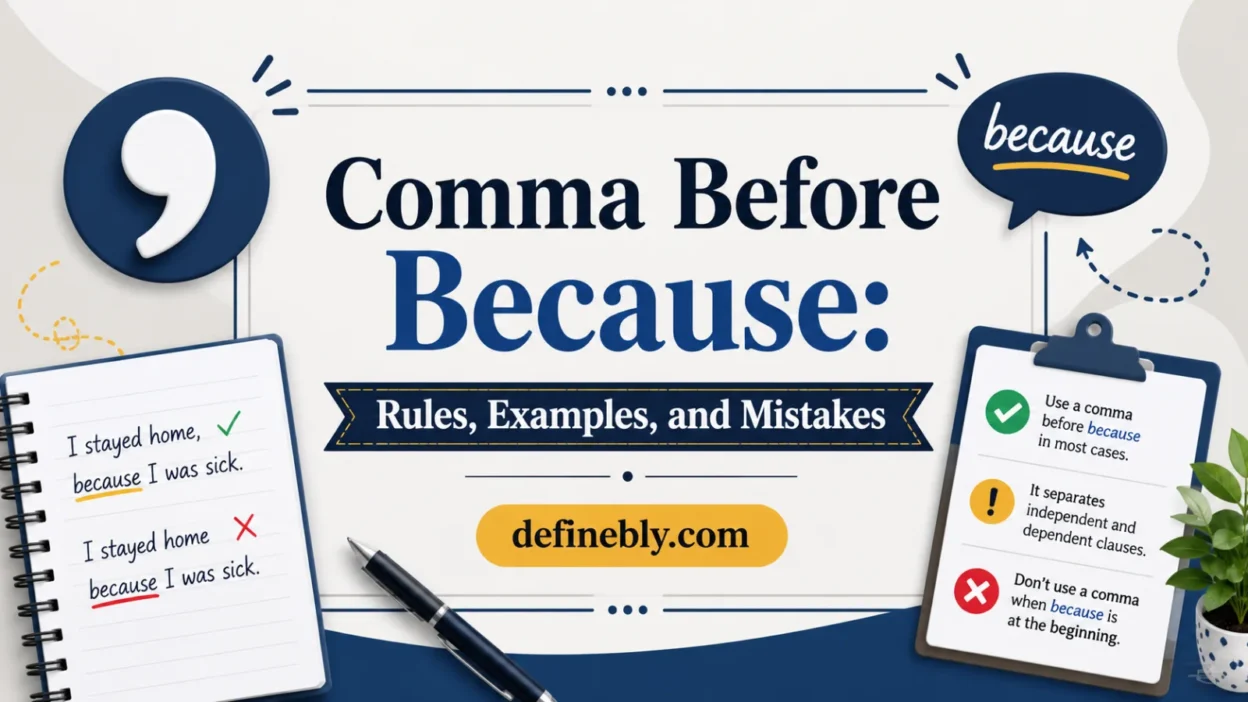
You usually do not need a comma before because.
Correct:
- I stayed home because I felt sick.
The because clause gives the reason. Since that reason is essential to the sentence, no comma is needed.
Use a comma before because only when the comma prevents confusion or when the reason is extra information.
Quick Answer
Do not use a comma before because when the reason is necessary to understand the sentence.
Correct:
- We left early because traffic was getting worse.
- She bought a jacket because it was cold.
- I missed the call because my phone was on silent.
Use a comma before because when the sentence could be misread without it.
Correct:
- I did not answer, because I was driving.
The comma makes the reason clear: driving is why I did not answer.
Also use a comma after an introductory because clause.
Correct:
- Because I was driving, I did not answer.
The Rule Explained
Because introduces a reason.
In most sentences, that reason is essential. It explains why something happened or why something is true.
Correct:
- The game was canceled because it rained.
The sentence needs the because clause to explain why the game was canceled.
A comma before because can make the reason feel separate from the main point.
Possible, but less direct:
- The game was canceled, because it rained.
In most everyday cause-and-effect sentences, skip the comma.
The comma becomes useful when it changes or clarifies the meaning.
Compare:
- I did not leave because I was scared.
- I did not leave, because I was scared.
The first sentence may suggest that fear was not the reason I stayed. The second sentence clearly says fear was the reason I did not leave.
When To Use It
Use A Comma Before Because To Prevent Confusion
Use a comma before because when the sentence could have two meanings.
Unclear:
- I did not call because I was angry.
This could mean:
- I did call, but not because I was angry.
- I did not call, and anger was the reason.
Clear:
- I did not call, because I was angry.
Now the sentence clearly says anger was the reason I did not call.
More examples:
- I did not reply, because I was in a meeting.
- She did not attend, because she had the flu.
- We did not wait, because the office was closing.
In each sentence, the comma helps connect the reason to the negative action.
Use A Comma Before Because When The Reason Is Extra Information
Sometimes the main point is complete before the because clause. The reason only adds extra context.
Correct:
- The meeting was canceled, because the speaker got sick.
- The package arrived late, because the storm delayed shipping.
- The office closed early, because the power went out.
These sentences can work with or without the comma. The comma puts more focus on the main result and treats the reason as added information.
For clean everyday writing, use this style carefully. If the reason is central to the point, leave the comma out.
Use A Comma Before Because In A Contrast Or Correction
Use a comma when the sentence contrasts one reason with another.
Correct:
- He did not win because he was lucky, but because he practiced every day.
- She was not promoted because she was popular, but because she delivered strong results.
- We chose the plan not because it was cheap, but because it was reliable.
In these sentences, the comma helps guide the contrast.
Use A Comma After An Introductory Because Clause
When a sentence starts with because, place a comma after the opening because clause.
Correct:
- Because I was tired, I went to bed early.
- Because the store was closed, we went home.
- Because the file was missing, the report was delayed.
The comma shows where the opening reason ends and the main sentence begins.
When Not To Use It
Do Not Use A Comma Before Because In Simple Cause-And-Effect Sentences
Most simple because sentences do not need a comma.
Incorrect:
- I bought a jacket, because it was cold.
Correct:
- I bought a jacket because it was cold.
The reason is essential. It explains why the person bought a jacket.
More correct examples:
- She smiled because the news was good.
- We ordered pizza because no one wanted to cook.
- He left early because he had an appointment.
- The baby cried because she was hungry.
Do Not Use A Comma Before Because Just For A Pause
A spoken pause does not automatically need a comma.
Incorrect:
- I stayed late, because I had work to finish.
Correct:
- I stayed late because I had work to finish.
The comma depends on meaning, not just sound.
Do Not Put A Comma Right After Because
Usually, no comma comes directly after because.
Incorrect:
- I stayed home because, I was sick.
Correct:
- I stayed home because I was sick.
Incorrect:
- We left because, the store was closing.
Correct:
- We left because the store was closing.
A comma after because is only possible if another interrupting phrase requires it.
Possible:
- I stayed home because, honestly, I was exhausted.
The commas belong around honestly, not because of because itself.
Do Not Add A Comma When The Reason Is The Main Point
If the whole purpose of the sentence is to explain why something happened, do not use a comma.
Correct:
- The project failed because the team missed the deadline.
- She passed because she studied every night.
- The room smelled fresh because someone had opened a window.
The because clause carries the main explanation.
Common Mistakes
Adding A Comma Before Every Because
Incorrect:
- He stayed late, because he had work to finish.
Correct:
- He stayed late because he had work to finish.
The reason is essential, so no comma is needed.
Leaving Out The Comma When The Sentence Is Ambiguous
Unclear:
- I did not agree because I was angry.
Clear:
- I did not agree, because I was angry.
The comma shows that anger was the reason for not agreeing.
Putting A Comma After Because
Incorrect:
- I left because, I was tired.
Correct:
- I left because I was tired.
Do not place a comma after because unless an interrupting word or phrase follows.
Forgetting The Comma After An Introductory Because Clause
Incorrect:
- Because I was sick I stayed home.
Correct:
- Because I was sick, I stayed home.
When the because clause comes first, use a comma after it.
Using A Comma When The Meaning Needs No Break
Awkward:
- She chose the smaller apartment, because it was cheaper.
Usually better:
- She chose the smaller apartment because it was cheaper.
The reason is central to the sentence, so the comma is not needed.
Correct Examples
| Sentence | Comma? | Why |
|---|---|---|
| I went inside because it was raining. | No | The reason is essential. |
| She was late because her train stopped. | No | The reason explains the main action. |
| I did not answer, because I was driving. | Yes | The comma clarifies the reason. |
| Because it was raining, we stayed inside. | Yes | The introductory clause needs a comma after it. |
| He did not leave because he was bored, but because he was tired. | No before first because | The sentence contrasts two reasons. |
| I stayed home because I was sick. | No | Simple cause and effect. |
| I did not text back, because I was in a meeting. | Yes | The comma helps clarify the negative statement. |
| Because the file was missing, the meeting was delayed. | Yes | The opening reason needs a comma after it. |
More examples:
- We ordered takeout because the fridge was empty.
- I missed the call because my phone was on silent.
- She brought an umbrella because rain was in the forecast.
- I did not respond, because I was driving.
- Because the store closed early, we went home.
- The team won because everyone stayed focused.
- He did not apologize because he was forced to, but because he meant it.
- I chose the later flight because it was cheaper.
Quick Memory Fix Or Rule Of Thumb
Use this rule:
No comma before because when the reason is needed.
Ask:
- Does the because part explain the main reason?
- Would the sentence feel incomplete or unclear without it?
If yes, skip the comma.
Use a comma before because only when it prevents confusion or adds a nonessential reason.
Use a comma after a because clause when it starts the sentence.
Example:
- Because I was tired, I left early.
FAQs
Do you put a comma before because?
Usually, no. Do not use a comma before because when the reason is essential.
Correct:
- I stayed home because I was tired.
The reason explains why the person stayed home.
When should you use a comma before because?
Use a comma before because when it prevents confusion or when the reason is extra information.
Correct:
- I did not go, because I felt sick.
The comma helps show that feeling sick was the reason for not going.
Do you always need a comma before because?
No. Most sentences do not need a comma before because.
The comma is mainly used when it changes or clarifies the meaning.
What is an example without a comma before because?
Example:
- She brought an umbrella because it was raining.
The reason is essential, so no comma is needed.
What is an example with a comma before because?
Example:
- I did not answer, because I was driving.
The comma helps show that driving was the reason the person did not answer.
Do you put a comma after because?
Usually, no. Do not put a comma right after because.
Incorrect:
- I left because, I was tired.
Correct:
- I left because I was tired.
A comma can appear after because only if an interrupter follows.
Correct:
- I stayed home because, honestly, I needed rest.
What if a sentence starts with because?
Use a comma after the introductory because clause.
Correct:
- Because I was tired, I left early.
The comma shows where the opening reason ends.
Can a sentence start with because?
Yes. A sentence can start with because if it has a complete main clause.
Correct:
- Because it was raining, we stayed inside.
Incorrect:
- Because it was raining.
The incorrect version is only a fragment.
Can a comma before because change the meaning?
Yes. A comma before because can change how the reader understands the reason.
Compare:
- I did not call because I was angry.
- I did not call, because I was angry.
The second version more clearly says anger was the reason for not calling.
Do you use a comma before because of?
Usually, no.
Correct:
- The flight was delayed because of the storm.
Use a comma only if the phrase is extra information or needed for clarity.
Is “just because” different?
Just because often works the same way. Do not use a comma when it gives the main reason.
Correct:
- I stayed home just because I needed a quiet night.
Use a comma only if the sentence structure needs one.
Conclusion
You usually do not need a comma before because.
Skip the comma when the because clause gives the main reason. Use the comma when it prevents confusion, adds extra information, or clarifies a negative statement.
The easiest rule is this: if the reason is essential, do not use a comma before because.