LOL Meaning: What It Stands For in Texting and Chat
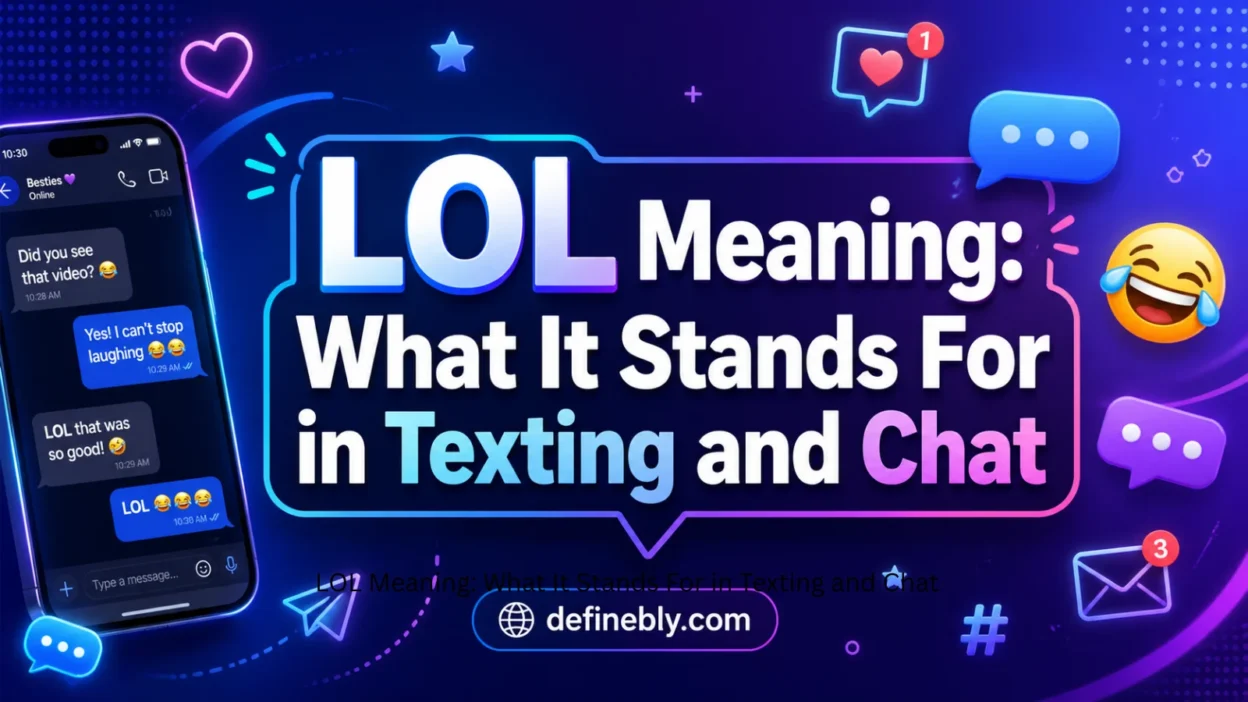
LOL stands for “laugh out loud” and is commonly used in texts, online chats, and social media to express amusement. However, the meaning of LOL is not always literal. People also use it to show that they are joking, keep a conversation friendly, or make a message sound less serious.
For example, if someone texts, “I just walked into the wrong classroom lol,” they may not be laughing out loud. They might be using LOL to make an embarrassing moment sound funny or less awkward.
Understanding the context is important because LOL can communicate anything from genuine laughter to a casual, playful tone.
Quick Answer: What Does LOL Mean?
LOL means “laugh out loud.” It is an informal abbreviation used in digital communication when something is funny or when someone wants to convey a lighthearted tone.
Here are the main ways people use it:
- To show amusement: Something made them laugh or smile.
- To react to a joke: They found a comment funny.
- To signal a playful tone: They want the message to sound casual.
- To soften a statement: They want to make a comment feel less blunt or awkward.
Example: “I forgot where I parked my car lol.”
In this message, LOL suggests that the person finds the situation amusing or is laughing at their own mistake.
What Does LOL Stand For?
LOL stands for laugh out loud. It is one of the best-known abbreviations in internet language and has been used in digital conversations for decades.
The original expression describes laughing audibly in response to something funny. In modern texting, however, people often use LOL more loosely.
Consider these examples:
- “That joke was hilarious LOL.” Here, LOL may indicate genuine amusement.
- “I forgot to buy milk lol.” Here, it makes an ordinary statement feel more playful.
- “LOL, I thought today was Friday.” Here, it introduces a humorous reaction to a mistake.
The abbreviation remains the same, but its conversational purpose changes with the surrounding words.
You may also see LOL described as “laughing out loud.” Both expansions are widely used to explain the abbreviation, and its intended meaning is usually clear from context.
What Does LOL Mean in Texting?
In texting, LOL can communicate more than laughter. Its meaning often depends on the relationship between the people messaging and the subject of the conversation.
1. LOL Means Something Is Funny
This is the most straightforward use. Someone adds LOL when a joke, story, image, or situation makes them laugh.
Example:
Friend: “My dog stole my sandwich and then fell asleep beside the empty plate.”
You: “LOL, he knew exactly what he was doing.”
Here, LOL communicates amusement.
2. LOL Can Make a Message Feel Less Serious
People sometimes add LOL after an embarrassing confession or an everyday complaint to keep the conversation light.
Example:
“I waved back at someone who wasn’t waving at me lol.”
The person is probably not laughing uncontrollably. Instead, LOL makes the embarrassing moment sound less uncomfortable.
3. LOL Can Soften a Message
A short text can sometimes sound harsher than intended. Adding LOL may signal that the sender is being playful rather than angry or critical.
Example:
“You really forgot my birthday lol?”
Depending on the relationship and tone, this could be playful teasing or a mild expression of disappointment.
It is important to remember that LOL does not automatically make a message friendly. The words around it still matter.
4. LOL Can Show Mild Amusement
Sometimes a person uses LOL to acknowledge something mildly funny without suggesting that they found it extremely entertaining.
Example:
Friend: “I spent ten minutes looking for my glasses while wearing them.”
You: “LOL, I’ve done that too.”
In this case, LOL signals recognition and mild amusement.
5. LOL Can Keep a Conversation Friendly
In casual messages, LOL may function as a social signal that helps maintain a relaxed tone.
Example:
“Thanks for reminding me lol. I almost forgot again.”
The sender uses LOL to make the response feel conversational rather than stiff.
These uses are common in informal digital communication, although no single interpretation applies to every message.
Does LOL Always Mean Someone Is Laughing?
No. LOL does not always mean that the sender is literally laughing out loud.
In some messages, it represents genuine laughter. In others, it simply signals that the conversation is casual, playful, or slightly awkward.
For example:
Actual amusement:
“That cat video made me laugh so hard LOL.”
The sender explicitly connects LOL with laughter.
A casual tone:
“I left my lunch at home again lol.”
The sender may be mildly amused or simply acknowledging a mistake.
Awkwardness:
“I just called my teacher Mom lol.”
The abbreviation makes an embarrassing story feel lighter.
This flexibility is one reason LOL has remained useful in online conversations. It can communicate emotion and tone without requiring a long explanation.
However, LOL can be ambiguous. If someone uses it after a serious statement, you cannot reliably determine their feelings from the abbreviation alone.
How to Use LOL in a Sentence
LOL is primarily used in informal digital communication. It can appear at the beginning, middle, or end of a message.
LOL at the Beginning
Putting LOL at the beginning can introduce a humorous reaction or express immediate surprise.
Examples:
- “LOL, I can’t believe that actually happened.”
- “LOL, you were right about the movie.”
- “LOL, I completely forgot about our plans.”
LOL at the End
This is a common placement in casual texting. It can make the entire message sound lighter.
Examples:
- “I nearly missed the bus lol.”
- “That was the weirdest dream ever lol.”
- “I thought you were joking lol.”
LOL in the Middle
LOL can also appear within a sentence when the writer wants to add a playful aside.
Examples:
- “I was, lol, completely unprepared for that question.”
- “She actually believed me lol when I said the meeting was canceled.”
Although these constructions are possible, placing LOL at the beginning or end is generally more natural in everyday texting.
LOL Examples in Everyday Conversations
The following examples show how LOL works in different situations.
Example 1: Reacting to a joke
Friend: “Why did I open the refrigerator? I forgot what I wanted.”
You: “LOL, that happens to me all the time.”
Example 2: Admitting a mistake
“I sent the message to the wrong group chat lol.”
Here, LOL makes the mistake sound less embarrassing.
Example 3: Playful teasing
“You said you were only going to watch one episode lol.”
The sender is teasing someone who continued watching.
Example 4: Sharing an awkward moment
“I said goodbye and then walked in the same direction as the person lol.”
The abbreviation makes the story sound humorous.
Example 5: Expressing surprise
“LOL, I didn’t expect that ending.”
Here, it signals a reaction to something unexpected.
Example 6: Responding to a funny photo
“LOL, why does he look so confused?”
The abbreviation communicates amusement about the image.
Example 7: Keeping a casual tone
“Sure, I’ll send you the notes later lol.”
Depending on the context, LOL may make the message feel relaxed and friendly.
Example 8: Laughing at yourself
“I spent five minutes searching for my phone while holding it lol.”
The writer is making fun of their own mistake.
Example 9: Lighthearted frustration
“My internet stopped working right before I submitted the assignment lol.”
Here, LOL may express ironic amusement about an annoying situation.
Example 10: Reacting to a surprising confession
“You’ve never watched that movie? LOL, you have to see it.”
The abbreviation adds a casual, surprised reaction.
What Is the Difference Between LOL and lol?
LOL and lol have the same basic meaning. The difference is usually stylistic rather than grammatical.
| Form | Common impression | Example |
|---|---|---|
| LOL | Can feel more emphatic or expressive | “LOL, that’s hilarious!” |
| lol | Often feels relaxed and conversational | “I forgot my keys lol.” |
| Lol | A mixed-case version that may begin a sentence | “Lol, I didn’t see that coming.” |
These are common tendencies, not strict rules. Some people use uppercase LOL in every situation, while others prefer lowercase lol.
The surrounding message matters more than capitalization. You should not assume that uppercase LOL always indicates stronger laughter or that lowercase lol always indicates sarcasm.
LOL vs. Other Texting Abbreviations
LOL is only one of many abbreviations people use to express laughter, amusement, or reactions online.
| Abbreviation | Full form | Typical meaning |
|---|---|---|
| LOL | Laugh out loud | General amusement or a lighthearted tone |
| LMAO | Laughing my ass off | Strong amusement; informal and sometimes vulgar |
| ROFL | Rolling on the floor laughing | Exaggerated laughter |
| LMFAO | Laughing my f***ing ass off | Strong amusement; vulgar and very informal |
| ROFLMAO | Rolling on the floor laughing my ass off | Exaggerated, emphatic laughter |
| OMG | Oh my God | Surprise, excitement, or disbelief |
| SMH | Shaking my head | Disappointment, disbelief, or disapproval |
| BRB | Be right back | Temporarily leaving a conversation |
| TBH | To be honest | Introducing an honest opinion or statement |
These abbreviations are not interchangeable in every situation.
For example, LOL is a relatively mild way to indicate amusement. LMAO generally expresses stronger laughter and includes profanity, making it less suitable for professional or formal settings.
Is LOL Formal or Informal?
LOL is an informal abbreviation used mainly in texting, social media, online chats, gaming conversations, and casual digital communication.
It is appropriate when chatting with friends, family members, or people who are comfortable with informal language.
For example:
Casual: “LOL, I just realized I forgot to reply to your message.”
Formal: “I just realized that I forgot to respond to your message.”
The first sounds conversational, while the second is more suitable for a professional email.
In academic papers, formal reports, business proposals, and other professional documents, it is generally better to write out your intended meaning instead of using LOL.
Casual workplace messages may be an exception if the communication style and relationship make abbreviations appropriate.
Is LOL Rude, Sarcastic, or Disrespectful?
LOL is not inherently rude. In many situations, it communicates amusement or friendliness. However, its meaning can change depending on what it follows.
Friendly use:
“LOL, that’s exactly what happened to me yesterday.”
The sender is sharing a humorous reaction.
Sarcastic use:
“Yeah, because that plan worked so well last time lol.”
Here, LOL may emphasize irony or criticism.
Potentially insensitive use:
“I lost my job today.”
“LOL.”
A response like this can appear dismissive or cruel because it does not acknowledge the seriousness of the situation.
If someone shares upsetting news, consider responding with empathy instead of using a laughter abbreviation. Even if you intend to soften an awkward conversation, LOL can be misunderstood.
What Does LOL Mean From a Girl or a Guy?
When a girl or a guy uses LOL in a text, the abbreviation generally has the same basic meaning: laugh out loud. It does not have a universal romantic or emotional meaning based on the sender’s gender.
Its purpose depends on the conversation.
For example:
- “LOL, that’s funny.” The person may genuinely find something amusing.
- “Okay lol.” The person may be keeping the reply casual, or they may be uncertain about how to respond.
- “I miss you lol.” The person may be expressing affection playfully, feeling awkward, or trying to soften the statement.
These interpretations are possibilities, not reliable conclusions. One abbreviation cannot tell you whether someone is flirting, annoyed, embarrassed, or romantically interested.
Look at the broader conversation, the person’s usual texting habits, and the actual words they use before interpreting their intentions.
Does LOL Sound Old-Fashioned Today?
LOL remains widely recognizable, but the way people interpret it can vary by age, community, and personal texting style.
Some people use LOL naturally in everyday conversations. Others prefer haha, lmao, emojis, or no laughter marker at all.
In certain conversations, especially when the surrounding message is serious, LOL can sound ironic, overly casual, or even slightly dated to some readers. In other contexts, it remains completely natural.
There is no universal rule that LOL is outdated. Its suitability depends on the audience and the tone you want to convey.
If you are unsure, pay attention to how the other person communicates and choose a style that fits the conversation.
What Is the Origin of LOL?
LOL developed through early computer-mediated communication and internet culture. It became a convenient way for people to express laughter in text-based conversations where facial expressions and vocal cues were unavailable.
One commonly cited early documented use of LOL in its modern internet sense appeared in the May 1989 issue of FidoNews, a newsletter associated with the FidoNet bulletin-board network. The abbreviation subsequently became familiar through online chat rooms, instant messaging, forums, and text messages.
As digital communication expanded, LOL moved beyond its original association with literal laughter. People began using it as a flexible conversational marker to express amusement, playfulness, or a less serious tone.
Today, LOL is recognized far beyond early internet communities and remains a familiar part of informal English-language communication.
Frequently Asked Questions
What does LOL stand for in texting?
LOL stands for “laugh out loud.” In texting, it can express laughter, amusement, a joking tone, or a casual way of communicating.
What does LOL mean in a text message from a girl?
It generally means “laugh out loud,” but it may also make a message sound playful or less serious. It does not automatically indicate flirting or romantic interest.
What does LOL mean in a text message from a guy?
It has the same basic meaning as when anyone else uses it. Depending on the message, it may indicate amusement, teasing, or a casual tone.
Does LOL mean laughing out loud or lots of love?
The standard modern texting abbreviation LOL means “laugh out loud.” Although people sometimes suggest “lots of love” as an alternative interpretation, it is not the usual meaning in online conversations.
What does lowercase lol mean?
Lowercase lol has the same core meaning as uppercase LOL. It often looks more casual in texting, but capitalization alone does not establish the sender’s feelings.
What does LOL mean at the end of a sentence?
At the end of a sentence, LOL may signal amusement, make a statement sound playful, or soften a potentially awkward remark. Its exact meaning depends on the message.
Is LOL an acronym or an abbreviation?
LOL is commonly called an abbreviation or an initialism because its letters represent the words “laugh out loud.” In everyday discussion, people frequently use the broader term acronym for such forms, but technically an initialism is pronounced letter by letter.
What is the difference between LOL and LMAO?
LOL means “laugh out loud” and is often used for general amusement or a lighthearted tone. LMAO means “laughing my ass off” and generally communicates stronger amusement. LMAO also contains profanity, so it is more informal.
Can LOL be used in professional messages?
It can be appropriate in casual workplace chats when colleagues use an informal communication style. It is generally best avoided in formal reports, official correspondence, and serious professional discussions.
What is the simplest meaning of LOL?
The simplest meaning is “laugh out loud.” In modern texting, it can indicate anything from genuine laughter to mild amusement or a friendly, casual tone.
Conclusion
LOL means “laugh out loud” and is one of the most recognizable abbreviations in digital communication. Although it originally referred to laughter, people now use it for several purposes, including reacting to jokes, softening messages, expressing mild amusement, and keeping conversations relaxed.
For example, “I forgot my keys again lol” may communicate embarrassment or self-deprecating humor rather than actual laughter.
When interpreting LOL, pay attention to the words around it, the subject of the conversation, and the sender’s usual communication style. This will help you understand whether the abbreviation expresses genuine amusement, playful sarcasm, or simply a casual tone.
LOL stands for “laugh out loud” or “laughing out loud.” In modern texting and online chat, though, it often means more than literal laughter. Depending on context, it can signal amusement, joking tone, friendliness, or a softer, less blunt message.
Quick Answer
LOL means “laugh out loud” or “laughing out loud.” People use it in texts, chats, comments, and social posts to show something is funny, lightly amusing, or not meant too seriously.
What LOL Stands For
The core expansion is straightforward: LOL = laugh out loud / laughing out loud. That is the standard definition across Cambridge, Merriam-Webster, Collins, Britannica, and Dictionary.com.
In older internet usage, that meaning was often closer to literal laughter. Today, the expansion is still the same, but the way people use it is wider.
What LOL Usually Means In Real Messages
In real texting, LOL often does not mean someone is actually laughing out loud. It can mean:
- That’s funny
- I’m joking
- I’m trying to sound friendly
- This is awkward, but I’m keeping it light
- Please read this casually, not aggressively
Linguist John McWhorter has described LOL as a texting marker of empathy or accommodation, and more recent reporting has echoed the same idea: many people use lol to soften tone, reduce bluntness, or make a message feel warmer.
That is why a sentence like “I forgot my keys again lol” usually does not mean the person is literally laughing hard. It more often signals mild self-deprecating humor or a light tone.
Where People Use LOL
LOL is most natural in informal digital communication, especially:
- text messages
- group chats
- social media comments
- DMs
- gaming chat
- casual online conversation
- sometimes casual email
Cambridge says it is used on social media and in text messages, while Britannica and Collins broaden that to internet and email contexts.
That does not make it formal. It belongs mainly in conversational, low-stakes, digital writing.
When LOL Sounds Natural And When It Does Not
LOL sounds natural when the message is casual and the tone is light.
It works well for:
- jokes
- playful teasing
- self-deprecating comments
- mild awkwardness
- softening short messages
It sounds less natural in:
- formal writing
- academic work
- professional reports
- serious apologies
- emotionally heavy messages
Because LOL often changes tone more than content, it can feel out of place when the situation is too serious for a laugh marker.
LOL Vs. Literal Laughter
This is one of the biggest gaps in weaker articles.
Sometimes LOL does mean real laughter. But often it means something lighter than that: a smile, a little amusement, or a social signal that says I’m being easygoing here. Oxford’s learner entry supports this broader view by defining LOL as expressing fun, laughter, or simply the feeling that something makes you smile.
So the best practical explanation is this: LOL can signal anything from actual laughter to mild friendliness, depending on the message around it.
LOL Vs. lol
There is no fixed official rule, but many modern usage explainers note a common pattern:
- lol often feels softer, lighter, and more conversational
- LOL can feel stronger, louder, or more performative
How-To Geek and newer texting explainers describe lowercase lol as the more common casual form, while uppercase LOL often reads as more emphatic. That is best treated as a common tendency, not a hard grammar rule.
Origin And History
LOL comes from early internet and computer-mediated communication culture. Multiple history references citing linguist Ben Zimmer note that one of the earliest documented uses in its current sense appears in FidoNews in May 1989. The OED also has a dedicated entry for LOL, which reflects how established the form has become in English.
That history matters because it explains why LOL feels native to digital communication. It was built for fast, text-based conversation long before modern social media.
Related Terms And Stronger Alternatives
LOL is one of several common laughter markers, but it is usually milder than stronger forms like LMAO and ROFL. Merriam-Webster defines LMAO as laughing my ass off, and Cambridge defines ROFL as rolling on the floor laughing, both of which signal stronger amusement than standard LOL.
In everyday texting, many people also use:
- haha for plain, neutral laughter
- lmao for stronger, more informal laughter
- rofl for exaggerated or older-style internet laughter
Example Sentences
- “I sent the email to the wrong person lol.”
- “That video was actually funny lol.”
- “Thanks for reminding me lol, I almost forgot.”
- “I wore mismatched shoes to work lol.”
- “You really thought that would work? lol”
These examples work because they show LOL doing different jobs: signaling real amusement, softening embarrassment, and keeping the tone casual.
FAQ
Does LOL always mean actual laughter?
No. It can mean literal laughter, but it often signals mild amusement, a joking tone, or a softer message. Modern language commentary and current usage coverage both support that broader role.
Is LOL formal?
No. LOL is mainly an informal digital abbreviation used in texts, chats, social posts, and similar contexts. Cambridge, Collins, and Britannica all place it in internet, texting, social, or email-style usage rather than formal prose.
Should I write LOL or lol?
Both are common. There is no strict rule, but lowercase lol often feels more casual and natural in everyday texting, while uppercase LOL can feel stronger or more obvious. That is a usage tendency, not a formal standard.
Can LOL sound outdated?
Sometimes. Recent coverage suggests that some younger users now hear LOL as dated, overly millennial, or overly softened, even while many people still use it constantly. That means audience and texting style matter more now than they used to.
What is the simplest meaning of LOL?
The simplest meaning is laugh out loud. That remains the core expansion across major dictionaries even though real-life usage is often broader than literal laughter.
Conclusion
LOL means “laugh out loud” or “laughing out loud,” but in modern texting it often does more than mark laughter. It can show amusement, soften tone, signal friendliness, or make a message feel less blunt. That is why it remains so common: it is short, flexible, and deeply built into digital conversation, even as its exact feel keeps evolving.