IRL Meaning: What Does IRL Mean in Texting and Social Media?
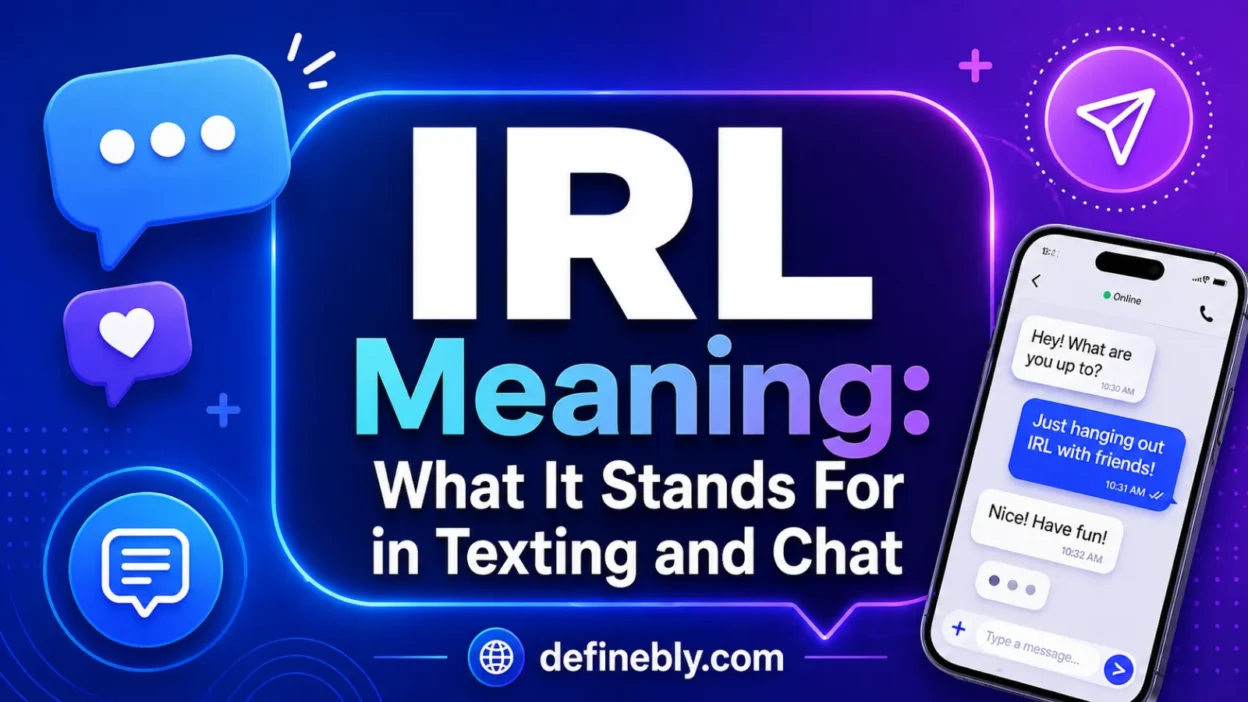
Have you ever seen someone write “IRL” in a text message, Instagram caption, or online conversation and wondered what it means? IRL stands for “in real life.” It is a popular internet abbreviation used when talking about real-world experiences rather than things that happen online.
People often use IRL when discussing face-to-face meetings, comparing online impressions with reality, or describing something outside the digital world. Whether you’re chatting with friends, playing online games, or scrolling through social media, understanding IRL can help you follow everyday internet conversations.
In this guide, you’ll discover what IRL means, how people use it, where it comes from, and how it differs from similar expressions such as “offline” and “in person.”
What Does IRL Stand For?
IRL stands for “in real life.” It is an informal abbreviation commonly used in text messages, social media posts, online gaming, and internet communities.
The expression helps distinguish real-world experiences from online interactions or virtual environments.
For example:
- “We’ve been friends online for years, but we’ve never met IRL.”
- “That restaurant looks much better IRL.”
- “He’s quiet in group chats but really outgoing IRL.”
In the first example, IRL refers to meeting face-to-face. In the second, it compares a restaurant’s actual appearance with its online pictures. In the third, it describes someone’s personality outside online conversations.
The meaning stays connected to the real world, but the exact interpretation depends on the situation.
What Does IRL Mean in Texting?
In texting, IRL usually means that something happens outside the internet or in the physical world.
People use it when they want to compare online experiences with what happens in everyday life.
For instance, someone might text:
“I’m always talking to people online, but I don’t know many of them IRL.”
This means the person communicates with others digitally but has not met many of them face-to-face.
IRL can also be used to describe:
- Meeting someone: Spending time together in person after connecting online.
- Appearance: Comparing how a person or object looks in real life with pictures.
- Personality: Explaining how someone behaves away from social media.
- Everyday experiences: Talking about places, events, or activities outside virtual spaces.
Because it is short and easy to understand, IRL is especially useful in casual digital conversations.
What Is the Difference Between IRL, Offline, and In Person?
Although these expressions are related, they are not always interchangeable.
IRL: In Real Life
IRL is a broad, informal expression that contrasts the real world with online or virtual experiences.
Example: “She seems different IRL.”
This means her real-world personality or behavior differs from the impression she gives online.
Offline: Not Connected to the Internet
Offline usually describes a person, device, or activity that is not connected to the internet or is happening outside an online environment.
Example: “Let’s discuss the details offline.”
Depending on the context, this can mean having a separate conversation outside a public online discussion. It does not necessarily mean meeting physically.
In Person: Face-to-Face
In person specifically means being physically present with someone rather than communicating through a screen or another person.
Example: “I’d prefer to discuss the project in person.”
This expression is often more appropriate for professional conversations.
The key difference: IRL broadly contrasts real-world experiences with online ones, offline emphasizes the absence of online activity or connection, and in person specifically refers to physical presence.
How Is IRL Used on Social Media?
IRL is common across social media platforms because people often share digital versions of their lives and then compare them with their actual experiences.
People may use IRL in captions when describing a place, event, or person beyond what appears in photos.
Example: “This beach is even more beautiful IRL.”
The caption suggests that the actual experience is better than the pictures.
TikTok
TikTok users may use IRL when comparing online trends with real-life situations.
Example: “Trying this viral recipe IRL was harder than I expected.”
Here, IRL highlights the difference between watching something online and doing it yourself.
Online Gaming
Gamers sometimes use IRL to distinguish their everyday lives from their gaming identities.
Example: “I’m a competitive player online, but I’m pretty relaxed IRL.”
The sentence compares behavior in a virtual environment with behavior outside it.
Group Chats and Dating Apps
IRL can also appear when people discuss meeting someone they first encountered online.
Example: “We’ve been messaging for weeks. Should we meet IRL?”
In this context, it means arranging an in-person meeting.
Why Do People Use IRL?
IRL makes it easy to describe the difference between a digital impression and an actual experience.
There are several common reasons people use the abbreviation.
- To arrange meetings: People use it when they want to meet online friends in person.
- To compare appearances: It helps describe how something looks outside photographs or videos.
- To discuss personality: It can highlight differences between someone’s online behavior and real-world character.
- To describe experiences: People use it when discussing activities beyond screens and virtual environments.
- To add humor: It can make comparisons between internet expectations and everyday reality more relatable.
For example, someone might write, “I’m confident in video calls but shy IRL.”
The message clearly distinguishes how the person behaves online from how they feel in face-to-face situations.
Is IRL Considered Slang?
Yes. IRL is an informal abbreviation associated with internet culture, texting, and online communication.
However, it is widely recognized and appears in established dictionaries. It is no longer limited to a small group of internet users.
You can comfortably use IRL in casual messages, social media captions, gaming chats, and conversations with friends.
In formal writing, however, it is usually clearer to write “in real life,” “in person,” or “outside the online environment,” depending on what you mean.
For example:
- Casual: “Let’s catch up IRL.”
- More formal: “Let’s arrange an in-person meeting.”
Both communicate a similar idea, but the second sounds more professional.
Where Did IRL Come From?
IRL developed as part of internet and online chat culture. As people increasingly communicated through messaging services, forums, and virtual communities, they needed quick ways to distinguish online interactions from experiences outside the internet.
The abbreviation became a convenient way to express that distinction without repeatedly typing the full phrase “in real life.”
As internet use expanded, IRL spread into social media, gaming, online friendships, and everyday texting. Today, it is commonly understood by people who participate in digital conversations.
Its continued popularity reflects how frequently people move between online communication and their physical, everyday lives.
Examples of IRL in Everyday Conversations
Here are some natural examples that show how IRL works in different situations.
Example 1: Online friendship
“We’ve followed each other for three years but have never met IRL.”
This means the two people know each other online but have not met physically.
Example 2: Appearance
“That jacket looks much better IRL than it does in the pictures.”
The speaker is comparing the real item with its online appearance.
Example 3: Personality
“He seems serious in his posts, but he’s hilarious IRL.”
This suggests that the person’s real-world personality differs from their online image.
Example 4: Travel
“The city looks amazing in videos, but experiencing it IRL is something else.”
The sentence emphasizes the difference between watching videos and visiting the place.
Example 5: Dating
“We’ve been chatting for a month, and now we’re planning to meet IRL.”
The people have communicated online and are considering a face-to-face meeting.
Example 6: Gaming
“My gaming friends know me as Alex, but IRL everyone calls me by my full name.”
This example distinguishes an online identity from everyday life.
Example 7: Social media
“Social media makes everything look perfect, but life IRL is more complicated.”
Here, IRL contrasts the real world with the polished images often presented online.
IRL vs. Other Internet Abbreviations
IRL is one of many abbreviations used in online conversations. Here are a few related terms.
- AFK: Away from keyboard. It usually indicates that someone is temporarily away from their device or game.
- BRB: Be right back. Used when someone is leaving a conversation briefly.
- DM: Direct message. A private message sent through a platform.
- F2F or FTF: Face-to-face. Refers to direct, in-person interaction.
- BTW: By the way. Used to introduce an additional point.
- IMO: In my opinion. Used to express a personal viewpoint.
Among these abbreviations, F2F and FTF are closest to IRL when the conversation specifically involves meeting someone physically. However, IRL has a broader meaning because it can also describe places, objects, behavior, and experiences.
Frequently Asked Questions About IRL
What is the simplest meaning of IRL?
IRL means “in real life.” It usually refers to something happening in the physical world rather than online or in a virtual environment.
What does IRL mean in texting?
In texting, IRL is used to describe real-world situations, face-to-face meetings, or differences between someone’s online image and actual life.
Does IRL mean offline?
Often, yes, but the meanings are not identical. IRL refers broadly to the real world, while offline usually means not connected to the internet or outside an online setting.
Is IRL slang?
Yes. IRL is an informal internet abbreviation. It is widely recognized and used in text messages, social media, online games, and digital communities.
Is IRL formal or informal?
IRL is generally informal. It works well in casual conversations, but “in person” or “in real life” may be more appropriate in professional emails and formal documents.
What does meeting IRL mean?
Meeting IRL means meeting someone face-to-face in the physical world, especially when the people have previously interacted online.
What does IRL mean on Instagram?
On Instagram, IRL often refers to how something looks or feels outside social media. It can describe a real-world experience, a person’s actual appearance, or a meeting with someone known online.
What does IRL mean in gaming?
In gaming, IRL distinguishes a player’s everyday life from their activities or identity within a game. For example, “We’re teammates online, but we’ve never met IRL” means the players have not met in person.
Final Thoughts
IRL stands for “in real life.” It is a widely used internet abbreviation that helps people distinguish real-world experiences from online interactions and virtual environments.
Whether someone is talking about meeting an online friend, describing how a product looks outside its photos, or comparing an online personality with real-world behavior, IRL makes the meaning quick and clear.
The next time you see IRL in a message or social media post, remember that it generally points to life beyond the screen. Its precise meaning depends on the context, but the central idea is always the same: the real world rather than just the online experience.
IRL stands for “in real life.” People use it in texts, chats, social media, and online communities to talk about something that happens offline, in person, or outside the internet. That core meaning is consistent across Cambridge, Collins, Oxford, and Dictionary.com.
Quick Answer
IRL means “in real life.” In real usage, it usually means not online or face-to-face in the physical world, especially when someone is comparing digital interaction with real-world experience.
What IRL Stands For
The expansion itself is simple: IRL = in real life. Cambridge defines it as an abbreviation used in email and social media, Collins treats it as messaging and social-media language, and Oxford glosses it as in real life; not on the internet.
What IRL Means In Real Context
In actual messages, IRL usually marks a contrast. The writer is separating something that happens online from something that happens in the physical world.
For example:
- “We finally met IRL.”
- “That place looks better IRL.”
- “He seems quiet online but is really funny IRL.”
In each case, the phrase draws a line between digital experience and real-world experience. That online-versus-offline contrast is central in Oxford, Dictionary.com, and multiple current usage pages.
Offline Vs. In Person
One of the biggest gaps in weaker articles is that they treat these meanings as identical. They overlap, but they are not always the same.
IRL can mean:
- offline / not on the internet
- in person / face-to-face
Sometimes those are the same thing. If two people who only knew each other online meet at a coffee shop, that is both offline and in person. But in other cases, IRL is broader. Someone might say a product looks different IRL, meaning it looks different in the real world than it did in photos, not necessarily in a face-to-face interaction. Oxford’s “not on the internet” wording and Cambridge’s meeting example together support this broader range.
How People Actually Use IRL
People usually use IRL when they want to highlight one of these contrasts:
- online friendship vs. meeting face-to-face
- online image vs. real-world appearance
- digital behavior vs. real-world personality
- virtual spaces vs. physical places
- online hype vs. what something is actually like in reality
That is why the term shows up so often in gaming, fandom, social media, dating apps, and creator culture. SocialPilot, TechBloat, and other explainers all emphasize that IRL helps bridge or compare someone’s digital life and actual experience.
Where People Use IRL
IRL is most common in informal digital communication, especially:
- text messages
- group chats
- social media posts
- online games
- dating apps
- forums and comments
Cambridge explicitly places it in email and social media, while newer usage pages show it commonly appearing in DMs, gaming, and internet communities.
It is much less natural in formal writing. In professional communication, plain-English alternatives like in person, offline, or in real life usually sound clearer and more polished. That follows directly from how dictionaries and usage pages frame the abbreviation: informal and internet-based.
Tone And What IRL Usually Signals
The tone of IRL is usually casual and conversational. It often sounds slightly internet-native because it assumes the speaker and reader both understand the online/offline contrast. Depending on context, it can feel:
- practical
- funny
- self-aware
- lightly ironic
- socially specific
For example, “She’s way nicer IRL” sounds casual and observational. “We’ve been mutuals for years but never met IRL” sounds community-based and internet-native. That kind of tone is exactly why the abbreviation remains useful instead of being replaced everywhere by the full phrase.
Origin And Usage History
IRL comes out of long-running internet and chat culture. TechBloat, SocialPilot, and other usage pages describe it as part of the early online vocabulary that grew out of internet communities trying to distinguish digital interaction from actual lived experience. Merriam-Webster, Cambridge, Oxford, Collins, and Dictionary.com all now recognize the abbreviation, which shows how established it has become.
IRL Vs. Similar Terms
Several plain-English phrases overlap with IRL, but they are not perfect substitutes.
- offline is closest when the focus is digital vs. non-digital activity
- in person is closest when the focus is face-to-face contact
- face-to-face is more formal and more specific than IRL
- real world is similar, but usually broader and less chat-like
If you want the cleanest plain-English equivalent, the right choice depends on context. Offline works for digital contrast. In person works for meeting or interacting physically. IRL covers both in a looser, more internet-native way.
Example Sentences
- “We’ve been online friends for years but never met IRL.”
- “That café looked smaller IRL than it did on Instagram.”
- “He jokes a lot online, but he’s actually quiet IRL.”
- “I only know her from TikTok, not IRL.”
- “The jacket looked way better IRL than it did in the product photos.”
These examples work because they show the main real-world uses of IRL: meeting face-to-face, comparing online and offline impressions, and describing real-world appearance or experience.
Similar Short Forms
There is no perfect acronym substitute for IRL, but nearby internet terms include:
- AFK — away from keyboard
- DM — direct message
- BRB — be right back
- F2F / FTF — face to face
The closest plain-English alternative is usually offline or in person, depending on context. 7ESL explicitly notes F2F/FTF as a similar term for in-person interaction.
FAQ
Is IRL slang?
Yes. It is informal internet and texting slang, though it is now widely recognized enough to appear in major dictionaries such as Cambridge, Collins, Oxford, and Dictionary.com.
Does IRL mean offline?
Often, yes. It usually refers to something happening outside the internet or away from digital interaction. But in many messages it also specifically means in person or face-to-face.
Is IRL formal?
No. It is best for casual texts, chats, posts, and internet-based conversation. In formal writing, the full phrase in real life or a clearer alternative like in person usually works better.
What is the simplest meaning of IRL?
The simplest meaning is in real life. In practical use, that usually means not online or in the real world.
Conclusion
IRL means “in real life.” In digital conversation, it helps people separate online interaction from physical-world experience, whether that means meeting face-to-face, describing how something looks away from a screen, or comparing online behavior with real-world reality. That mix of flexibility and clarity is exactly why the abbreviation still works so well.