FOMO Meaning: What Does This Abbreviation Really Mean?
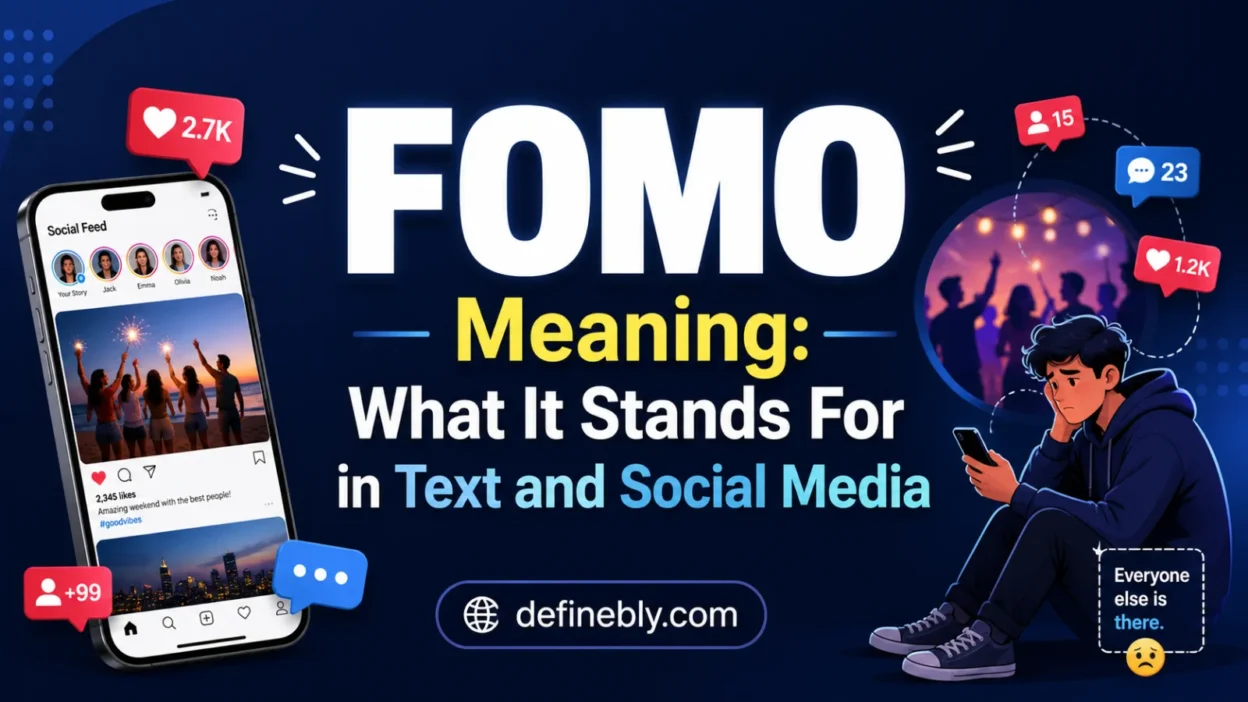
FOMO stands for “fear of missing out.” It describes the feeling you get when you think other people are enjoying exciting experiences, attending important events, or discovering great opportunities without you. The term is widely used in text messages, social media conversations, and everyday discussions about friendships, activities, and trends.
FOMO can be a lighthearted way to describe regret over missing a party or concert. However, it can also reflect a deeper concern about being left out or making the wrong decision.
Quick Answer: What Does FOMO Mean?
FOMO means “fear of missing out.” It describes the worry that you might be missing something enjoyable, valuable, or important while other people get to experience it.
For example, if your friends post pictures from a weekend trip you skipped, you might feel FOMO because you wish you had gone along.
What Does FOMO Stand For?
FOMO is an abbreviation of the phrase “fear of missing out.” It is commonly used when someone feels that other people are having rewarding experiences or taking advantage of opportunities they are missing.
The expression is especially relevant to social situations, but it is not limited to friendships or entertainment. People can experience FOMO when comparing their careers, purchases, travel plans, or personal achievements with those of others.
In simple terms, FOMO is the feeling that something better might be happening somewhere else.
What Does FOMO Mean in Everyday Conversations?
In everyday communication, FOMO often describes a combination of curiosity, regret, and social pressure.
You might experience it when you:
- Miss a gathering that everyone else attends.
- See friends enjoying a holiday without you.
- Notice a popular trend you have not tried.
- Worry about missing an important opportunity.
- Feel tempted to join an activity simply because other people are participating.
For example, someone might say, “I wasn’t planning to go to the concert, but now I have FOMO after seeing everyone’s pictures.”
This means the photos have made them feel as though they missed an experience they might have enjoyed.
Why Is FOMO So Common on Social Media?
Social media makes it easier to see what other people are doing throughout the day. Photos, videos, stories, and updates can create the impression that everyone else is having exciting experiences.
When you repeatedly see people attending parties, traveling, buying new products, or celebrating achievements, it can become tempting to compare their lives with your own.
This comparison can lead to FOMO, especially when online posts show only the highlights of someone’s life.
For example, watching several friends share vacation photos might make your ordinary weekend seem less exciting, even if you were perfectly happy with your plans before seeing those posts.
Social media does not create every instance of FOMO, but it can make the feeling more frequent or noticeable.
What Causes the Feeling of FOMO?
FOMO can develop for different reasons. Some people worry about social exclusion, while others dislike the possibility of making a decision they may later regret.
Common triggers include:
- Social comparison: Believing others are having better experiences than you.
- Fear of exclusion: Worrying that you are being left out of a group.
- Too many choices: Feeling uncertain about which event or opportunity to choose.
- Online pressure: Seeing constant updates about activities you are not attending.
- Regret: Wondering whether another choice would have been more rewarding.
For instance, you might accept an invitation even when you feel exhausted because you are worried everyone else will have fun without you.
In this situation, FOMO influences your decision more than your actual interest in the event.
Is FOMO Just Slang or a Real Emotion?
FOMO is widely recognized as an informal expression, but the feeling it describes is not limited to internet culture.
In casual conversation, people may use it to describe something minor, such as missing a restaurant opening or skipping a popular television show.
In other situations, persistent fear of missing out can contribute to stress, dissatisfaction, repeated social-media checking, or difficulty enjoying the present moment.
The distinction is important: saying “I have FOMO” does not automatically mean someone is experiencing a mental health problem. The phrase can describe anything from mild curiosity to a more persistent pattern of worry.
How Does FOMO Affect Decision-Making?
FOMO can influence the choices people make in their personal and professional lives.
Someone experiencing it might spend money on a product because it is trending, attend an event they do not really want to attend, or repeatedly check their phone to see what others are doing.
It can also make ordinary decisions feel more difficult. Instead of choosing the option that suits their needs, people may focus on the possibilities they could be missing.
For example, a person might purchase expensive concert tickets simply because their friends are going, even though the cost does not fit their budget.
Recognizing FOMO can help people pause and ask whether they genuinely want something or are reacting to pressure from others.
Where Is FOMO Commonly Used?
FOMO appears in many types of informal and digital communication, including:
- Text messages and group chats
- Instagram, TikTok, and other social platforms
- Conversations about parties and social events
- Shopping discussions and limited-time offers
- Travel plans and entertainment trends
- Workplace conversations about opportunities
The abbreviation is also used in marketing, where brands may emphasize limited availability or popular products to encourage people to act quickly.
For example, an advertisement suggesting that everyone is buying a particular product may trigger FOMO by making customers worry that they will miss out.
What Is the Difference Between FOMO and JOMO?
JOMO stands for “joy of missing out.” It describes the satisfaction of choosing not to participate in something and feeling comfortable with that decision.
FOMO and JOMO represent two different ways of thinking about missed opportunities.
- FOMO: Worrying that other people are enjoying something you are missing.
- JOMO: Feeling content with your decision to skip an activity or spend time differently.
For example, FOMO might make you feel disappointed about staying home while friends go out. JOMO is enjoying a peaceful evening at home without feeling that you need to be somewhere else.
JOMO does not mean avoiding every social activity. It means being comfortable choosing what works best for you instead of feeling pressured to participate in everything.
How to Manage FOMO in Daily Life
If FOMO regularly affects your mood or decisions, a few simple habits may help.
- Limit unnecessary scrolling: Take breaks from social media when updates make you feel left out.
- Focus on your own priorities: Choose activities based on your interests, energy, and budget.
- Remember that posts show selected moments: Online content rarely represents someone’s entire life.
- Practice being present: Give your attention to the people and experiences around you.
- Accept that you cannot do everything: Missing one event does not mean missing every valuable opportunity.
The goal is not to stop caring about social connections. It is to make choices that reflect what you actually value rather than what you fear missing.
FOMO Example Sentences
Here are some examples of how FOMO is used naturally in conversations:
- “I have serious FOMO after seeing everyone’s pictures from the festival.”
- “She joined the group trip because she didn’t want to miss out.”
- “Don’t let FOMO convince you to buy something you can’t afford.”
- “Watching their travel videos gave me FOMO about my own vacation plans.”
- “I was happy staying home until I saw the concert photos. Now I have FOMO.”
- “He keeps checking his phone because he has FOMO about the party.”
These examples show how the abbreviation can describe regret, social pressure, and the feeling that an experience might be better than the one you chose.
Similar Abbreviations and Related Terms
Several expressions appear in conversations about internet culture, choices, and social experiences.
- JOMO: Joy of missing out; the opposite of FOMO in many situations.
- YOLO: You only live once; often used to encourage taking opportunities or trying new things.
- ICYMI: In case you missed it; used to share information someone may not have seen.
- FOBO: Fear of better options; anxiety about choosing when another option might be preferable.
Among these terms, JOMO is the closest counterpart because it directly contrasts with the fear of missing an experience.
Frequently Asked Questions
What does FOMO mean in a text message?
FOMO means “fear of missing out.” In a text, it usually describes feeling left out or worrying that you are missing an exciting event, opportunity, or experience.
Is FOMO internet slang?
Yes, FOMO is widely used in internet slang and casual conversation. However, it is also recognized in mainstream English dictionaries and is commonly used in discussions about social behavior.
Does FOMO only happen because of social media?
No. FOMO can happen whenever you worry that you are missing something valuable or enjoyable. Social media can intensify the feeling, but it can also occur when friends make plans without you or when you have to choose between competing opportunities.
Is FOMO a bad thing?
Not necessarily. Occasional FOMO is a normal experience and may simply reflect your desire to participate in something enjoyable. However, when it repeatedly causes stress or leads to decisions you do not want to make, it may be helpful to reconsider your habits and priorities.
What is the opposite of FOMO?
The opposite is commonly called JOMO, meaning “joy of missing out.” It describes feeling satisfied with your decision not to participate in an activity or follow a trend.
What is the simplest meaning of FOMO?
The simplest meaning is “fear of missing out.” It describes the worry that something exciting, important, or rewarding is happening without you.
Conclusion
FOMO stands for “fear of missing out.” It describes the uneasy feeling that other people are experiencing something enjoyable or valuable while you are not included. Although the term is frequently used in texts and social media posts, it also describes a familiar emotional response to comparison, uncertainty, and social pressure.
Understanding FOMO can help you recognize when you are making decisions based on genuine interest and when you are reacting to the fear of being left behind. You do not need to participate in every event or follow every trend to enjoy your own experiences.
FOMO stands for “fear of missing out.” It describes the uneasy or worried feeling that something exciting, rewarding, or socially important is happening without you. Major dictionaries and psychology-oriented sources agree on that core idea, even though people use the term both casually and more seriously.
Quick Answer
FOMO means “fear of missing out.” In everyday use, it usually means you feel left out, curious, or pressured because other people seem to be doing something fun, important, or desirable and you are not part of it.
What Does FOMO Stand For
The abbreviation is simple: FOMO = fear of missing out. Merriam-Webster defines it as fear of not being included in something interesting or enjoyable that others are experiencing, while Cambridge calls it a worried feeling that you may miss exciting events. Collins gives a similar definition built around the belief that others are having a good time without you.
What FOMO Means In Context
In real use, FOMO is usually about comparison and absence. You see something happening somewhere else, and instead of simply noticing it, you feel a pull: maybe you should be there, maybe you made the wrong choice, maybe you are being left out, or maybe other people are having a better experience than you are. That is why the term appears so often around parties, trips, concerts, trends, sales, and social updates.
What FOMO Usually Implies
FOMO often carries more than simple regret. It can imply social pressure, fear of exclusion, curiosity about what others are doing, and the nagging idea that you are missing something better. Forbes Health describes it as involving both the perception of missing out and compulsive checking behavior, while Psychology Today connects it to deeper concerns around inclusion, approval, and negative future outcomes.
Why Social Media Is So Closely Tied To FOMO
Social media did not invent the feeling, but it amplifies it. Mental Floss, Forbes Health, and Cambridge all tie FOMO closely to the experience of seeing exciting events, highlights, and updates that make other people’s lives look fuller or more rewarding. That constant visibility makes comparison easier and missing out feel more immediate.
Casual Use Vs. More Serious Use
People often use FOMO lightly. Someone might say they have FOMO because they skipped a dinner, missed a concert, or passed on a sale. But psychology and health sources also treat FOMO as something that can overlap with more serious anxiety, compulsive checking, stress, and dissatisfaction. The word therefore works on two levels: casual slang and a more meaningful emotional pattern.
Where People Use FOMO
FOMO appears in both casual conversation and internet culture. It is common in:
text messages, group chats, social media posts, event invites, marketing language, and everyday speech about plans, trends, or opportunities. Cambridge and Collins both recognize it as a standard abbreviation in modern English, and Forbes Health and Mental Floss show how naturally it fits into digital-life discussions.
Tone, Context, And How The Word Sounds
The tone of FOMO depends on context. It can sound playful when someone says, “I got FOMO seeing everyone’s vacation photos,” but it can sound more serious when the conversation is about stress, social comparison, or compulsive checking. Collins treats it as informal, while psychology pages show that the feeling behind it can be more intense than the slang tone suggests.
FOMO And Decision-Making
One reason the term matters is that it often affects behavior. People may join events they do not really want to attend, buy things they do not need, or keep checking apps because they do not want to miss a better option or social moment. Forbes Health explicitly notes compulsive checking behaviors, which makes FOMO more than just a label for envy or curiosity.
The Opposite Of FOMO
The best-known opposite term is JOMO, which means “joy of missing out.” Merriam-Webster defines JOMO as the pleasure or satisfaction of not attending events or not participating in social pressure. That contrast is useful because it shows that FOMO is not just about missing something; it is about how you feel about missing it.
Example Sentences
“I stayed home, but now I have major FOMO after seeing everyone’s concert videos.”
“Don’t let FOMO push you into buying something you don’t actually want.”
“She muted the group chat for a while because it was giving her FOMO.”
“I only said yes to the trip because I had FOMO.”
“Seeing all the event posts made me feel a little FOMO, even though I was tired and probably wouldn’t have gone.”
Similar Short Forms
A few nearby terms show up in similar conversations, but JOMO is the closest true counterpart because it directly reverses the idea of FOMO. Terms like YOLO and ICYMI overlap with internet culture, but they do not describe the same emotional state. Merriam-Webster’s JOMO entry makes the FOMO/JOMO contrast especially clear.
FAQ
Is FOMO slang?
Yes, but it is also widely recognized in mainstream English. Major dictionaries like Merriam-Webster, Cambridge, and Collins all include it, which shows that it has moved far beyond niche internet slang.
Does FOMO only happen because of social media?
No. Social media can intensify it, but the feeling can happen with any event, opportunity, or social situation where you believe other people are having a better experience without you. Psychology Today and Forbes Health both frame social media as an amplifier, not the only cause.
Is FOMO always serious?
No. People often use it casually to describe mild regret or curiosity. But psychology and health sources also show that FOMO can overlap with more serious stress, anxiety, and compulsive behavior.
What is the simplest meaning of FOMO?
The simplest meaning is fear of missing out. In practice, that usually means feeling uneasy that something good, important, or exciting is happening without you.
Conclusion
FOMO stands for “fear of missing out.” It describes the uneasy feeling that other people are experiencing something enjoyable or valuable while you are not included. Although the term is frequently used in texts and social media posts, it also describes a familiar emotional response to comparison, uncertainty, and social pressure.
Understanding FOMO can help you recognize when you are making decisions based on genuine interest and when you are reacting to the fear of being left behind. You do not need to participate in every event or follow every trend to enjoy your own experiences.