IMHO Meaning: What Does IMHO Stand For in Texting?
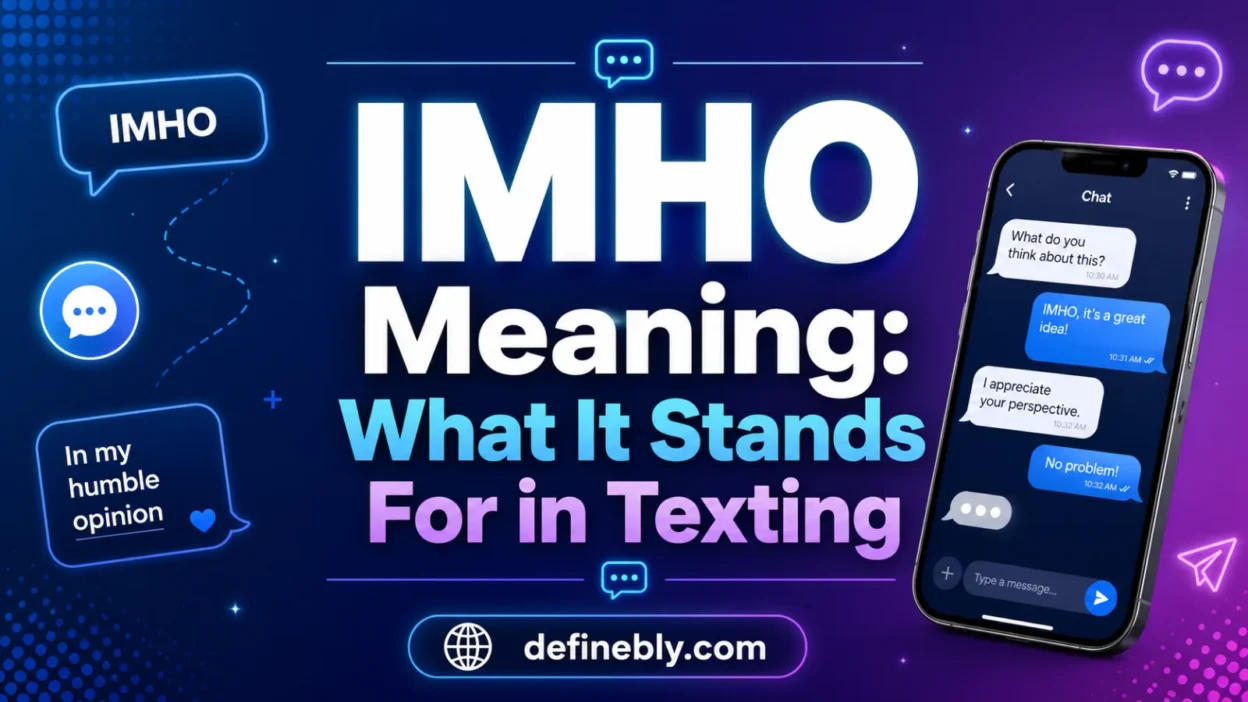
IMHO stands for “in my humble opinion.” It is a common internet abbreviation people use when sharing their thoughts in text messages, online discussions, social media comments, and casual emails. It tells the reader that the statement reflects a personal viewpoint rather than an unquestionable fact.
For example, if someone writes, “IMHO, the older design was better,” they are sharing their preference without presenting it as the only correct answer.
What Does IMHO Mean?
IMHO means “in my humble opinion.” It is often placed at the beginning or end of a sentence to introduce a personal judgment, recommendation, preference, or disagreement.
People use it when they want to express an opinion without sounding too forceful. However, the abbreviation does not automatically make a message polite. The meaning and tone still depend on the words surrounding it.
Example:
“IMHO, we should keep the original plan.”
This means the writer personally believes keeping the original plan is the better choice.
What Does Each Letter in IMHO Stand For?
The abbreviation contains four letters, each representing part of the phrase:
- I — In
- M — My
- H — Humble
- O — Opinion
Together, they form “in my humble opinion.”
You may also see people interpret IMHO as “in my honest opinion.” This alternative is used in online conversations, but “in my humble opinion” is the standard expansion found in major English dictionaries.
How Is IMHO Used in Text Messages?
In texting, IMHO helps introduce a thought, suggestion, or personal preference. It can make a message sound less absolute by showing that the sender is expressing an individual perspective.
Here are common situations in which people use it.
1. Sharing a Personal Preference
Someone might use IMHO when discussing movies, music, food, fashion, or other matters of taste.
Example:
“IMHO, the first movie was much better than the sequel.”
The writer is sharing a preference, not claiming that everyone must agree.
2. Giving Advice or Making a Suggestion
IMHO can introduce a recommendation while leaving room for other opinions.
Example:
“IMHO, you should compare the prices before buying it.”
The sender presents the suggestion as their personal judgment.
3. Disagreeing With Someone
People sometimes use IMHO before disagreeing with a friend or another participant in an online discussion.
Example:
“IMHO, that argument overlooks an important detail.”
The abbreviation frames the statement as a viewpoint, although the sentence may still sound critical.
4. Commenting on Online Discussions
IMHO is also common in forums, social media threads, gaming communities, and group chats.
Example:
“IMHO, this update fixed some problems but introduced a few new ones.”
It allows the writer to express an evaluation without treating it as an established fact.
Does IMHO Mean Humble or Honest?
IMHO most commonly stands for “in my humble opinion.” Some people use the same letters to mean “in my honest opinion,” so the intended expansion can occasionally depend on the writer.
The two interpretations are related, but their emphasis differs:
- In my humble opinion: Presents a view with modesty or acknowledges that others may disagree.
- In my honest opinion: Emphasizes that the writer is sharing a sincere or candid view.
In everyday online conversation, readers can often understand the general intention from context. Still, if you are explaining the abbreviation or using it in writing, “in my humble opinion” is the safest standard definition.
IMHO vs. IMO: What’s the Difference?
IMHO and IMO are both used to mark personal opinions. Their meanings are similar, but their wording gives them slightly different tones.
| Abbreviation | Full Form | Typical Use |
|---|---|---|
| IMHO | In my humble opinion | Shares an opinion with a potentially modest or softened tone |
| IMO | In my opinion | Introduces a personal view more directly |
Examples:
- IMHO: “IMHO, the second option is more practical.”
- IMO: “IMO, the second option is more practical.”
Both sentences communicate the same basic judgment. IMHO may sound a little more self-conscious or modest, but many people use IMHO and IMO interchangeably.
IMHO vs. TBH vs. NGL
IMHO is not the only abbreviation people use when expressing their thoughts online. TBH and NGL are also common, but they serve somewhat different purposes.
| Abbreviation | Meaning | Main Purpose |
|---|---|---|
| IMHO | In my humble opinion | Introduces a personal viewpoint |
| IMO | In my opinion | Signals an opinion |
| TBH | To be honest | Introduces a candid or sincere statement |
| NGL | Not gonna lie | Emphasizes a frank admission or reaction |
Examples:
- “IMHO, this is the best option.” — Presents a personal judgment.
- “TBH, I expected a better result.” — Emphasizes candor.
- “NGL, that ending surprised me.” — Introduces a frank reaction.
These expressions can overlap in casual conversation, but they are not exact substitutes for one another.
Is IMHO Rude or Polite?
IMHO is generally neutral and can make a disagreement sound less direct. It signals that the writer is expressing a personal opinion rather than declaring a universal truth.
For example:
- “Your idea won’t work.” sounds direct and potentially dismissive.
- “IMHO, your idea may not work as planned.” sounds more measured.
However, adding IMHO does not guarantee that a message will be received positively.
Consider this example:
“IMHO, that was a terrible decision.”
The abbreviation marks the statement as an opinion, but the criticism remains strong. When discussing sensitive subjects, respectful wording matters more than the abbreviation itself.
Where Is IMHO Commonly Used?
IMHO is most natural in informal written communication, particularly when people exchange views quickly.
Common places include:
- Text messages and group chats
- Social media posts and comments
- Online forums and discussion boards
- Gaming chats and online communities
- Direct messages
- Casual emails
It is less suitable for academic papers, formal reports, professional proposals, and other writing that requires a polished tone. In those situations, phrases such as “in my opinion,” “I believe,” or “I would suggest” are usually clearer and more appropriate.
Should You Write IMHO in Capital Letters?
You can write IMHO in uppercase or lowercase. Both forms are recognizable in informal digital communication.
Examples include:
- “IMHO, the layout needs improvement.”
- “imho, the layout needs improvement.”
- “The layout needs improvement, IMHO.”
Uppercase is a familiar way to write the abbreviation, while lowercase often appears in casual chats and online posts. Neither form changes the basic meaning.
Punctuation depends on where you place it. If IMHO introduces a complete sentence, a comma after it is common: “IMHO, this is the better choice.”
Examples of IMHO in Everyday Conversation
These examples show how the abbreviation works in different situations.
Talking about entertainment
“IMHO, the book explains the story better than the movie.”
Discussing food
“This place has great pizza, IMHO.”
Offering a suggestion
“IMHO, we should leave a little earlier to avoid traffic.”
Sharing feedback
“IMHO, the revised version is easier to read.”
Disagreeing respectfully
“IMHO, there is another way to look at this problem.”
Discussing technology
“IMHO, the simpler app is easier to use.”
Giving an opinion in a group chat
“IMHO, Saturday works better for everyone.”
In each example, IMHO tells the reader that the statement reflects the writer’s perspective.
Common Mistakes to Avoid When Using IMHO
Although IMHO is simple, a few mistakes can make it less effective.
Treating an Opinion as a Fact
IMHO introduces a personal view; it does not prove that the view is correct.
Instead of assuming that adding IMHO makes a claim accurate, support important statements with evidence when needed.
Assuming It Always Means Honest
Some users interpret the H as “honest,” but the standard expansion is “humble.” If the distinction matters, write out the full phrase.
Using It in Every Sentence
Repeating IMHO throughout a message can make the writing feel awkward. Use it when it adds useful context, not as a routine prefix for every opinion.
Using It in Formal Documents
IMHO can look too casual in professional or academic writing. Consider writing “in my opinion” or stating the reasoning behind your view directly.
Assuming It Makes Harsh Comments Polite
A blunt or insulting statement can remain offensive even when it begins with IMHO. Respectful language is still important.
Frequently Asked Questions
What does IMHO mean in texting?
IMHO means “in my humble opinion.” People use it in text messages and online chats to introduce a personal view, preference, or judgment.
What does IMHO stand for on social media?
On social media, IMHO usually stands for “in my humble opinion.” It appears in comments, posts, and discussions when someone wants to share a viewpoint.
Can IMHO mean “in my honest opinion”?
Yes. Some people interpret IMHO as “in my honest opinion.” However, “in my humble opinion” is the standard dictionary meaning.
Is IMHO the same as IMO?
They are very similar. IMHO means “in my humble opinion,” while IMO means “in my opinion.” Both introduce a personal viewpoint, although IMHO can sound slightly more modest.
Is IMHO still used?
IMHO remains recognizable in digital communication. Whether someone uses it depends on their writing habits, platform, and online community.
How do you reply to someone who says IMHO?
You can respond naturally by agreeing, disagreeing respectfully, or asking a follow-up question.
For example:
- “I agree with you.”
- “I see your point, but I think the other option works better.”
- “What makes you prefer that version?”
You do not need to use another abbreviation in response.
Is IMHO appropriate at work?
It can be acceptable in a casual workplace chat if abbreviations are normal in your team. For formal emails, reports, or communication with unfamiliar clients, writing “in my opinion” is generally a safer choice.
Conclusion
IMHO means “in my humble opinion.” It is an informal abbreviation used in texts, chats, social media, forums, and casual emails to introduce a personal viewpoint. It can make a statement sound more modest, but it does not automatically make criticism polite or turn an opinion into a fact.
Remember the main distinction: IMHO introduces a personal opinion, while IMO means “in my opinion.” Although some people interpret IMHO as “in my honest opinion,” “in my humble opinion” remains its standard meaning.
IMHO usually stands for “in my humble opinion.” People use it in texts, chats, forums, comments, and casual emails to show that what they are saying is a personal view rather than an objective fact. That is the standard meaning reflected in Cambridge, Merriam-Webster, Oxford, and Collins.
Quick Answer
IMHO means “in my humble opinion.” In everyday digital conversation, it marks a statement as subjective and often makes the message sound a little softer, less absolute, or less confrontational.
What IMHO Stands For
The standard expansion is in my humble opinion. That is the version used by major dictionaries. Some users also interpret the H as honest, but the strongest lexicographic sources still treat humble as the primary meaning. Merriam-Webster and Cambridge both define it only that way, while usage-oriented pages note the alternate interpretation as a secondary variation.
What IMHO Means In Context
In practice, IMHO does more than announce an opinion. It often signals that the writer is trying to present a view without sounding overly forceful. That is why the abbreviation is common in discussions where people may disagree. It frames the sentence as my take, not the final truth. Recent usage pages describe it as a buffer against conflict and a marker that a statement is personal rather than factual.
For example, “IMHO, the first version looked better” does not just mean I think the first version looked better. It also subtly signals openness to other views.
How IMHO Softens Tone
One reason IMHO lasts as internet shorthand is that it can soften tone. By placing the opinion inside a phrase like in my humble opinion, the writer makes the claim sound a little less sharp. That does not automatically make a rude opinion polite, but it can make a disagreement feel less absolute. Stronger usage pages describe IMHO exactly this way: as a softener that keeps online discussion more civil or less confrontational.
That means:
- “That update is bad.” sounds blunt.
- “IMHO, that update is bad.” still sounds critical, but slightly more personal and less universal.
Where People Use IMHO
IMHO is most common in informal digital communication, especially:
text messages, group chats, online forums, social media comments, direct messages, and casual emails. Cambridge explicitly mentions email use, and Collins says the abbreviation is mainly used in text messages and emails.
It is much less natural in formal writing, reports, academic work, or polished business communication, where spelling out in my opinion or using a fuller phrase is usually better.
IMHO Vs. IMO
IMHO and IMO are very close. Both signal that a statement is a personal viewpoint, not a fact. The main difference is tone: IMHO often sounds slightly softer, more modest, or more self-aware because of humble. Usage pages consistently describe both abbreviations as softeners, with IMHO carrying a somewhat gentler edge.
In real use, though, the difference is often small. Many people treat them as near-equivalents.
IMHO Vs. “In My Honest Opinion”
Some internet users read IMHO as in my honest opinion. That interpretation is real and widely recognized in usage pages and crowdsourced references, but it is not the main dictionary meaning. A careful article should present it as a secondary user variation, not the standard base definition.
So the safest explanation is this: IMHO most commonly means “in my humble opinion,” though some people use or understand it as “in my honest opinion.”
Origin And History
IMHO comes from early internet and chat culture. Multiple usage pages trace it back to the late 1980s and early 1990s, when abbreviations became common in bulletin board systems, chat rooms, Usenet, and other early online spaces. That history fits the way the term still functions today: as a fast, lightweight way to signal stance in typed conversation.
Other Meanings Of IMHO
In online conversation, IMHO almost always means in my humble opinion. But like many abbreviations, it can have other meanings in other domains. The key is context. In texting, chats, forums, and comments, the opinion meaning is overwhelmingly the relevant one.
Example Sentences
- “IMHO, the first design was easier to use.”
- “That restaurant is good, but a little overpriced, imho.”
- “IMHO, we should wait before making a final decision.”
- “The book was better than the movie, IMHO.”
- “This version feels cleaner, imho.”
These work because they show the abbreviation where it sounds most natural: casual opinions, light disagreement, and low-friction online conversation.
Similar Short Forms
The closest related form is IMO, which means in my opinion. Other nearby abbreviations include TBH for to be honest and NGL for not gonna lie, but those do slightly different jobs. If the goal is to mark a statement as personal and a little softer, IMO and IMHO are the closest pair.
Is IMHO polite?
Usually, yes. It often makes a statement sound a little softer or less forceful by presenting it as a personal viewpoint. Usage pages specifically describe it as a way to show modesty or reduce friction in discussion.
Does IMHO mean honest or humble?
It most commonly means in my humble opinion. That is the standard meaning in Cambridge, Merriam-Webster, Oxford, and Collins. Some users also interpret it as in my honest opinion, but that is better treated as a secondary variation.
Is IMHO formal?
No. It is mostly used in casual digital communication such as texts, chats, forums, comments, and casual emails. In more formal writing, spelling out in my opinion is usually better.
What is the difference between IMHO and IMO?
Both mark a statement as a personal opinion. IMHO usually sounds slightly softer or more modest because of humble, while IMO is more neutral and direct. In actual use, though, the difference is often small.
What is the simplest meaning of IMHO?
The simplest meaning is in my humble opinion. That remains the core dictionary definition even though real-world usage can be broader.
Conclusion
IMHO means “in my humble opinion.” In digital conversation, it helps mark a statement as personal, often making the tone feel a little softer and less absolute. That is why it remains useful in texts, chats, forums, and comments: it is short, familiar, and good at signaling opinion without pretending to be fact.