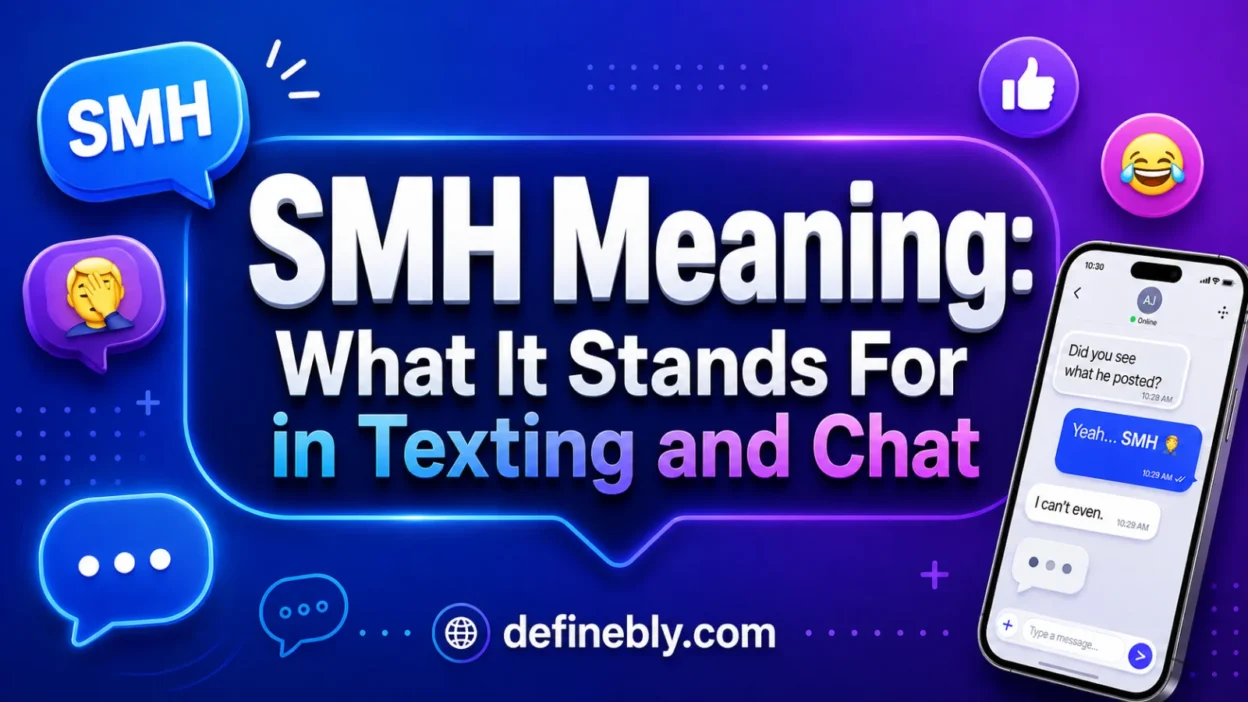
SMH stands for “shaking my head.” In texts, chats, and social media, people use it to show disapproval, disbelief, dismay, annoyance, or frustration about something they have just seen or heard. That is the core meaning reflected in Merriam-Webster, Cambridge, and Collins.
Quick Answer
SMH means “shaking my head.” It is a quick digital reaction that usually signals “I can’t believe this,” “this is disappointing,” or “that was a bad move.”
What SMH Stands For
The expansion itself is simple: SMH = shaking my head. Merriam-Webster defines it that way directly, and Collins identifies it as a messaging and social-media abbreviation for the same phrase.
What SMH Means In Real Messages
In actual digital conversation, SMH usually does more than name a physical action. It signals a reaction. People use it when something seems foolish, frustrating, disappointing, embarrassing, or hard to believe. Merriam-Webster’s definition is especially useful here because it frames the abbreviation around disapproval, dismay, or disbelief, not just generic negativity.
So when someone writes “He forgot the tickets again, smh,” they are not just saying they shook their head. They are signaling an emotional response: annoyance, disappointment, or disbelief.
Why SMH Feels More Like A Gesture Than A Statement
One of the most useful ways to understand SMH is to think of it as a digital gesture. Merriam-Webster’s slang explainer says that SMH offers the reader a gesture—a shaking head—rather than a plain statement. That is why it feels different from simply typing “I disapprove” or “That’s frustrating.”
It works like the text version of:
- shaking your head slowly
- rolling your eyes
- giving a disappointed look
- reacting without a full explanation
That gesture-like quality is a big part of why the abbreviation remains so common online.
Where People Use SMH
SMH is most natural in informal digital communication, especially:
- text messages
- group chats
- social media comments
- memes
- online forums
- casual direct messages
Cambridge explicitly places it in social media and text messages, and Collins labels it as messaging and social-media language.
It is much less natural in formal writing. In a work email, report, or academic setting, spelling out the reaction or using a fuller sentence is usually better. That follows directly from how dictionaries classify it: informal, chat-based, and digitally conversational.
Tone, Context, And What SMH Usually Signals
The tone of SMH is usually casual but critical. Depending on context, it can sound:
- disappointed
- disapproving
- frustrated
- incredulous
- mildly sarcastic
- playfully judgmental
Cambridge anchors the abbreviation in disbelief or non-approval, while Merriam-Webster adds dismay. In practice, that means SMH often lands somewhere between a sigh and an eye-roll.
With friends, SMH can feel playful:
- “You really started the project at midnight? smh”
In a more serious message, it can sound sharper:
- “They canceled the event without telling anyone. SMH.”
So the abbreviation is not automatically rude, but it can feel judgmental if the context is already tense.
SMH Vs. SMDH
SMDH is a stronger version of SMH. Slangwise glosses it as “shaking my damn head,” which raises the emotional intensity. If SMH is mild disbelief or frustration, SMDH sounds more emphatic and more irritated.
That makes SMH the safer everyday choice, while SMDH works more like a stronger, more dramatic reaction.
SMH Vs. smh
There is no strict grammar rule here. In casual digital writing, people often use both SMH and smh. Lowercase usually feels more relaxed and conversational, while uppercase can feel more noticeable or emphatic. That is best understood as a texting habit, not a formal distinction.
Origin And History
Modern usage explainers trace SMH to internet, forum, and texting culture from the early 2000s. Slangwise links its spread to early chatrooms, forums, and digital shorthand culture, while Merriam-Webster’s wordplay page places it firmly in the family of gesture-based internet abbreviations.
That history fits the way the term works now: it is fast, expressive, and built for quick online reaction.
Example Sentences
- “He left his keys in the car again, smh.”
- “You really waited until midnight to start the project? SMH.”
- “The app crashed right before I submitted the form, smh.”
- “She believed that fake post, smh.”
- “They canceled the event without telling anyone. SMH.”
These examples work because they show the abbreviation doing what it usually does: reacting to something frustrating, foolish, or hard to believe.
Similar Short Forms
A few related abbreviations often appear in the same kinds of messages:
- SMDH — shaking my damn head
- LOL — laugh out loud
- TBH — to be honest
- IDC — I don’t care
The closest stronger version is SMDH. It does the same job as SMH, but with more force and more irritation.
Is SMH rude?
Not always. In many chats it is just a quick way to show disbelief or mild frustration. But because it can sound judgmental, it may come across as rude if you use it directly at someone in a tense or serious conversation. Merriam-Webster and Cambridge both tie it to disapproval or disbelief, which is why tone matters.
Is SMH formal?
No. SMH is an informal abbreviation used in texting, social media, and other casual digital communication. Cambridge and Collins both place it in social-media and messaging contexts rather than formal writing.
Does SMH always mean anger?
No. It can show annoyance, but it can also express disappointment, disbelief, dismay, or playful frustration. Merriam-Webster’s definition specifically includes disapproval, dismay, or disbelief, which is broader than anger alone.
What is the simplest meaning of SMH?
The simplest meaning is “shaking my head.” That is the direct dictionary definition in Merriam-Webster, Cambridge, and Collins.
Conclusion
SMH means “shaking my head.” In digital conversation, it works less like a literal statement and more like a quick gesture of disbelief, disappointment, or disapproval. That is why it remains so useful: it compresses an eye-roll, a sigh, and a quiet judgment into just three letters.