
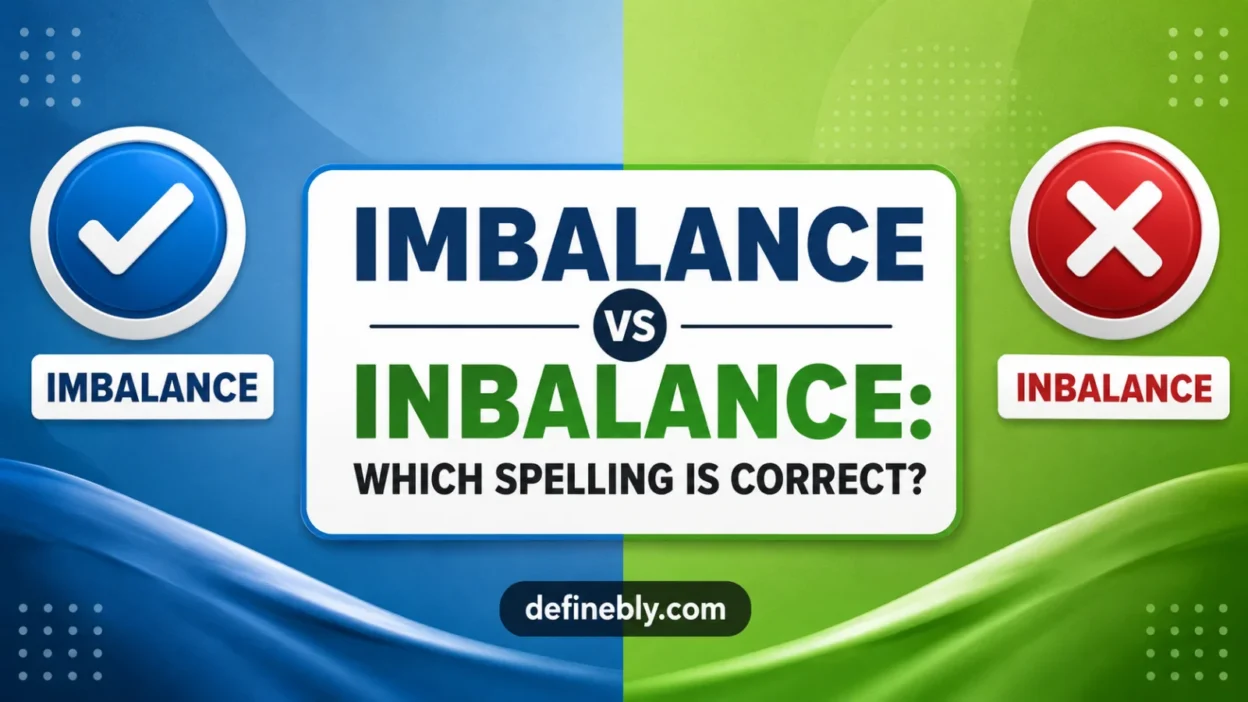
Imbalance is the correct spelling — the only one recognized in any standard English dictionary. Inbalance is not a word. It is a misspelling caused by a reasonable but incorrect assumption about how English prefixes work, and no dictionary, style guide, or editorial authority treats it as an accepted variant in any context.
If you have been writing inbalance, the fix is straightforward: replace it with imbalance, everywhere, always.
Why People Write “Inbalance” — And Why It’s Wrong
The logic behind the error is understandable. English uses the prefix in- to reverse a word’s meaning: accurate → inaccurate, complete → incomplete, visible → invisible. Applying the same pattern to balance produces inbalance — which feels correct but is not.
The reason: English inherited a Latin prefix assimilation rule that changes in- to im- before words beginning with b, m, or p. The shift is purely phonological — im- before those letters is easier to pronounce than in-.
Balance begins with b, so the prefix becomes im-, not in-: imbalance.
The Assimilation Rule — With the Full Word Family
This prefix shift is not unique to imbalance. It applies across a large family of English words, most borrowed from Latin through French. Seeing the full pattern makes the rule genuinely memorable:
| Base Word | Incorrect Form | Correct Form |
|---|---|---|
| balance | imbalance | |
| moral | immoral | |
| perfect | imperfect | |
| pure | impure | |
| possible | impossible | |
| mature | immature | |
| mobile | immobile | |
| partial | impartial | |
| probable | improbable |
Every word in this list follows the same rule: the in- prefix becomes im- before b, m, or p. Inbalance fits the same pattern as inpossible and inmature — it would be wrong for the same reason.
Where “Imbalance” Came From
Balance traces to Old French balance, from Medieval Latin bilanx, meaning “a scale having two pans” — from Latin bi- (“two”) + lanx (“dish, plate, scale”). The word entered English in the 14th century. The prefixed form imbalance developed later, particularly gaining widespread use in the 20th century through medical writing (hormonal imbalance, chemical imbalance) and economic writing (trade imbalance, fiscal imbalance). The prefix assimilation from in- to im- follows the same Latin rule that governed impossible and immature long before imbalance entered common use.
“Imbalance” vs. “Imbalanced” — Noun and Adjective
These two forms appear in similar contexts but play different grammatical roles, and mixing them is a separate, common error.
Imbalance is a noun — it names a condition or state.
There is a clear power imbalance in the negotiation.
The doctor diagnosed a hormonal imbalance.
The report flagged a budget imbalance.
Imbalanced is an adjective — it describes a noun.
The negotiation was imbalanced from the start.
She felt emotionally imbalanced for weeks.
The budget is imbalanced by several million dollars.
The error to watch: “There’s an imbalanced in the report” — this uses the adjective where a noun is required. The correct form is “There’s an imbalance in the report.”
“Imbalance” vs. “In Balance” — Two Different Meanings
Imbalance (one word) means a state of unevenness or inequality.
In balance (two words) means properly balanced, proportionate, or equal.
The books are in balance. — accounts are even; no discrepancy.
The books show an imbalance. — accounts are uneven; a discrepancy exists.
These are not variants of the same idea — they are opposites. One word versus two words is the entire difference between the concepts.
How “Imbalance” Is Used
Imbalance is a noun that applies across medical, scientific, economic, social, and everyday contexts. The word does not change based on register — it is equally standard in academic papers, medical records, business reports, and casual conversation.
Medical and biological:
A chemical imbalance in the brain affects mood and behavior.
Her fatigue was traced to a vitamin D imbalance.
Electrolyte imbalances can cause muscle cramps and fatigue.
Economic and financial:
Economists are tracking the trade imbalance between the two countries.
The fiscal imbalance grew throughout the decade.
Social and structural:
The report documented a significant power imbalance in the workplace.
A talent imbalance between the two teams was visible from the first quarter.
Everyday:
There’s an imbalance in how the household tasks are divided.
He noticed an imbalance between his work hours and personal time.
A Note on “Imbalance” as a Verb
Merriam-Webster documents a rare verbal use of imbalance — to cause to be out of balance. In practice, this use is uncommon and most editors avoid it, preferring constructions like “to create an imbalance” or “to upset the balance.” You are unlikely to need it, but it is documented as grammatically defensible.
Common Mistakes and Quick Fixes
Mistake: The patient has a chemical inbalance.
Fix: The patient has a chemical imbalance. — inbalance is not a word.
Mistake: There’s an imbalanced in the workload.
Fix: There’s an imbalance in the workload. — imbalanced is an adjective; the noun imbalance is needed here.
Mistake: Assuming inbalance is an acceptable informal spelling.
Clarification: There is no register, region, or context in which inbalance is acceptable. Spellcheck usually catches it, but not always — treat it as a straightforward error every time.
Mistake: Confusing imbalance (one word, unevenness) with in balance (two words, properly even).
Fix: One word = uneven; two words = even. These are opposite concepts with identical pronunciation in some constructions.
Quick Practice
Choose the correct word or phrase.
- The doctor found a hormonal [imbalance / inbalance] that was affecting her sleep.
- After the audit, the accounts were back [in balance / imbalance].
- There is a significant [imbalance / imbalanced] in the way resources are distributed.
- The team was [imbalance / imbalanced] — three experienced players against eight rookies.
- A trade [imbalance / inbalance] between the two economies has persisted for decades.
Answers: 1. imbalance — 2. in balance (two words, meaning properly even) — 3. imbalance (noun) — 4. imbalanced (adjective) — 5. imbalance
FAQs
Is “inbalance” a word?
No. Inbalance does not appear as a recognized entry in Merriam-Webster, the Oxford English Dictionary, Collins, Cambridge, or any other major English dictionary. It is a misspelling of imbalance caused by incorrect prefix logic. There is no context in which it is correct.
Why is it “imbalance” and not “inbalance”?
Because English follows a Latin prefix assimilation rule: in- changes to im- before words beginning with b, m, or p. Balance begins with b, so the prefix becomes im-: imbalance. The same rule produces impossible, immature, and impartial.
What is the difference between “imbalance” and “imbalanced”?
Imbalance is a noun naming a condition: “there is an imbalance.” Imbalanced is an adjective describing a state: “the system is imbalanced.” Mixing them — “there is an imbalanced” — is a grammatical error.
What is the difference between “imbalance” and “in balance”?
They are opposites. Imbalance (one word) describes unevenness or disproportion. In balance (two words) describes a state of proper proportion or equality. “The books show an imbalance” means something is wrong; “the books are in balance” means everything checks out.
Is “imbalance” used the same way in medical and non-medical writing?
Yes. Imbalance is standard across all contexts: medical (hormonal imbalance, electrolyte imbalance), economic (trade imbalance, fiscal imbalance), social (power imbalance, gender imbalance), and everyday (workload imbalance, imbalance in the relationship). The spelling and usage rules are identical in every domain.
The Bottom Line
Imbalance is the only correct spelling. Inbalance is a misspelling that no dictionary recognizes in any context. The prefix in- becomes im- before words beginning with b, m, or p — the same rule that gives us impossible and immature. Once that rule is clear, the choice is permanent: it is always imbalance, everywhere, without exception.
Conclusion
The choice here isn’t close: imbalance is the only correct spelling, and inbalance is a misspelling with no independent meaning. The prefix simply shifts from “in-” to “im-” before words starting with b, m, or p, which is why “imbalance” is the form every dictionary recognizes. Once that small rule clicks, you won’t second-guess it again.