
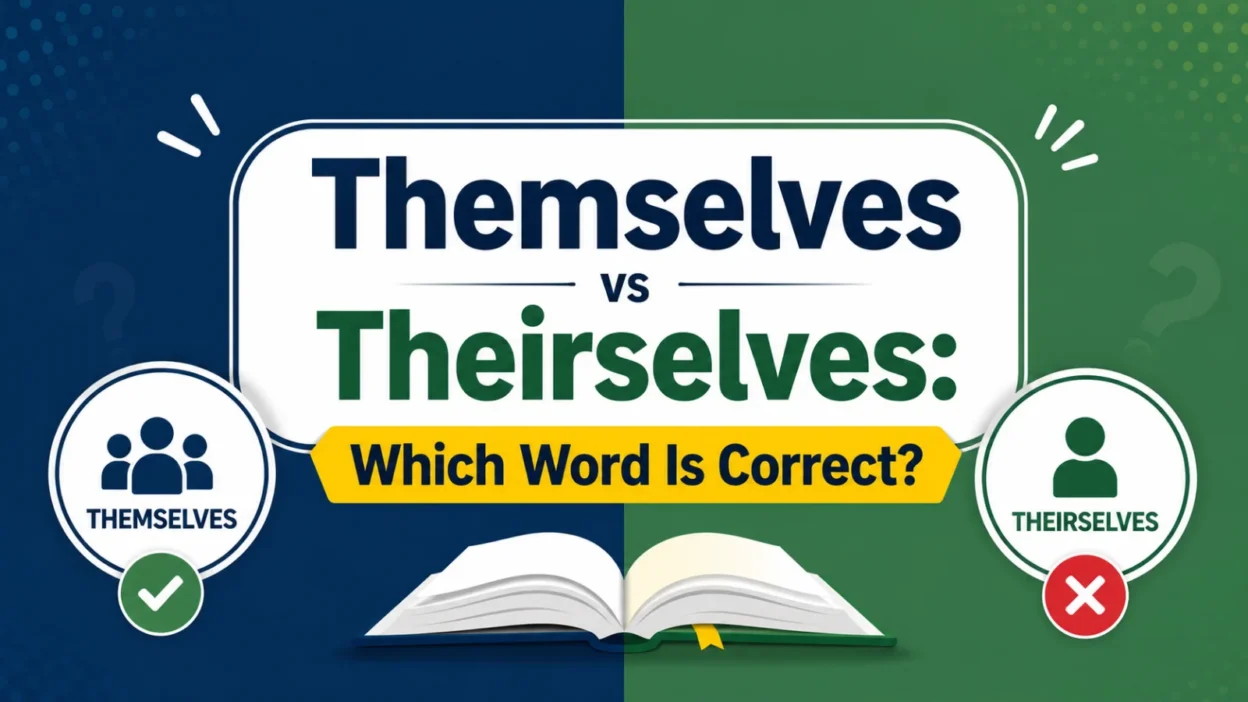
Themselves is the only standard English reflexive pronoun. Theirselves is nonstandard — it shows up in casual speech and some dialects, but it doesn’t belong in writing of any kind, formal or informal.
Here’s exactly why, plus the pattern that makes it easy to remember for good.
Quick Answer
- Correct in all writing and speech: themselves
- Never correct in standard English: theirselves
- There is no context — formal, casual, spoken, or written — where theirselves is the recommended choice
Why Theirselves Breaks The Rule
English reflexive pronouns follow a consistent pattern: they’re built from the object form of a pronoun, not the possessive form.
| Pronoun Type | Object Form | Reflexive Form |
|---|---|---|
| First person singular | me | myself |
| Second person | you | yourself |
| Third person singular | him / her / it | himself / herself / itself |
| Third person plural | them | themselves |
“Their” is a possessive pronoun, the same category as “my,” “your,” and “our.” Reflexive pronouns don’t use that category — nobody says “myselves” or “ourselves” is built from “mine.” “Theirselves” applies possessive logic to a slot that’s always filled by an object pronoun, which is exactly why it sounds off even to people who can’t explain the grammar behind it.
How Common Is Theirselves, Really?
< cite index=”11-1″>Grammar researcher Bryan Garner estimates that themselves outnumbers theirselves in written English by roughly 3,182 to 1</cite>. That gap isn’t a stylistic preference — it reflects that theirselves has essentially never been part of standard written English at any point in its modern history.
Where Theirselves Comes From
Theirselves isn’t a typo or a modern internet error. < cite index=”17-1″>It shows up in certain regional dialects in both the UK and parts of the US</cite>, formed by analogy with other possessive-based words. It’s a real, recognizable feature of some spoken dialects — just not a feature of standard written or professional English. Using it in casual conversation within a dialect community is different from using it in an email, essay, or article, where standard grammar is expected.
Themselves in a Sentence
| Correct | Incorrect |
|---|---|
| They took care of themselves during the storm. | They took care of theirselves during the storm. |
| The kids made themselves lunch. | The kids made theirselves lunch. |
| The team congratulated themselves after the win. | The team congratulated theirselves after the win. |
| Students who cheat are only hurting themselves. | Students who cheat are only hurting theirselves. |
What About “Theirself”?
< cite index=”14-1″>”Theirself” is a related nonstandard form, used the way “himself” or “herself” would be used for a single person</cite> — for example, “he taught theirself to cook.” It has the exact same problem as theirselves: it’s built from the possessive “their” instead of an object pronoun, and it isn’t accepted in standard English either.
Themself vs. Theirselves: Not The Same Thing
These two often get lumped together, but they’re not equivalent:
- Themself is a singular reflexive pronoun used with singular “they” (e.g., “Everyone should be able to express themself.”). It’s increasingly accepted in modern usage, especially in contexts referring to a person of unspecified or nonbinary gender.
- Theirselves is a plural form built on the possessive “their” and is not gaining acceptance anywhere — it remains nonstandard in every style guide and dictionary.
The difference matters: one of these words is shifting toward broader acceptance, and the other isn’t moving at all.
Common Phrases With Themselves
- by themselves
- to themselves
- among themselves
- for themselves
These phrases never take “theirselves” in standard English, in any register.
The One Rule To Remember
Always use themselves. If you want a quick mental check, remember that every standard reflexive pronoun is built from an object pronoun (him, her, it, them) — never a possessive one (his, her, its, their). That’s the whole rule, and it has no exceptions in standard written English.
Frequently Asked Questions
Is theirselves ever correct in standard English?
No. It’s nonstandard in every context, including casual speech, and should always be replaced with themselves in writing.
Why do some people say theirselves?
It comes from applying the same pattern used to form possessive-based words, and it persists in certain regional dialects — but it never became part of standard grammar.
Is theirselves the same as themself?
No. Themself is a singular pronoun tied to singular “they” and is increasingly accepted in modern usage. Theirselves is a plural form built on the possessive “their” and remains nonstandard.
How much more common is themselves than theirselves in writing?
By some estimates, themselves appears roughly 3,000 times more often than theirselves in written English — the gap is not close.
What’s the correct plural reflexive pronoun?
Themselves is the only standard plural reflexive pronoun in English.
Is “theirself” the same issue as “theirselves”?
Yes. Theirself is the singular version of the same mistake — both incorrectly build a reflexive pronoun from the possessive “their” instead of an object pronoun.
Conclusion
Themselves is the only standard choice. Theirselves might sound familiar from casual speech, but it doesn’t belong in writing or in any context where you want to sound clear and correct. When in doubt, themselves is always the safe answer.