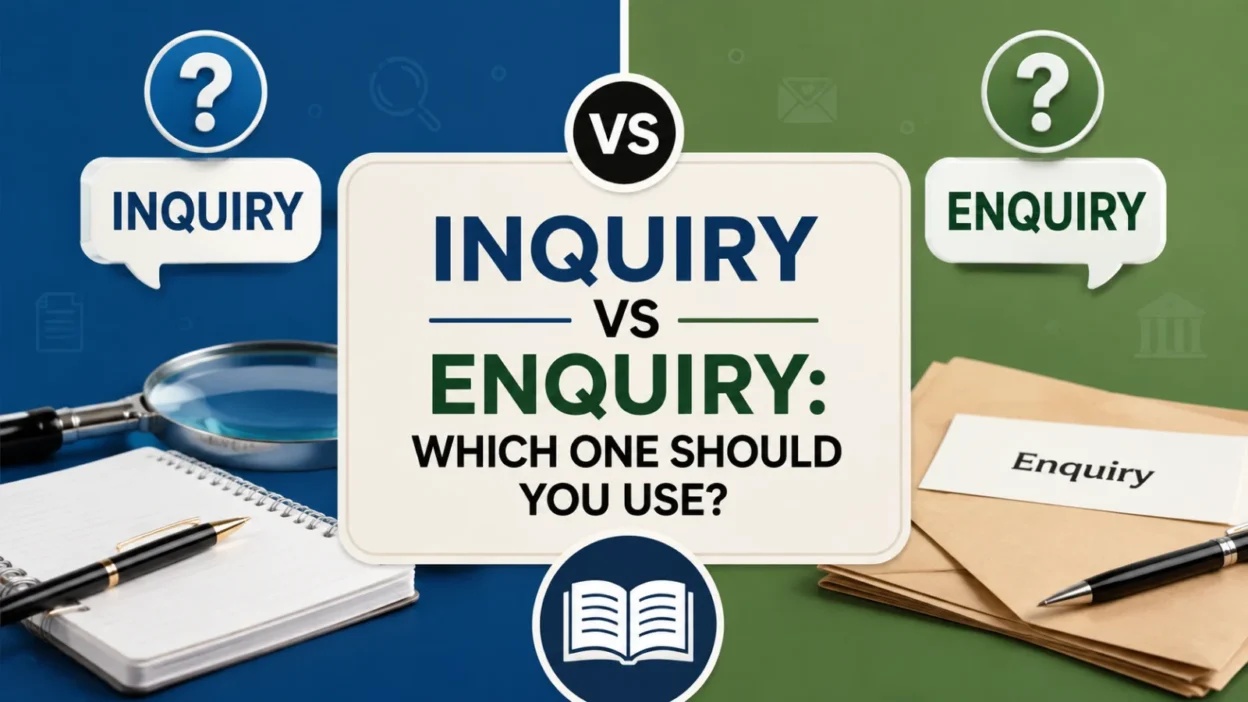
If you’re writing for an American audience, use inquiry — always, in every context, formal or casual. If you’re writing for a British audience, enquiry works for everyday questions and inquiry is the safer choice for anything official. That’s the entire decision in one sentence. Everything below explains why, and where the exceptions live.
The Quick Answer
Merriam-Webster classifies “enquiry” as a chiefly British spelling of “inquire, inquirer, inquiry” — meaning American dictionaries treat it as a variant, not a separate word. The Associated Press Stylebook and the Chicago Manual of Style both follow American English conventions and consistently use “inquiry.” If you’re writing for a US audience or you’re unsure who’s reading, “inquiry” is the safe, correct, professional choice every time. Merriam-Webster + 2
British English is where the real nuance lives, and it’s less rigid than most guides let on.
Where American English Draws The Line
There is no line. In the United States, “inquiry” covers a casual question and a formal government investigation with equal ease:
- “We received an inquiry about the job opening.”
- “The Senate opened a formal inquiry into the contract.”
Even though “enquiry” technically exists and is occasionally used in American English, “inquiry” is used far more frequently, and many style guides call for its use exclusively. If an American reader sees “enquiry” in a business email, the likeliest reaction is that it’s a typo — not a deliberate stylistic choice. Writing Explained
Where British English Actually Splits (And Where It Doesn’t)
Many articles present the British distinction as a hard grammar rule. It isn’t. It’s a loose editorial convention that plenty of British writers and publications ignore entirely. The formal/casual split represents a style preference rather than a universal grammatical rule — British dictionaries and publications may use either spelling for both meanings. Grammarexplore
Where the convention does hold, especially in edited British journalism and government writing, it tends to work like this:
- Enquiry — a general, everyday question. “I have an enquiry about your return policy.” A library or hotel might have an “Enquiries” desk.
- Inquiry — a formal or official investigation. “The public inquiry into the incident begins next month.” The famous UK inquiries into government conduct (the Leveson Inquiry, the Grenfell Inquiry) are never spelled with an “e” — formal inquiries in Britain are always “inquiry,” never “enquiry.”
So even in British English, “inquiry” is the one word that’s never wrong. “Enquiry” is the one that’s context-dependent.
Inquire Vs Enquire: The Verb Forms Follow The Same Pattern
The verb forms behave identically to their noun counterparts.
| American English | British English | |
|---|---|---|
| Formal or general use | inquire | inquire (formal) |
| Casual use | inquire | enquire (casual) |
- US: “She inquired about the flight schedule.”
- UK, casual: “He enquired about the store’s hours.”
- UK, formal: “Investigators inquired into the cause of the collapse.”
Beyond The US And UK: Canada, Australia, And Other English Variants
Most style guides outside the US and UK don’t enforce a strict rule either way, but general patterns hold:
- Canadian English leans toward “inquiry,” following American convention, though “enquiry” appears occasionally in more British-influenced institutional writing.
- Australian and Irish English tend to follow the British pattern loosely, with “inquiry” dominating official and government contexts.
- Indian English, shaped heavily by British usage, often defaults to “enquiry” in everyday and customer-service contexts.
If you’re writing for a global or mixed audience, default to “inquiry.” It’s understood everywhere and never reads as incorrect.
Common Mistakes To Avoid
- Using “enquiry” in US business writing. It won’t be flagged as grammatically wrong by most checkers, but it will look like a typo to American readers.
- Treating the British split as an absolute rule. It’s a tendency among careful writers, not a law — many British outlets use “inquiry” for everything.
- Mixing both spellings in the same document. Pick one standard based on your audience and stay consistent throughout.
- Assuming plural forms differ in structure. Both follow the same pattern: inquiry → inquiries, enquiry → enquiries.
Real-World Examples By Context
- US customer service email: “Thank you for your inquiry — our team will respond within 24 hours.”
- US news reporting: “The newspaper’s inquiry uncovered internal memos contradicting the company’s public statements.”
- UK customer service signage: “General Enquiries” desk at a train station or library.
- UK formal reporting: “The government inquiry into the flooding response will publish its findings in spring.”
- Academic/research context (both regions): “Her research inquiry focuses on early childhood language acquisition” — American and British academic writing both default to “inquiry” here, since it’s treated as a formal process.
Which One Should You Use? A Simple Rule
- Writing for a US audience, in any context → use inquiry
- Writing a casual British customer message → enquiry is acceptable, though “inquiry” is never wrong
- Writing about a formal British investigation → use inquiry
- Unsure of your audience, or writing for an international readership → default to inquiry
Frequently Asked Questions
Is “enquiry” a real word or a typo?
It’s a real word, not a typo. Merriam-Webster lists it as a chiefly British spelling variant of “inquire, inquirer, inquiry.” It’s simply rare and non-standard in American English. Merriam-WebsterMerriam-Webster
Do AP style and Chicago style prefer one spelling?
Yes. Both the AP Stylebook and the Chicago Manual of Style follow American English conventions and use “inquiry” consistently. Neither uses “enquiry” as a standard spelling. Grammar Update
Is it wrong to use “inquiry” in British English?
No. “Inquiry” is always correct in British English — it’s accepted for both formal and general use. “Enquiry” is the one with contextual limits, not “inquiry.”
Which spelling should I use in a résumé or job application?
Use “inquiry” unless you’re applying to a UK-based organization that explicitly uses “enquiry” in its own materials — in which case, match their house style.
Does spellcheck flag “enquiry” as incorrect?
Most American English spellcheckers will flag it or suggest “inquiry,” since it’s not standard in US dictionaries. UK-English spellcheckers will accept it without issue.
Conclusion
For US writing, the choice is simple: use inquiry every time. British writers have more flexibility, with enquiry fitting casual questions and inquiry fitting formal investigations. Once you know your audience, the inquiry vs enquiry question answers itself.